


Trump receives $30 million from crypto giants! OpenAI invests $12.5 million to lobby for regulatory easing
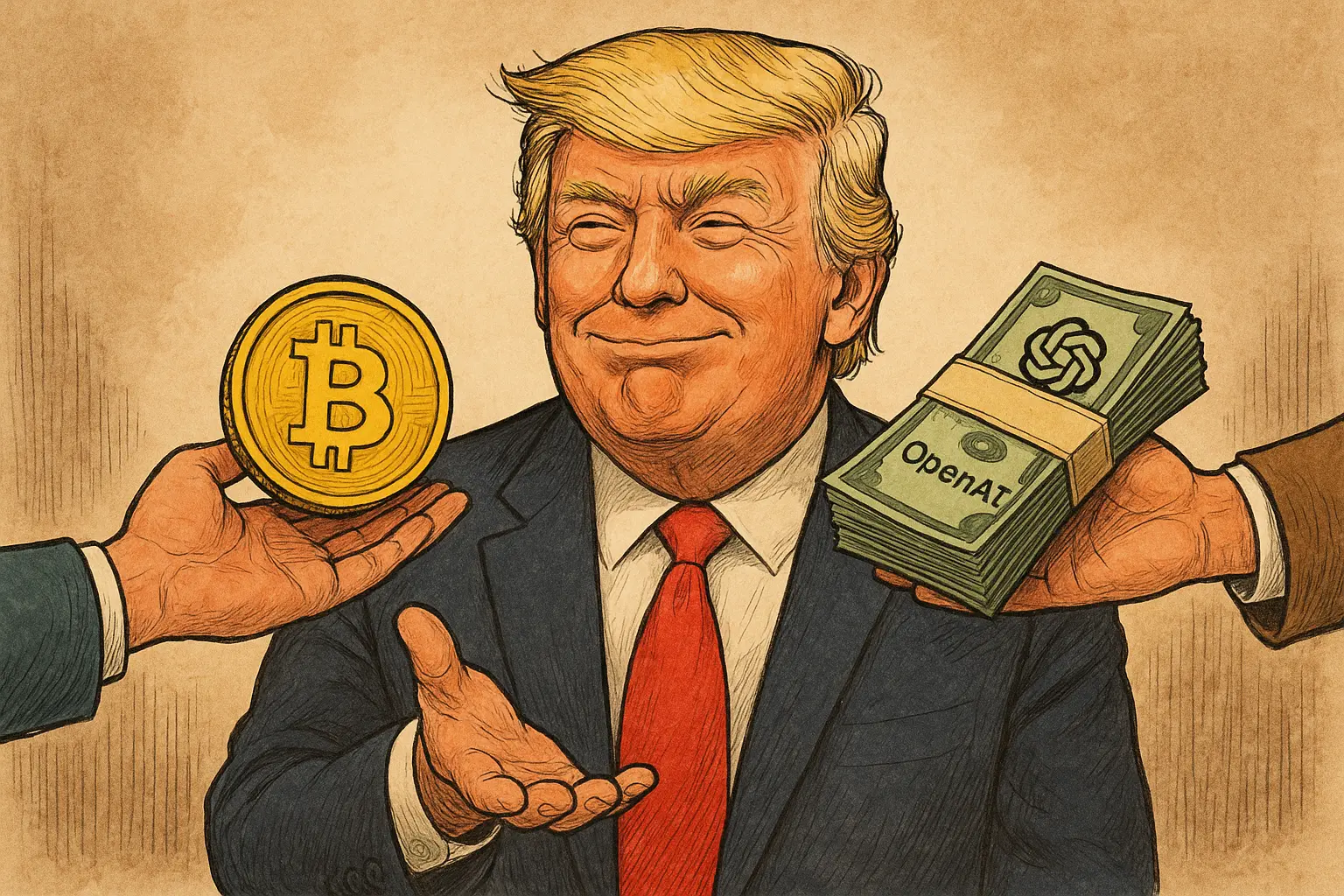
Donald Trump and his allies raised a record-breaking $429 million, with Maga PAC holding $304 million. The largest donor, Crypto.com, contributed $30 million; Brockman from OpenAI donated $12.5 million; founders of A16Z each gave $3 million. The crypto industry and Silicon Valley are investing heavily to secure regulatory easing, especially in crypto legislation and opposition to state-level AI regulations. The funds may be used to influence midterm elections or to maintain influence after leaving office.
Crypto.com $30 million becomes the largest donor
Public records show that the largest donation came from cryptocurrency exchange Crypto.com, which injected $30 million into Trump’s main political action committee last year. Additionally, Crypto.com has reached multiple agreements with several crypto companies operated by the Trump family. This dual relationship—political donations and business collaborations—demonstrates the deep ties between the crypto industry and the Trump administration.
Crypto.com’s $30 million donation is unprecedented in crypto political funding. As one of the top ten global crypto exchanges, Crypto.com’s expansion in the U.S. market has been hampered by regulatory uncertainty. After Trump took office, SEC Chairman Gary Gensler was replaced by crypto-friendly Paul Atkins, and numerous investigations and lawsuits against crypto firms were dismissed or settled. This dramatic regulatory shift greatly benefits Crypto.com’s business interests.
Crypto.com’s business agreements with the Trump family are also notable. The company became a partner of World Liberty Financial, a decentralized finance platform operated by the Trump family. Additionally, Crypto.com is exploring collaborations with Trump’s meme coin projects. This deep integration of politics and business goes far beyond traditional political donations, resembling strategic business investments. For Crypto.com, a $30 million donation could translate into billions or even tens of billions of dollars in business opportunities and regulatory advantages.
Although such blatant exchanges of interests are legal in U.S. politics (super PACs can accept unlimited donations), they raise serious ethical concerns. Critics argue that this model shifts policy-making from serving the public interest to serving the private interests of large donors. When regulatory appointments and policy directions clearly favor industries that made large donations, the independence and fairness of regulation are fundamentally threatened.
Silicon Valley Tech Giants’ Lobbying for Regulation
OpenAI co-founder Greg Brockman donated $12.5 million, becoming one of Trump’s key fundraisers. The timing of this donation is intriguing. OpenAI is currently under scrutiny by multiple countries’ regulators over issues like data privacy, copyright infringement, and algorithmic bias. After Trump’s administration took power, U.S. AI regulation stance shifted toward looseness, with the Department of Justice announcing that unless there is “intentional” violation, cases involving digital assets and AI would not be prosecuted for regulatory violations.
Venture capital giant A16Z founders Marc Andreessen and Ben Horowitz each donated $3 million. The firm has been actively lobbying for legislation favorable to crypto startups and trying to block states from passing fragmented AI regulations. A16Z’s portfolio includes top crypto companies like Coinbase, OpenSea, Uniswap, and AI startups like Anthropic and Mistral. For these companies, a unified and relaxed federal regulatory framework is far preferable to the fragmented patchwork of state laws.
Crypto and Silicon Valley Major Donor List
Crypto.com: $30 million (largest crypto industry donor)
Greg Brockman (OpenAI): $12.5 million (largest AI sector donor)
Marc Andreessen (A16Z): $3 million
Ben Horowitz (A16Z): $3 million
These large donations indicate that major donors are eager to fund a government that strongly supports crypto and AI industries, relaxes regulations, and halts legal investigations of political allies. This blatant exchange of interests has existed since Trump’s first term but has reached new heights in scale and transparency during his second term.
It’s worth noting that super PACs like Maga can raise unlimited funds but cannot coordinate directly with campaigns. However, in practice, super PACs often operate in a gray area of “coordination bans,” using public statements, media reports, and shared consultants to align strategies with candidates’ needs.
Strategic Use of the $304 million War Chest
Trump has not yet revealed how he plans to use this massive $304 million fund. Republican strategist Alex Conant said that if Trump and his allies decide to support certain candidates in the midterms, they will have ample funds to invest in a few highly competitive House and Senate races. Conant also mentioned that Trump could use this money after leaving the White House to “maintain political influence.”
The $304 million figure is extremely rare in U.S. political history. For comparison, in the 2022 midterms, the largest Democratic super PAC held about $150 million. Trump’s campaign has a financial advantage of over twice that amount, which can translate into overwhelming advertising, ground organization, and voter mobilization efforts. In swing states, an extra few tens of millions of dollars in ads could decide election outcomes.
A deeper strategic significance lies in maintaining long-term influence. Even after leaving office in 2029, Trump could use this fund to steer the Republican Party’s direction. He can selectively support loyal candidates, punish critics, and thus maintain absolute authority within the party. This model of controlling the party through money makes Trump a de facto “godfather” of the GOP even when he is not in office.
For the crypto industry and Silicon Valley, this investment’s returns are already materializing. SEC investigations are halted, DOJ enforcement is relaxed, crypto investments by pension funds are permitted, and a national Bitcoin reserve is being considered—all policies with economic value far exceeding the donation amount. For Crypto.com, a $30 million donation secures billions of dollars in market access and compliance cost savings. For OpenAI, $12.5 million grants freedom from strict AI regulation. The return on investment far surpasses any traditional business investment.
Related Articles
Ray Dalio warns of four major weaknesses of Bitcoin: BTC is unlikely to become a hedge asset, and there is only one gold in the world
Fires reignited: How Middle East conflict is reshaping the risk premium of gold and crude oil
African Bitcoin Company Chairman: Merchants refusing to accept US dollars, Bitcoin "Smart" becomes a practical circulating currency
Gate Daily (March 4): Trump accuses banks of blocking the GENIUS Act; Mizuho raises Circle's target price to $100
After the AWS attack, banks and payment services were disrupted. Can blockchain reduce risks in geopolitical conflicts?
Geopolitical Shock Sends Markets and Crypto Reeling