


Ripple payment volume exceeds 100 billion USD, XRP Binance liquidity hits new low
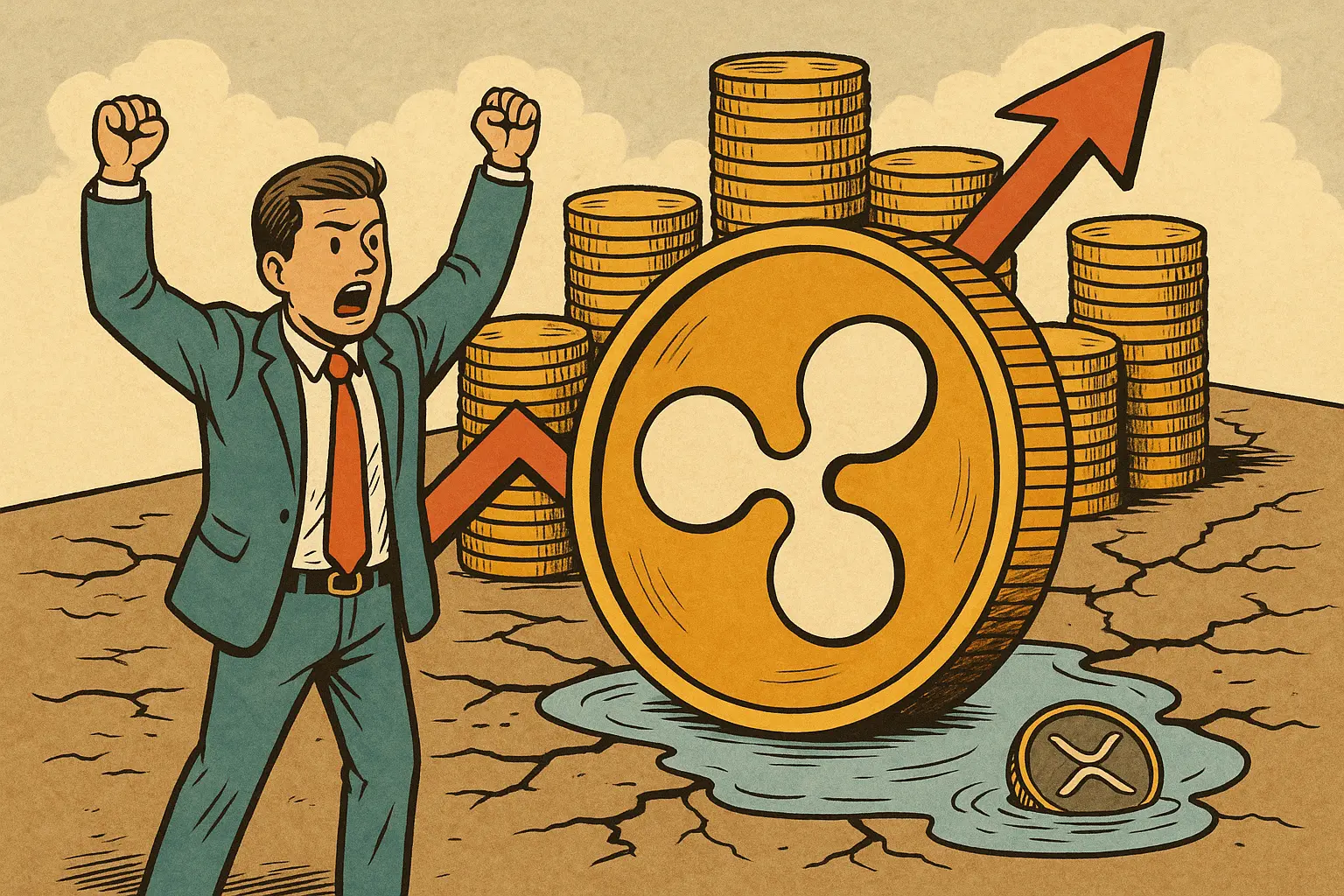
Ripple announced that the total transaction volume of its Ripple Payments platform has exceeded $100 billion, with operations covering more than 60 markets. However, at the same time, the XRP 30-day liquidity index on Binance has fallen to 0.097, reaching a new low since 2022.
Ripple Payments Milestone: Strategic Upgrades for an End-to-End Platform
Ripple Payments is a global payment infrastructure based on XRPL, connecting financial institutions to enable fast, low-cost cross-border fund transfers. Following this upgrade, the platform now allows customers to receive, hold, exchange, and make payments in fiat and stablecoins within a unified system, eliminating the need to coordinate with multiple providers.
The acquisitions of Palisade and Rail added two core capabilities: customers can establish customized virtual accounts and wallets, automate payment collection processes, and settle funds without switching service providers. Current institutional clients using Ripple Payments include Swiss Amina Bank, Philippines’ AltPayNet, Brazil’s Banco Genial, Malaysia’s CambioReal, Corpay, and MassPay.
Key Data on the Ripple Payments Platform
Total Transaction Volume: Surpassed $100 billion
Markets Covered: Over 60 countries and regions
Global Licenses: Over 75, including a New York DFS trust charter
Recent Acquisitions: Acquired Palisade and Rail for $200 million
Representative Clients: Amina Bank, Banco Genial, AltPayNet, CambioReal, etc.
Binance XRP Liquidity Decline: Market Impact and Technical Analysis
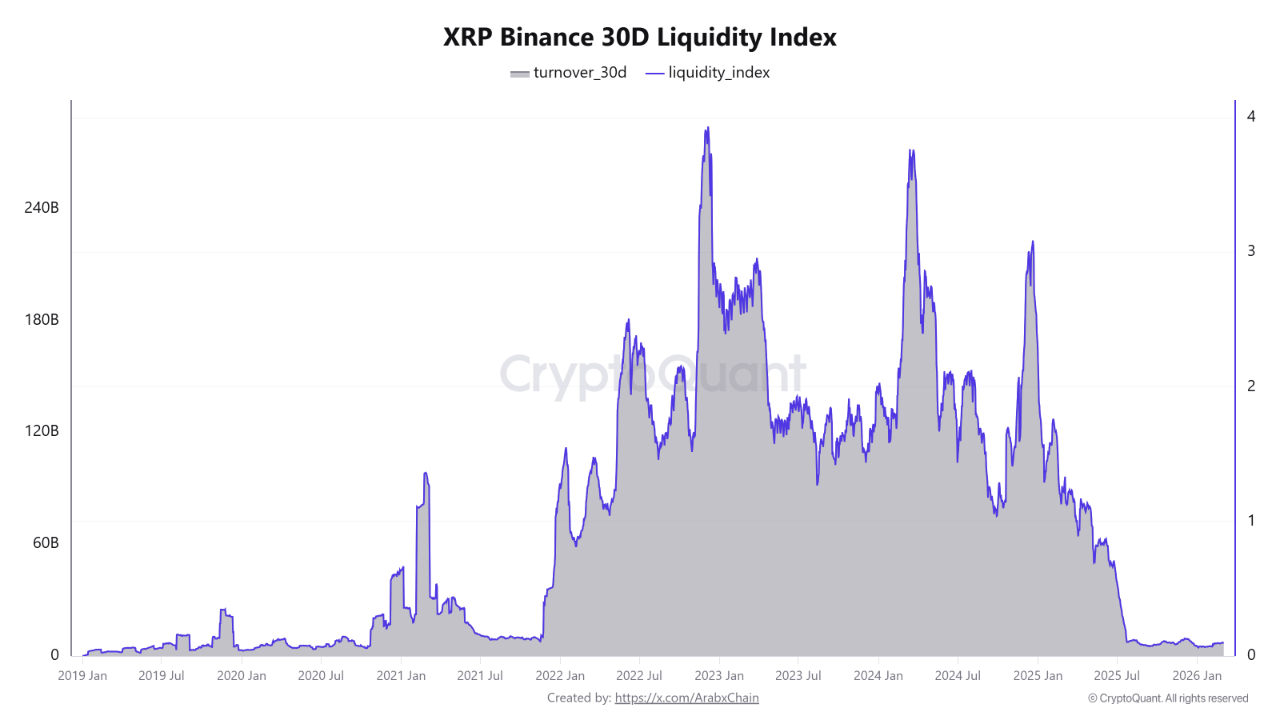
(Source: CryptoQuant)
Despite Ripple’s milestone achievements in business, XRP liquidity on Binance has experienced a significant decline. According to CryptoQuant data, the Binance 30-day liquidity index for XRP has fallen to 0.097, with a trading volume of approximately 7.02 billion XRP, substantially lower than the 180-240 billion XRP trading volume range from 2022 to 2024, and the liquidity index exceeding 3 at that time.
Analysts note that this indicator measures the ratio of 30-day turnover to total supply, reflecting the relative activity on the platform. The downward trend in liquidity began in 2025 and continued into 2026, possibly indicating reduced trading activity or liquidity shifting from Binance to other platforms.
It’s important to recognize that low liquidity does not necessarily mean weak prices—it makes the market more sensitive to capital flows. Analysts suggest that at current levels, a significant increase in trading volume could trigger a “notable shift in price dynamics,” implying higher volatility risks for both bulls and bears.
Frequently Asked Questions
What does surpassing $100 billion in Ripple Payments signify?
It marks an important business milestone for Ripple’s payment infrastructure across more than 60 markets worldwide, reflecting actual adoption of XRPL-based cross-border payment solutions by institutional clients, rather than merely market cap or speculative activity growth.
How does the decline in Binance XRP liquidity affect investors?
The liquidity index dropping from over 3 to 0.097 indicates a sharp decrease in XRP trading activity on Binance. In a low-liquidity environment, large capital movements can cause more dramatic price swings, increase the costs of entering and exiting positions, and reduce market depth.
Can the growth of Ripple’s payment business support XRP’s long-term price?
Theoretically, continued growth in Ripple Payments transaction volume suggests increasing actual demand for XRP (since XRPL is used for cross-border settlements). However, the success of the payment business and XRP market liquidity are two separate dimensions; short-term weakness in liquidity indicators may not be immediately corrected by business growth.
Related Articles
RippleX Head of Engineering Details How AI Will Help Strengthen XRP Ledger Security From Now On - U.Today
XRP Price News: Ripple Advances RLUSD Stablecoin Payment Strategy, Potential Impact on XRP Demand
Cardano Founder: XRP May Meet SEC's Proposed Security Standards
XRP approaches the $0.85 long-term support level: holding may restart the rally, losing it could lead to a drop to $0.62
5,923% ROI Alert: APEMARS Ignites Top Altcoin Picks While XRP Price Prediction Stabilizes and Solana Attracts $8.2M