


Bitcoin price recovers but miners are still "riding the wire" as hashprice approaches breakeven
As we move into early 2026, Bitcoin miners find themselves in a familiar yet increasingly harsh scenario: network hashrate declines from late 2025 peaks, difficulty adjustments with inherent lag, while electricity costs remain a rigid barrier determining who stays and who must shut down.
On the surface, the market may appear quite stable, especially with Bitcoin prices recovering. However, at the fragile edge of economic viability, just a single difficulty increase or a local electricity price shock can quickly turn the “operating” state into “load shedding” within a very short period.
Hashrate cools down after late 2025 peak
Bitcoin network hashrate has cooled off after reaching a peak at the end of 2025 and has yet to stabilize at that high level, even during periods of spot price recovery.
According to JPMorgan estimates, Bitcoin’s average monthly hashrate in October 2025 increased by 5%, reaching 1.082 EH/s — the highest monthly average recorded in the bank’s data series. In November, this figure slightly decreased to 1.074 EH/s, reflecting a modest adjustment rather than a continuous upward trend.
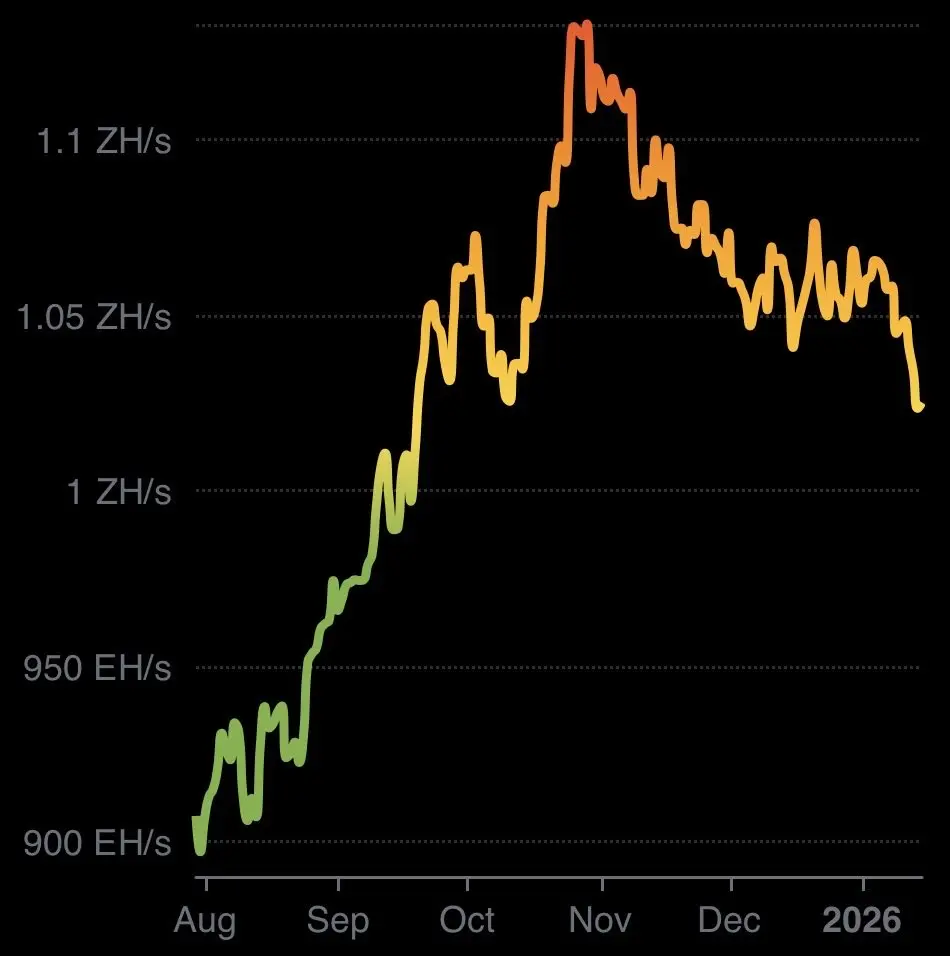 *Bitcoin’s (hashrate) decreased (Source: BitcoinIsaiah)*Since late December, daily estimates show significant volatility, with hashrate fluctuating around 1,000 EH/s. This indicates miners are rotating operational times rather than expanding capacity smoothly.
Data from YCharts (source: Blockchain.com) also record dips below 1,000 EH/s, interspersed with recoveries above this threshold during the mid-January price rebound.
| Indicator | Time | Value | Significance |
|---|---|---|---|
| Average monthly hashrate | October 2025 | 1.082 EH/s | JPMorgan’s estimated monthly record |
| Average monthly hashrate | November 2025 | 1.074 EH/s | Slight adjustment after peak |
| 7-day average hashrate | January 2026 | 1.024 EH/s | Short-term cooling after late 2025 pressure |
Hashprice, not just Bitcoin price, is the key factor for turning machines on/off
Miners’ behavior depends less on spot Bitcoin prices and more on hashprice — the expected daily revenue per unit of hashrate. This is a crucial metric indicating whether the least efficient mining machines can continue operating without losses.
In the weekly report on January 12, Luxor stated that the USD-denominated hashprice had decreased from $40.23 to $39.53/PH/s/day. This level is described as “approaching or at the breakeven threshold for many miners.”
In other words, the network can still experience significant volatility even as Bitcoin prices recover, because miners’ profits remain tightly squeezed.
Luxor also noted that Bitcoin declined 2.9% last week, down to approximately $91,132, coinciding with hashprice narrowing, increasing pressure on units with less flexible cost structures.
In the same report, Luxor’s 7-day average hashrate decreased by 2.8%, from 1.054 EH/s to 1.024 EH/s.
The late 2025 context plays a crucial role. Previously, Luxor’s research team recorded the network difficulty reaching an all-time high after a 6.31% adjustment on October 29, pushing difficulty to 155.97T.
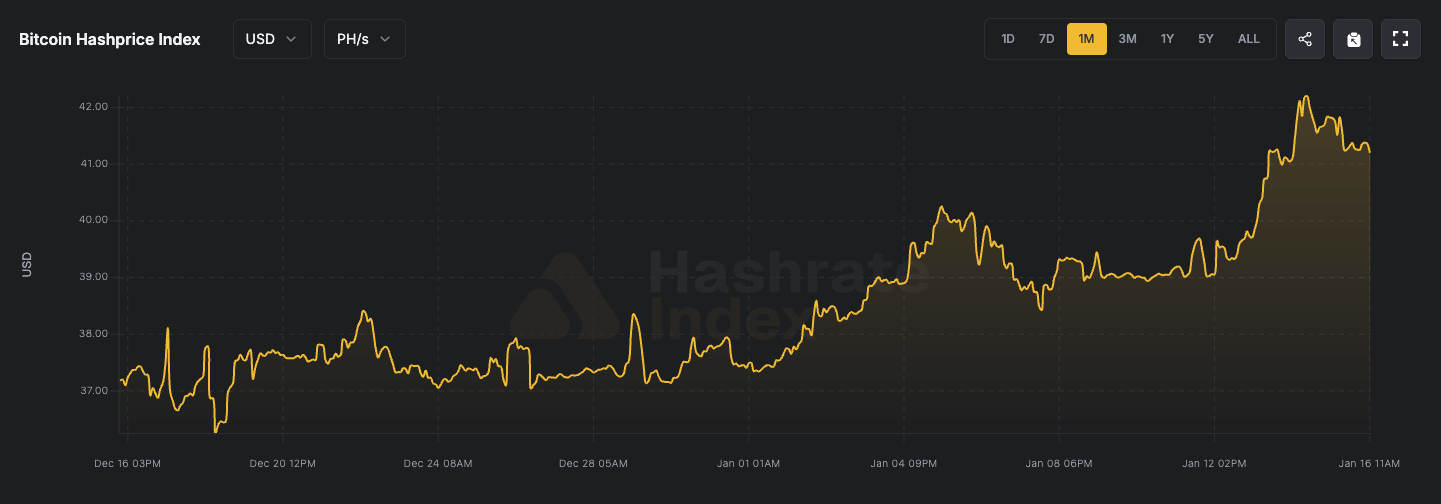 *Hashprice chart (Source: Luxor)*However, in November, hashprice weakened as transaction fees and Bitcoin prices were insufficient to offset higher difficulty. Data from Hashrate Index shows hashprice falling to a record low around $36/PH/day.
The market has moved up from this bottom in early 2026, but the recovery margin is very limited. This explains why the hashrate recovery process since October has been uneven: many operators are on the brink, where just a small difference in electricity costs can determine whether they turn machines on or off.
Reality check at the mining machine level
This sensitivity is more evident when converting hashprice into revenue per machine and comparing it with electricity costs.
According to Bitmain specs, the Antminer S19j Pro has a hashrate of 92 TH/s with a power consumption of 2,714 W, while the S21 reaches 200 TH/s with 3,500 W.
The table below assumes a hashprice of $38.2/PH/s/day, corresponding to the 6-month average announced by Luxor. The reference electricity price is the industrial average in the US in September 2025: 9.02 cents/kWh (according to EIA).
| Miner | Hashrate | Power | Daily Revenue | Daily Electricity Cost |
|---|---|---|---|---|
| S19j Pro | 92 TH/s | 2,714 W | ~$3.51 | ~$5.88 |
| S21 | 200 TH/s | 3,500 W | ~$7.64 | ~$7.58 |
This does not mean all miners are losing money. Many units have better electricity prices, revenue from load management, or higher operational efficiency.
The issue lies with the “marginal miners” — the group that determines the hashrate volatility. At the current hashprice level, marginal units are increasingly operating more like flexible loads rather than “continuous operation” infrastructure.
Difficulty as a lagging variable that can immobilize miners
Difficulty only adjusts after every 2,016 blocks (roughly two weeks), so it does not react immediately to Bitcoin price or hashrate fluctuations.
This lag forces miners to endure unfavorable hashprice conditions throughout an entire epoch before the network self-adjusts, squeezing profit margins during downturns and slowing the recovery process many expect.
In early January, difficulty was recorded down 1.20% to 146.4T in the first adjustment of 2026. However, forecasts suggest the January 22 adjustment could rise back to around 148.20T.
Futures markets currently reflect only very limited improvement. Luxor states that the average hashprice over the next six months is valued around $38.19, lower than the spot $39.53, implying limited short-term recovery potential unless significant factors change: a strong Bitcoin price rally, higher transaction fees, difficulty reduction, or lower electricity costs.
The emerging model resembles a “whiplash” cycle: declining hashprice weakens hashrate, difficulty reacts slowly, and miners are forced to bear unfavorable economic conditions over an entire cycle before protocol-level adjustments occur.
Electricity costs — the convergence point of pressure
If hashprice indicates how much the network is paying, electricity costs determine how much miners actually retain.
According to Luxor, the estimated revenue per MWh of electricity, based on different miner efficiencies, is as follows:
| Miner efficiency | Estimated revenue (USD/MWh) |
|---|---|
| Below 19 J/TH | 97 |
| 19–25 J/TH | 75 |
| 25–38 J/TH | 51 |
This is especially important because electricity prices vary significantly across regions and contract types. IEA reports that the average wholesale electricity price in the US in the first half of 2025 was about $48/MWh, while in the European Union it was around $90/MWh, with the 2026 futures around $80/MWh.
For miners with efficiencies of 25–38 J/TH, the revenue level of about $51/MWh means they face rapid load shedding risks if actual electricity costs increase or basis risk widens.
Negative electricity prices are becoming more common in Europe, further highlighting the advantage of flexible units — capable of quick on/off switching, benefiting from load management or self-generation behind the meter.
Texas — a key region and policy variable
Texas remains one of the most important regions for Bitcoin mining, as grid policies and connectivity directly influence economic viability.
SB 6 law allows ERCOT to require new large loads (from 75 MW and above, connected after 12/31/2025), to cease operation or use backup power in emergencies. Existing facilities are exempt.
Meanwhile, the queue for new load connections at ERCOT exceeded 230 GW in 2025, over 70% of which comes from data centers. IEA also warns that data centers will be the biggest driver of global electricity demand growth through 2026.
For Bitcoin miners, this increases the value of existing connections and stable contracts, while making expansion more difficult without negotiating load reduction terms and early grid access.
Next factors to monitor
- One or two upcoming difficulty epochs: lag could help ease pressure if difficulty decreases, or worsen it if difficulty rises while hashprice remains flat.
- Hashprice stability: the $39–$40 USD/PH/s/day range is the breakeven point for many miners, while the futures curve around $38 shows very little margin.
- Electricity price volatility: the 25–38 J/TH group faces the greatest risk if costs surpass calculated revenue.
- Load shedding risk at ERCOT: emergency authority under SB 6 could cause sudden hashrate drops, independent of Bitcoin price.
- Competition from data centers: continuous increases in electricity demand could limit miners’ access to cheap power sources.
Currently, the reference point is spot hashprice at $39.53 USD/PH/s/day, Bitcoin price around $91,132, and the 7-day average hashrate at 1.024 EH/s.
All these factors set the stage for the next difficulty adjustment — the moment when miners must decide again: continue operating, reduce load, or wait for a delayed rebalancing through protocol mechanisms.
And with JPMorgan’s recorded late 2025 peak of 1.082 EH/s still the closest record, the key remaining question is: will the network be able to return and surpass that level, or will cost pressures keep hashrate in a tug-of-war?
Related Articles
Iran Conflict Poses Limited Risk to Bitcoin Hashrate, Despite $7.8 Billion Crypto Sanctions Workaround
CEXt-Linked Whale Opens 20x Leveraged Long Position on 400 BTC Worth $27.3M
Tennessee Bitcoin Reserve Bill has been submitted to the Finance, Fundraising, and Means Committee for review
Bitunix Analyst: Hormuz Risk Escalation, Oil-Gold Chain Activation, BTC Upside Short Liquidity Accumulation
Data: 220 BTC transferred from an anonymous address, routed through intermediaries, and sent to another anonymous address