


Federal Reserve cuts interest rates three times! Bitcoin's "buy the rumor, sell the news" rebound pattern revealed
After the Federal Reserve’s third rate cut of the year, Bitcoin rebounded from the lows below $90,000 to $93,500. On-chain analytics firm Santiment pointed out that this follows the classic “buy the rumor, sell the news” pattern. Analysts state that the rate cut, being within expectations, has already been absorbed by the market. The $40 billion short-term treasury purchase plan is interpreted as a slight bullish signal.
Three rate cuts totaling 0.75% mark the start of a liquidity cycle
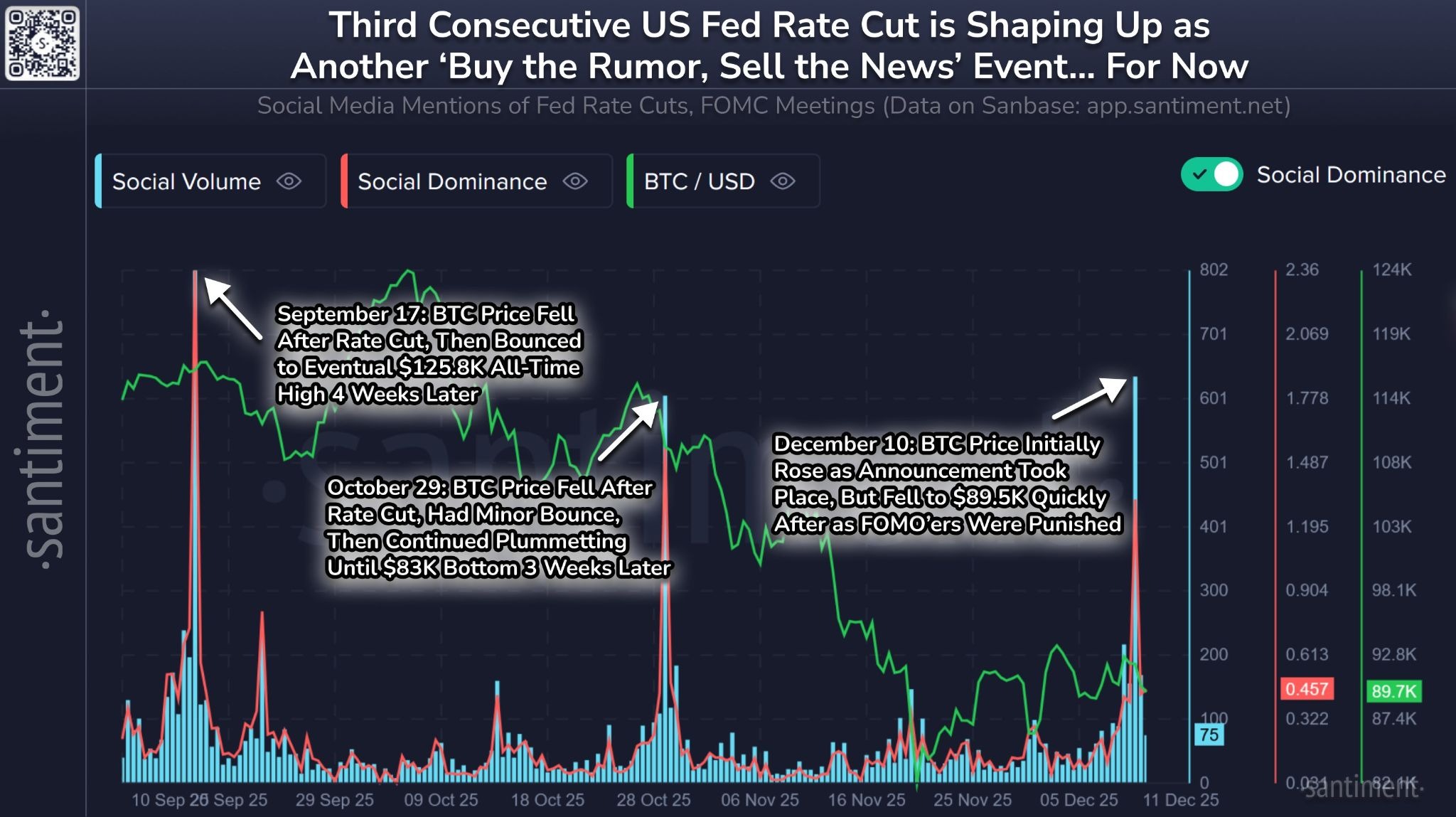
(Source: Santiment)
From September to December, the Federal Reserve cut rates three consecutive times, totaling 0.75%, marking the most intensive rate-cutting cycle since the pandemic rescue in 2020. The core logic behind rate cuts is to lower borrowing costs and stimulate economic activity, but for risk assets like Bitcoin, the implications go far beyond. Lower interest rates and cheaper borrowing costs typically increase risk appetite and attract capital inflows into speculative assets.
Historical data shows that Fed rate cut cycles are often accompanied by increased liquidity in the cryptocurrency market. When risk-free yields in traditional financial markets decline, investors are forced to seek higher-yield investments, making Bitcoin, as an emerging asset class, naturally a target for capital flows. The cumulative 0.75% rate cut has already been sufficient to generate significant liquidity effects in the market.
CoinEx chief analyst Jeff Ko pointed out that the latest rate cut was within general expectations and has been almost fully priced in by the market. More importantly, the $40 billion short-term treasury purchase plan is a liquidity tool aimed at lowering short-term interest rates. Although it is not a large-scale stimulus plan, the market interprets it as a slight bullish signal, with US stocks rising and Bitcoin rebounding amid overall risk sentiment.
However, the Fed’s updated dot plot indicates that policymakers see a slightly hawkish stance for the next move in interest rates, suggesting that further rate cuts may be limited. For Bitcoin investors, this subtle shift in policy attitude warrants close attention, as it will directly influence the upcoming months’ market liquidity environment.
The predictable pattern of “buy the rumor, sell the news”
Santiment’s on-chain analysis report reveals a predictable trading pattern. Although the long-term fundamentals of cryptocurrencies remain positive, every rate cut triggers short-term sell-offs, following the classic “buy the rumor, sell the news” pattern. This pattern is especially evident in Bitcoin markets, as participants tend to price in events early, and once the news is announced, profit-taking pressure emerges.
Santiment notes that after the dust settles, a rebound usually occurs, offering predictable trading opportunities. So far, this rate cut is no different than previous ones, with expectations of minor panic or retail sell-offs, indicating that the mild decline after the rate cut has already ended. Historical sentiment and price trends closely correlate with Fed rate cuts, providing an additional reference for technical analysis.
Bitcoin trading strategies during rate cut cycles
Pre-event positioning: A few days before the Fed announces a rate cut, the market often shows anticipatory buying, making it an ideal time to establish bullish positions.
De-risking after news: Short-term sell-offs following the rate cut announcement often provide high-level exit opportunities to avoid losses from short-term volatility.
Adding positions after pullback: The rebound after dust settles is a second entry point, usually accompanied by a more stable upward trend.
The effectiveness of this strategy is based on statistical patterns observed in history. After the past three Fed rate cuts, Bitcoin experienced similar price fluctuation patterns, providing investors with a workable trading framework. Of course, historical patterns do not guarantee future performance, but they at least offer a risk management reference.
Institutional perspective: Bitcoin market maturity
Fidelity Investments’ global macro chief Jurrien Timmer, focusing on a longer timeline, pointed out that Bitcoin’s performance this year has lagged behind stocks but, compared to previous cycles, the market is becoming more mature. It’s hard to judge immediately whether a new crypto winter has arrived, but by observing the evolving wave structure of Bitcoin’s mature network curve, it seems the recent bull market appears quite mature.
Signs of market maturity include reduced volatility, increased institutional participation, and more rational responses of prices to macroeconomic events. Compared to the frenzy bull markets of 2017 and 2021, the current cycle’s Bitcoin price surge is more steady, lacking retail FOMO-driven chasing, with institutional inflows more continuous and stable. This structural shift indicates Bitcoin is transitioning from a purely speculative asset to one with macro allocation value.
On Friday morning trading hours, the crypto market showed a slight rebound. Bitcoin recovered from its lows below $90,000 and surged to $93,500 on Coinbase. However, resistance at that level proved too strong, causing the price to fall back to $92,300. This testing of key resistance levels is typical of consolidation phases. Once it breaks through the $93,500 to $95,000 resistance zone, the next target could be the psychological milestone of $100,000.
The Fed’s rate cut cycle has provided a macro environment supportive of Bitcoin, but short-term technical resistance still needs to be overcome. Investors should pay attention not only to price itself but also to changes in volume and holdings structures, as these on-chain indicators will offer more reliable trend confirmation signals.
Related Articles
Non-farm payrolls may unexpectedly increase by only 70,000! White House: It's not an employment recession, but a productivity revolution
Kevin Wash's Federal Reserve New Policy! Using AI to tame inflation, refusing to be a big buyer of U.S. bonds
Charlie Munger: How do I respond when assets drop by 50%?
Wosh is about to succeed as Federal Reserve Chair! The probability of a rate cut in June skyrocketed to 46%, boosting risk assets.
Trump to Announce Federal Reserve Chair! Bitcoin-Friendly Kevin Wash's win rate soars to 95%
Gate Daily (January 30): Trump declares a national emergency and Cuban tariffs; The United States will announce a new chairman of the Federal Reserve next week