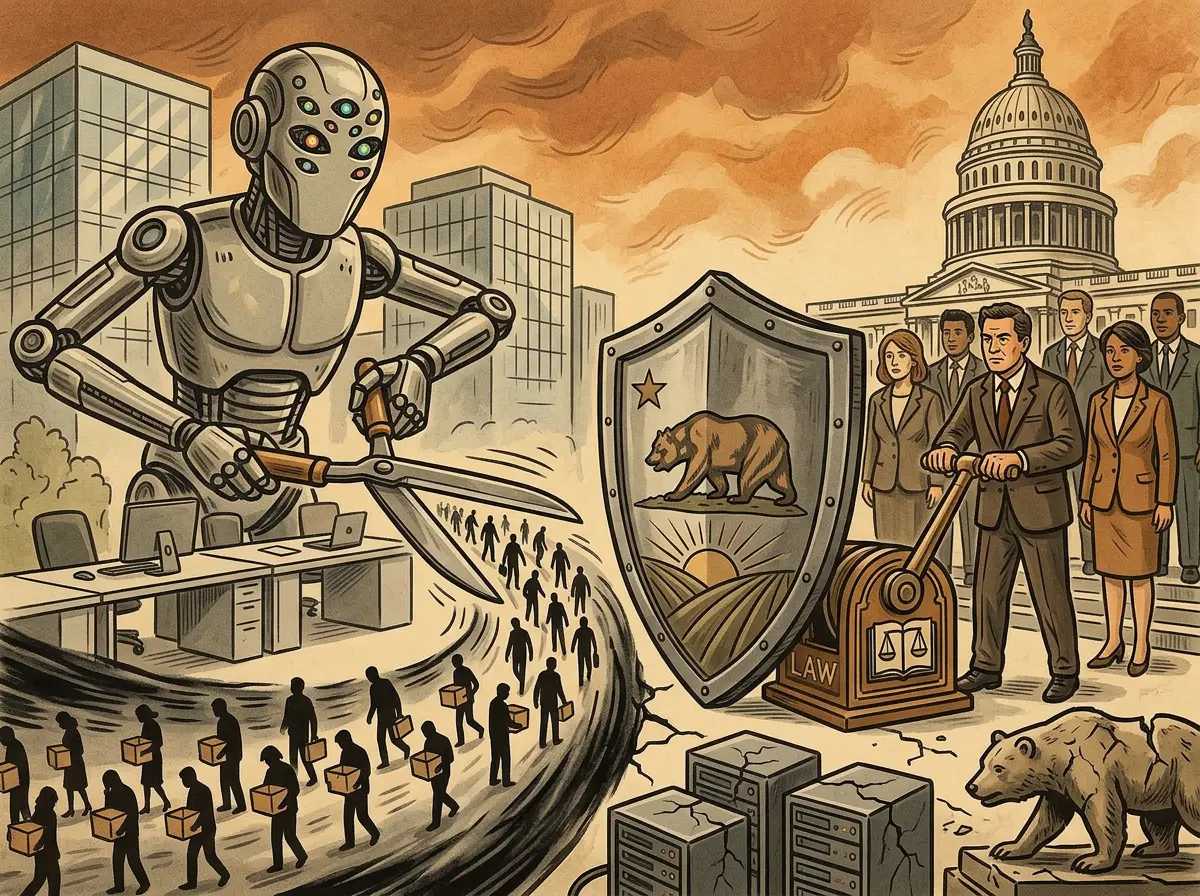
California Governor Gavin Newsom signed on May 21 an executive order he called a “first-in-the-nation” directive, instructing California to address the economic impact of AI on workers, small businesses, and communities. It requires the Department of Employment Development to create a public dashboard that tracks AI impacts by industry. Layoffs.fyi tracking data shows that as of 2026 to date, 150 Silicon Valley technology companies have laid off more than 114,000 people.
Key provisions of the executive order: 180-day timeline, WARN updates, and the EDD dashboard
Under the executive order, the Labor and Workforce Development Agency must submit within 180 days proposed updates to the California WARN Act to reflect changes in the AI-driven job market. The EDD will build a public dashboard to track AI’s employment-market impact by industry, enabling the state government to identify layoff trends earlier. The executive order convenes a committee composed of universities, economists, labor experts, government agencies, and industry executives, tasked with developing new policies and tracking AI-related employment impacts across sectors. The executive order also establishes AI job training programs and sets up a unified online entry point for government services.
Policy exploration options: severance pay, employee ownership, and universal basic capital
Policy exploration options listed in the executive order include: new severance pay rules, employment insurance, and transitional subsidies for unemployed workers; as well as company-structure options for worker ownership, a universal basic capital plan, and broader career-training programs. These options are currently all listed as “plans under consideration,” with no specific implementation plans yet. Newsom said the goal is to help California workers (not just technology companies) share the productivity gains brought by AI.
Background on Silicon Valley layoffs: 150 companies lay off more than 114,000 people this year
Layoffs.fyi tracking data shows that as of 2026 to date, 150 technology companies have laid off more than 114,000 people. Layoffs announced this week also include: ClickUp (layoffs of 22%, with CEO Zeb Evans tying this to the “one-hundredfold growth organization” vision), Intuit (3,000 people), and Meta (8,000 people). Standard Chartered plans to cut more than 15% of positions in its corporate-function departments by 2030.
FAQ
What is the significance of the California WARN Act update, and why set a 180-day deadline?
The California WARN Act requires advance notice to employees before large-scale layoffs. The executive order requires the Labor and Workforce Development Agency to submit update recommendations within 180 days to reflect new layoff patterns driven by AI. Any specific proposed amendments would need to go through formal legislative procedures; the executive order cannot directly amend existing law.
What is the “universal basic capital” plan, and what stage is it at right now?
“Universal basic capital” is one of the research-and-exploration options listed in the executive order. The concept is to provide people with a certain form of capital ownership to ensure that the benefits of AI productivity gains are distributed more broadly. At present, this option is only listed as a “plan under consideration,” with no specific implementation plan or timeline.
Why is California taking an all-U.S.-leading stance on AI labor policy?
California has 33 of the world’s top 50 private AI companies, making it both the largest employment market for AI technology and the most affected area. With 150 Silicon Valley tech companies laying off more than 114,000 people in 2026 to date (Layoffs.fyi), California’s direct exposure to AI-related layoffs is the highest among all U.S. states.


