During a recent interview, President Javier Milei stated that the largest obstacle to dollarization in Argentina was that people did not want it. He stressed that even when the government has approved the use of the dollar for financial transactions, people still do not use it.
Key Takeaways:
- Javier Milei admits his dollarization push stalled; citizens favor the peso, complicating future reforms.
- Milei’s currency competition policy, allowing currencies like the dollar to be used, failed, leaving the peso as the default currency.
- After lifting currency restrictions, Scott Bessent and the U.S. intervened in October to stabilize the peso’s value.
President Javier Milei Explains Why Argentina Has Not Adopted The Dollar Yet
President Javier Milei has explained why the process of dollarizing Argentina might be more complex than expected, as it has hit a solid roadblock.
Milei, who campaigned and won the Argentine presidency on the promise of adopting the U.S. dollar as fiat currency, ending the Argentine peso, and disbanding the central bank, acknowledged a newfound obstacle to his plans.
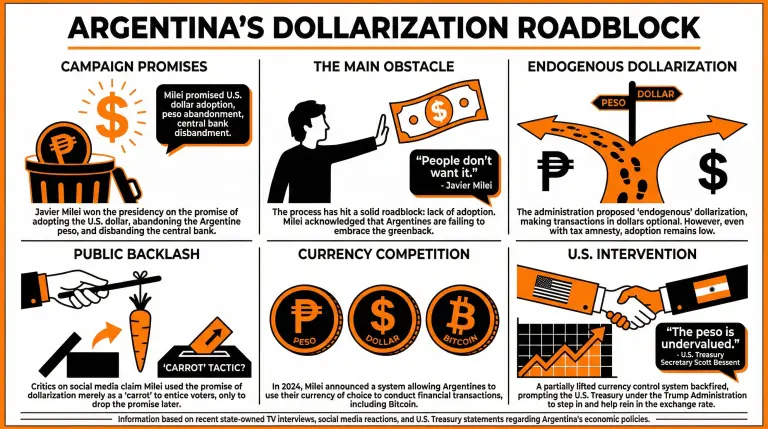
During a recent TV interview, Milei highlighted that the main issue when dollarizing the country was the lack of adoption by Argentines, who have failed to embrace the greenback and continue to use the Argentine peso.
“People don’t want it,” said Milei, referring to using the U.S. dollar instead of the Argentine peso. “We’ve proposed endogenous dollarization. Endogenous. That is, if you want, you can make your transactions in dollars, and yet people don’t. We’ve enacted tax amnesty, and yet people don’t take advantage of it,” he stressed.
Furthermore, Milei highlighted that, “strictly speaking, you can’t force things on people.” The remarks were criticized on social media, with some claiming that Milei had used dollarization as motivation to entice Argentines to vote for him, only to drop the promise later.
In 2024, Milei stated that he would implement a system of currency competition, allowing Argentines to use their currency of choice, including bitcoin, to conduct financial transactions.
He also lifted currency controls partially, establishing a floating system that would allow the dollar to float within a fixed price band. However, this backfired, and Milei had to receive help from the Trump Administration to rein in the dollar exchange rate. “Argentina is a beacon in Latin America. This isn’t a bailout; it’s buying low and selling high. The peso is undervalued,” said U.S. Treasury Secretary Scott Bessent in October.
Disclaimer: The information on this page may come from third parties and does not represent the views or opinions of Gate. The content displayed on this page is for reference only and does not constitute any financial, investment, or legal advice. Gate does not guarantee the accuracy or completeness of the information and shall not be liable for any losses arising from the use of this information. Virtual asset investments carry high risks and are subject to significant price volatility. You may lose all of your invested principal. Please fully understand the relevant risks and make prudent decisions based on your own financial situation and risk tolerance. For details, please refer to
Disclaimer.
Related Articles
French Finance Minister: Euro-Based Stablecoins Vital to European Financial Sovereignty
French Finance Minister Roland Lescure has called on European banks to aggressively develop euro-based stablecoins and tokenized deposits to challenge the overwhelming dominance of the U.S. dollar in digital payments.
Key Takeaways:
Roland Lescure urged EU banks to launch euro stablecoins
Coinpedia2h ago
UBS Expects Fed to Cut Rates 50 Basis Points by Year-End; 10-Year Treasury Yield Forecast at 3.75%
UBS analysts predict the Federal Reserve will cut interest rates by 50 basis points by 2026, despite rising energy prices. Fed Chairman Powell suggests limited tightening is needed, focusing on core inflation evidence before cuts. The forecast for Treasury yields indicates potential downward movement.
GateNews7h ago
Fed Likely to Hold Rates in April at 99.5% Probability, CME Data Shows
The Federal Reserve is highly likely to keep interest rates steady in April, with a 99.5% probability. Looking ahead to June, there's a 94.1% chance of maintaining rates, a 0.5% chance of an increase, and a 5.4% chance of a cut.
GateNews04-17 23:11
Fed Governor Waller Backs Holding Rates for Rest of 2026 If Inflation Remains Elevated
Fed Governor Christopher Waller expressed his readiness to maintain interest rates steady until 2026 if inflation remains a significant concern, despite a stagnant labor market. He warned about prolonged inflation and potential job losses amid ongoing Fed leadership discussions.
GateNews04-17 21:11
TradFi Fall Alert: USDKRW (US Dollar vs South Korean won) Falls Over 1%
Gate News: According to the latest Gate TradFi data, USDKRW (US Dollar vs South Korean won) has dropped by 1% in a short period. Current volatility is significantly higher than recent averages, indicating increased market
GateNews04-17 17:24
U.S. 5-Year Treasury Yields Drop 10 Basis Points
Gate News message, April 17 — U.S. 5-year Treasury yields (benchmark measure of medium-term U.S. government borrowing rates) fell 10 basis points intraday.
GateNews04-17 15:01


