


Iran and North Korea both love it! Stablecoins have become the most popular virtual asset for illegal transactions, estimated to be involved in scams worth $51 billion.

The Financial Action Task Force (FATF) has pointed out that stablecoins are the preferred choice for illegal transactions involving North Korea, Iran, and others, with estimated fraud amounts reaching $51 billion. To prevent vulnerabilities in non-custodial wallets, they strongly urge countries to strengthen anti-money laundering regulations on issuers.
FATF: Stablecoins Are the Top Choice for Illegal Transactions
According to a 42-page report released by the Financial Action Task Force (FATF), stablecoins are currently the most popular virtual assets used in illegal transactions (including sanctions evasion). Participants include countries like Iran and North Korea, prompting calls for stricter regulation of stablecoin issuers.
In January this year, FATF stated that stablecoins account for the majority of on-chain illegal activity transactions. The organization estimates that in 2024, illegal stablecoin activities related to scams and fraud will total approximately $51 billion.
North Korea and Iran Favor Stablecoins
FATF further explained that North Korea’s Lazarus Group and other organizations use stablecoins to purchase military equipment; Iran’s Islamic Revolutionary Guard Corps also relies on stablecoins to acquire drone parts; terrorist groups and drug trafficking organizations heavily depend on Tether ($USDT) and USDC for fund transfers and money laundering.
On July 2, 2025, Tether, the issuer of USDT, conducted the largest-ever freeze of Iran-related funds, freezing 42 cryptocurrency wallet addresses, over half of which are heavily linked to the local exchange Nobitex.
As a global standard-setting body focused on international anti-money laundering efforts, FATF points out that stablecoins, with features like price stability and high liquidity, are attractive tools for criminals to transfer funds.
Further Reading:
Fiat currency devalued by 90%! Iran’s central bank buys $500 million USDT to save rial exchange rate. Iran’s banks are paralyzed, and exchanges have been hacked! Can Bitcoin hedge against information warfare in the Taiwan Strait?
Vulnerabilities in Non-Custodial Wallets Record Illegal Stablecoin Receipts
In its latest report from March 2026, FATF again warns that stablecoins pegged to the US dollar have become key tools in illegal financial activities.
The organization cites a report from blockchain analysis firm Chainalysis, stating that in 2025, illegal virtual asset transactions totaled $154 billion, with stablecoins accounting for 84%, a stark contrast to the Bitcoin-dominated illegal transactions of 2020.
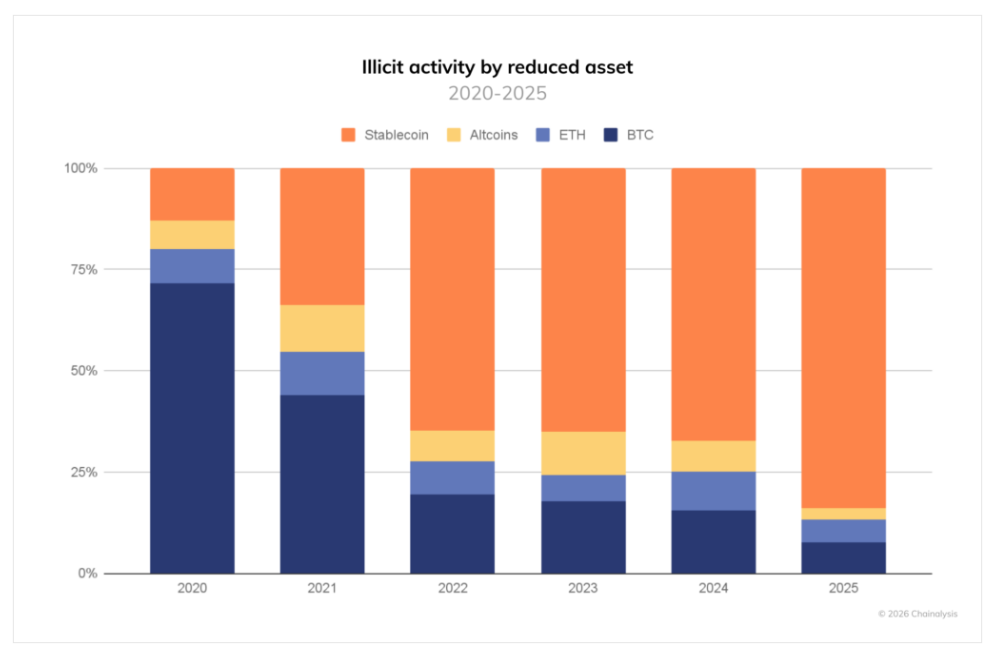
Source: Chainalysis — In 2025, illegal virtual asset transactions reached $154 billion, with stablecoins accounting for 84%
Additionally, according to a report released in mid-February by blockchain analysis firm TRM Labs, illicit entities received a total of $141 billion in stablecoins in 2025, setting a five-year high. The report notes that last year, overall stablecoin activity repeatedly exceeded $1 trillion per month, with 86% related to sanctions.
The report emphasizes that malicious actors often hide their funds using cross-chain technology, decentralized exchanges, and OTC brokers. FATF highlights that peer-to-peer transfers through non-custodial wallets are a critical vulnerability, as these transactions occur in environments lacking anti-money laundering controls, making it difficult for regulators to track geographic locations and beneficiaries.
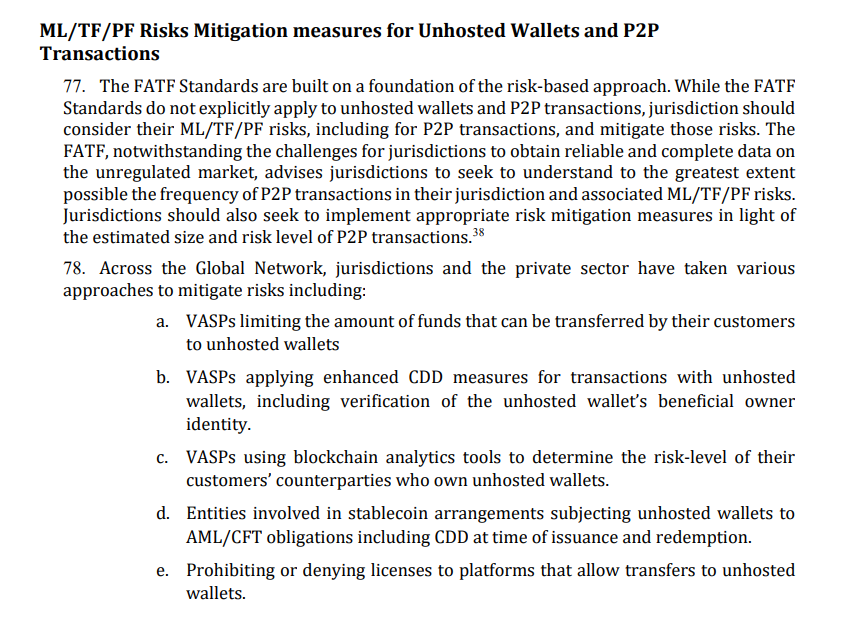
Source: FATF report — Peer-to-peer virtual asset transfers via non-custodial wallets are a key vulnerability
Stablecoin Market Cap Surpasses $300 Billion, Urgent Need for Regulation
It’s important to note that FATF does not call for banning stablecoins outright but strongly urges countries to impose anti-money laundering obligations on stablecoin issuers and intermediaries.
FATF recommends that stablecoin issuers utilize smart contract control features to establish whitelists and blacklists to restrict certain wallet transactions. Issuers should have the technical capability to intercept, freeze, and destroy suspicious stablecoins in secondary markets. To address cross-border operational challenges, FATF encourages countries to establish international regulatory bodies to enhance information sharing and joint oversight.
Currently, the global stablecoin market value has exceeded $300 billion. As adoption accelerates and integration with traditional finance deepens, FATF believes that regulators worldwide must act swiftly and implement blockchain analysis tools to close regulatory and compliance gaps.
Further Reading:
Preparing for Crypto Legislation! E.SUN Bank: Banking sector to adopt three-tier financial models, not missing out on stablecoins and tokenization
Conflict impacts Gaza banks! Trump’s Peace Commission plans to use US dollar stablecoins to promote digital transactions
Related Articles
ETF Frenzy for Capital Inflow, Strong Bearish Momentum in Futures: Bitcoin Surges Past $69,000, Can the Short-term Rebound Continue?
JPMorgan CEO slams the crypto industry: "Interest-bearing stablecoins" are equivalent to deposits and should be regulated like banks
Oil prices surge, interest rate cut expectations cool down! Circle benefits as the target price breaks $100
Governor Signs Bitcoin Rights Act – Indiana Teachers & Workers Now Stack Sats!
The US-Iran conflict highlights the advantages of 24/7 cryptocurrency trading, with on-chain markets becoming the new global financial hub
Goldman Sachs CEO Solomon Warns: US-Iran War Impact Could Trigger Several Weeks of Continuous Crypto Market Decline