


SoFiUSD collaborates with Mastercard to become a global settlement stablecoin

SoFi Technologies announces expanded partnership with Mastercard, positioning its full reserve US dollar stablecoin SoFiUSD as a settlement currency within the global payment network. Under the agreement, both parties will explore how issuing and acquiring banks can use SoFiUSD to settle credit and debit card transactions, with SoFiUSD expected to receive technical support from Mastercard’s multi-token network.
SoFiUSD Integration with Mastercard’s Technical Architecture and Core Goals
SoFiUSD was issued by SoFi Bank last December. The bank is a federally chartered depository institution regulated by the Office of the Comptroller of the Currency (OCC) and insured by the Federal Deposit Insurance Corporation (FDIC), with the token deployed on Ethereum. Fully backed 1:1 by cash reserves, SoFiUSD is positioned as the first stablecoin issued by a nationally chartered bank on a public blockchain.
This partnership integrates SoFiUSD into traditional financial settlement infrastructure, focusing on: issuing and acquiring banks exploring replacing fiat currency with SoFiUSD for transaction settlement; connecting traditional payment channels and digital asset ecosystems via Mastercard’s multi-token network; and Galileo platform providing SoFiUSD settlement options to payment card customers and issuing banks.
SoFi CEO Anthony Noto stated, “SoFiUSD is at the core of our strategy, aiming to enable faster, cheaper, and more secure money transfers worldwide. With SoFiUSD as the settlement currency on the Mastercard network, issuing and acquiring banks can more easily help millions of businesses globally achieve real-time, 24/7 settlement.”
Key Elements of SoFiUSD Integration with Mastercard’s Global Network
Unique Background: The first stablecoin issued by a nationally chartered bank regulated by OCC on the Ethereum public blockchain
Technical Integration: Connecting to Mastercard’s multi-token network to explore interoperability between fiat, stablecoins, and tokenized deposits
Use Cases: Cross-border remittances, inter-business transfers, 24/7 real-time transaction settlement
Platform Role: Galileo as an early adopter providing SoFiUSD settlement options to issuing banks
Programmable Payments: Both parties will explore programmable fund management and new payment transfer solutions (subject to regulatory approval)
Market Context and Industry Significance of Stablecoin Settlement
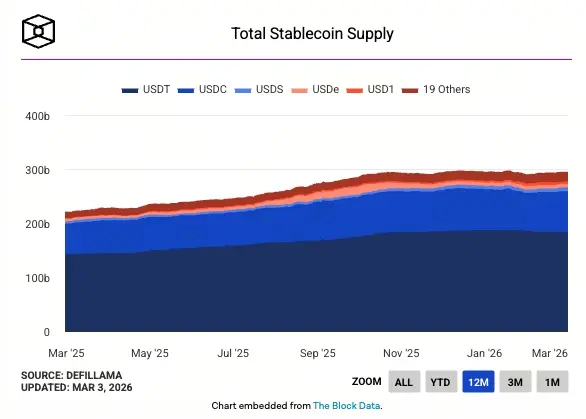 (Source: The Block)
This partnership exemplifies the rapid growth of the global stablecoin market. According to McKinsey, daily stablecoin trading volume is approximately $30 billion, with issuance doubling by 2025 compared to the previous year. A global study by BVNK in collaboration with Coinbase and Artemis shows over half of crypto holders have held stablecoins in the past 12 months, and more than 75% of respondents would open a stablecoin wallet if offered by their bank.
Sherri Haymond, Mastercard’s Head of Global Digital Commerce, said this collaboration will expand the operational capabilities of regulated stablecoins in the real world, making regulated digital currencies more reliable, secure, and widely accessible for consumers, businesses, and financial institutions.
Frequently Asked Questions
What is SoFiUSD, and what makes it special?
SoFiUSD is a full reserve US dollar stablecoin issued by SoFi Bank, fully backed 1:1 by cash reserves, deployed on Ethereum. Its uniqueness lies in being the first stablecoin issued by a federally regulated, FDIC-insured national bank on a public blockchain, combining traditional banking compliance with blockchain transparency.
What does the integration of SoFiUSD with Mastercard mean for global payments?
This integration allows SoFiUSD to serve as a settlement currency within Mastercard’s global payment network, enabling issuing and acquiring banks to explore replacing traditional fiat with stablecoins for settlement, unlocking faster, 24/7 settlement capabilities for cross-border remittances and inter-business transfers.
What is Mastercard’s Multi-Token Network (MTN)?
Mastercard’s Multi-Token Network is a digital asset platform designed to connect traditional payment channels with the digital asset ecosystem, enhancing interoperability between fiat, stablecoins, and tokenized deposits to provide more settlement options across the payment ecosystem.
Related Articles
The altcoin market is experiencing a structural decline, with 38% of tokens approaching historical lows, as funds continue to flow into Bitcoin and Ethereum.
Gate launches the new Gate Card, with cashback and level system fully upgraded
Lamborghini dealerships in the United States now accept Ethereum payments, with ETH expanding luxury car consumption scenarios
Ethereum validators queue reaches a record high, with large investors choosing to stake rather than sell
Middle East conflict impacts Asian stock markets, Bitcoin holds at $67,000, Ethereum and Solana come under pressure and retreat
Yesterday, US Bitcoin spot ETF saw a net inflow of $225 million, while Ethereum ETF experienced a net outflow of $10.8 million.