


Iran blocks the Strait of Hormuz, oil prices may surge past $100, will Taiwan stocks open lower on Monday?
U.S. and Israeli joint forces launched an attack on Iran, resulting in the death of Supreme Leader Khamenei. Iran retaliated by blocking the Strait of Hormuz. Global oil transportation, averaging 20 million barrels per day, has been disrupted, with Brent crude soaring 3.7% in a single day to $72.80. Analysts warn that if the blockade continues, oil prices could break through $100.
(Background recap: Iranian President Raisi appoints a three-person committee to take control; potential successors exposed)
(Additional background: Reports suggest Israel has launched a “preemptive” military strike on Iran! Bitcoin suddenly drops below $65,000, market panic surges)
Table of Contents
Toggle
- Is $72 just the beginning?
- Iran’s trump card
- Will Taiwan stocks open on Monday with caution?
On the 28th, the U.S. and Israel launched a joint military operation against Iran, targeting military command centers, nuclear facilities, and high-ranking officials. The Iranian Red Crescent reports at least 201 deaths and over 700 injuries. The most critical blow: Iran’s Supreme Leader Khamenei confirmed he was killed in the airstrike this morning.
In retaliation, Iran launched dozens of ballistic missiles and drones, attacking 27 military bases in Israel, Jordan, Kuwait, Bahrain, Qatar, Iraq, Saudi Arabia, and the UAE.
Then, Iran’s Revolutionary Guard did what markets fear most: they closed the Strait of Hormuz.
According to the U.S. Energy Information Administration (EIA), in 2024, an average of 20 million barrels of oil pass through this strait daily, accounting for 20% of global liquid petroleum consumption. Data for 2025 shows about 13 million barrels per day transported via this strait, representing 31% of global maritime oil flow.
In other words, nearly one-third of global maritime oil and one-fifth of liquefied natural gas are now effectively blocked.
Is $72 just the beginning?
After the news broke, Brent crude futures surged 3% in a single day, closing at $72.48 per barrel. Several investment banks warn that if there are no clear signs of de-escalation, prices could jump another $10 to $20 at Monday’s open.
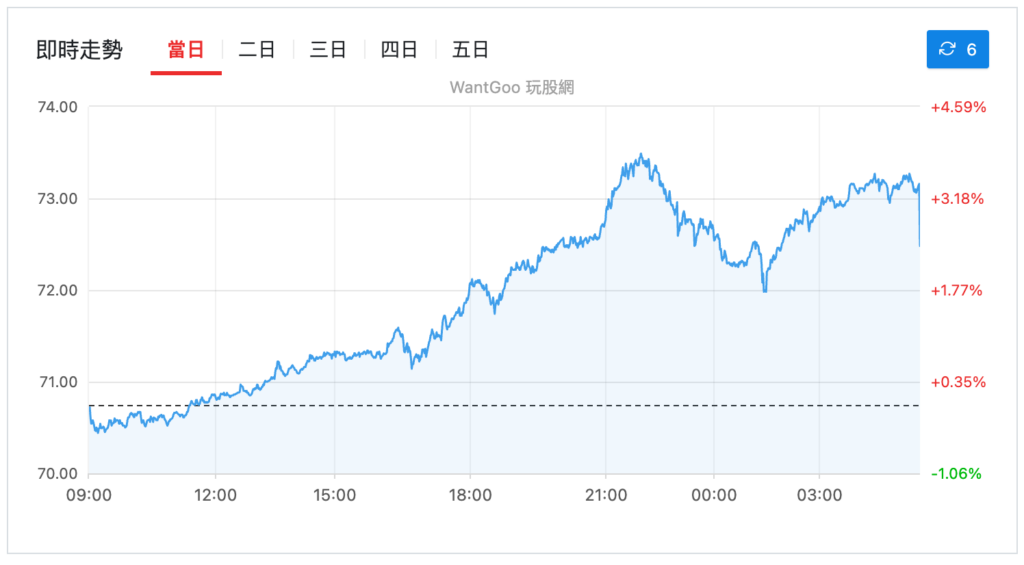
Analysts predict: if the conflict is contained within three to five weeks, the risk premium on oil could be about $4 to $10, which markets can absorb. But if it evolves into a prolonged standoff with Iran continuing to block the strait, cutting off up to 20% of global oil supply, Brent could easily surge toward $100. Bloomberg analysts further state that if the blockade is successful and sustained, reaching $140 for Brent is not impossible.
Iran’s trump card
Iran is the fourth-largest oil producer in OPEC, with a daily output slightly over 3 million barrels as of January this year. But Iran’s real threat to oil prices isn’t its own production, but its ability to choke the Strait of Hormuz.
Most of the oil exports from Saudi Arabia, the UAE, Kuwait, and Iraq must pass through this narrow 33-kilometer-wide waterway. Even without considering Iran’s own exports (about 90% of which go to China, averaging around 1.9 million barrels per day), just blocking the strait could trigger global energy market panic.
CNBC cites analysts saying: “The consequences of this conflict are much greater than Venezuela’s.” Venezuela’s production disruptions involve hundreds of thousands of barrels; the blockade of the Strait of Hormuz affects tens of millions of barrels. They are not in the same scale.
OPEC’s spare capacity is limited. Saudi Arabia could theoretically increase production, but even at full capacity, it cannot compensate for the shortfall caused by the strait’s closure, since the additional oil would also need to pass through the strait. An alternative pipeline through the Red Sea exists but is far from sufficient in capacity.
Will Taiwan stocks open cautiously on Monday?
Taiwan’s weighted index hit a record high on February 26 before the holiday, marking five consecutive days of record-breaking gains. But 72 hours later, missile strikes in the Middle East shattered this celebration.
Major investment firms’ scenario analyses suggest: Taiwan stocks may open Monday down by 300 to 500 points, or even 800 to 900 points. KGI Securities’ analysis bluntly states: “If Iran continues to blockade the Strait of Hormuz, and the conflict turns into a long-term war, with oil prices soaring into triple digits, the impact on financial markets will be unpredictable.”
Foreign investors are the biggest variable. Historically, when geopolitical risks escalate, their first reaction is often to withdraw quickly. Institutional investors expect Taiwan stocks to become a target for foreign capital outflows, especially for liquid large-cap stocks like TSMC, which will bear the brunt of selling pressure.
However, some institutions hold a relatively cautious optimism. The logic is: as long as the battlefield isn’t on U.S. soil, the actual impact on the global economy won’t be too severe; markets might shake for a few days, but if the conflict is contained, it could present an opportunity to buy into TSMC and other AI-related stocks.
But the key premise is: the Strait of Hormuz must reopen, and oil prices must not truly surge past $100.

Related Articles
UNI Rallies as Federal Court Ends Investor Case Against Uniswap Labs
BTC drops 0.99% in 15 minutes: Short-term selling driven by a sudden decline in macro risk appetite and on-chain fund withdrawals
ETH 15-minute decline of 1.25%: leveraged liquidation and on-chain fund outflows jointly drive short-term selling pressure