


Trump confirms Hamas leader killed, Crypto liquidation exceeds $600 million, Will Iran close the Strait of Hormuz?

Israel Airstrikes Iran Trigger Middle East Conflict, Bitcoin Plunges Over $652 Million in Liquidations, Energy and Inflation Risks Rise, Impacting Global Markets.
Conflict Erupts and Middle East Situation Escalates
By late February 2026, the Middle East had descended into extreme turmoil. The United States and Israel launched a large-scale military operation against Iran, codenamed “Operation Epic Fury,” aimed at destroying Iran’s nuclear facilities, missile production sites, and naval forces. President Trump confirmed U.S. military involvement via social media, claiming the action was to eliminate imminent threats against the U.S. and its allies. Israel’s Defense Minister Katz immediately declared a nationwide state of emergency, with air raid sirens sounding in Tel Aviv and other cities, and hospitals switching to underground operations.
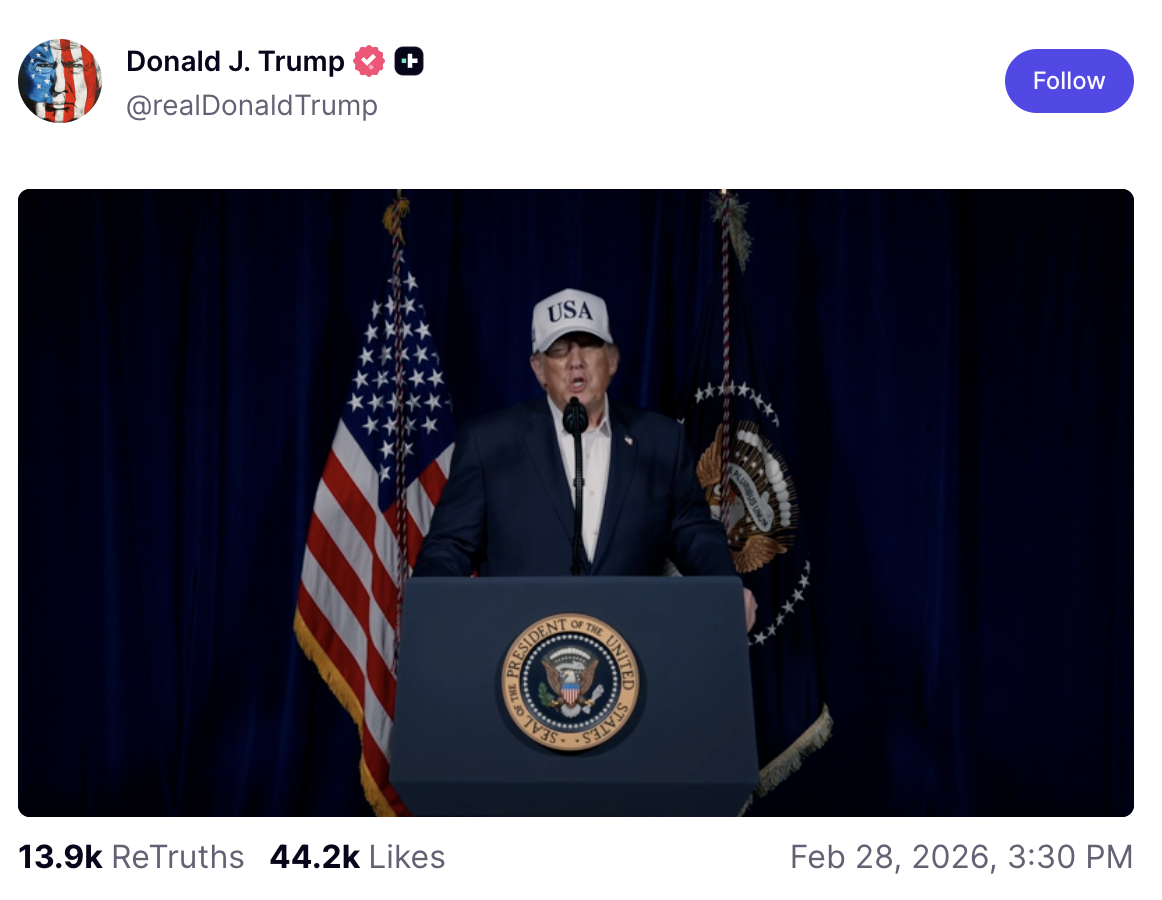
Image source: Truth Social/realDonaldTrump President Trump confirms U.S. military action against Iran
Iran’s provinces, including Tehran, Isfahan, and Qom, were bombed. According to initial reports from the Iranian Red Crescent, the strikes resulted in at least 201 deaths and 747 injuries. A girls’ elementary school in Hormozgan Province was mistakenly hit, causing dozens of casualties among students.
Subsequently, the situation took a dramatic turn, with Israeli Prime Minister Netanyahu and Trump both claiming that Iran’s Supreme Leader Khamenei had been killed in the airstrikes. Although Iran’s Foreign Ministry initially denied the reports, later Iran’s state TV confirmed Khamenei and some of his family members died in a precise strike on his Tehran office. Iran immediately declared a 40-day mourning period and a 7-day suspension of work nationwide.
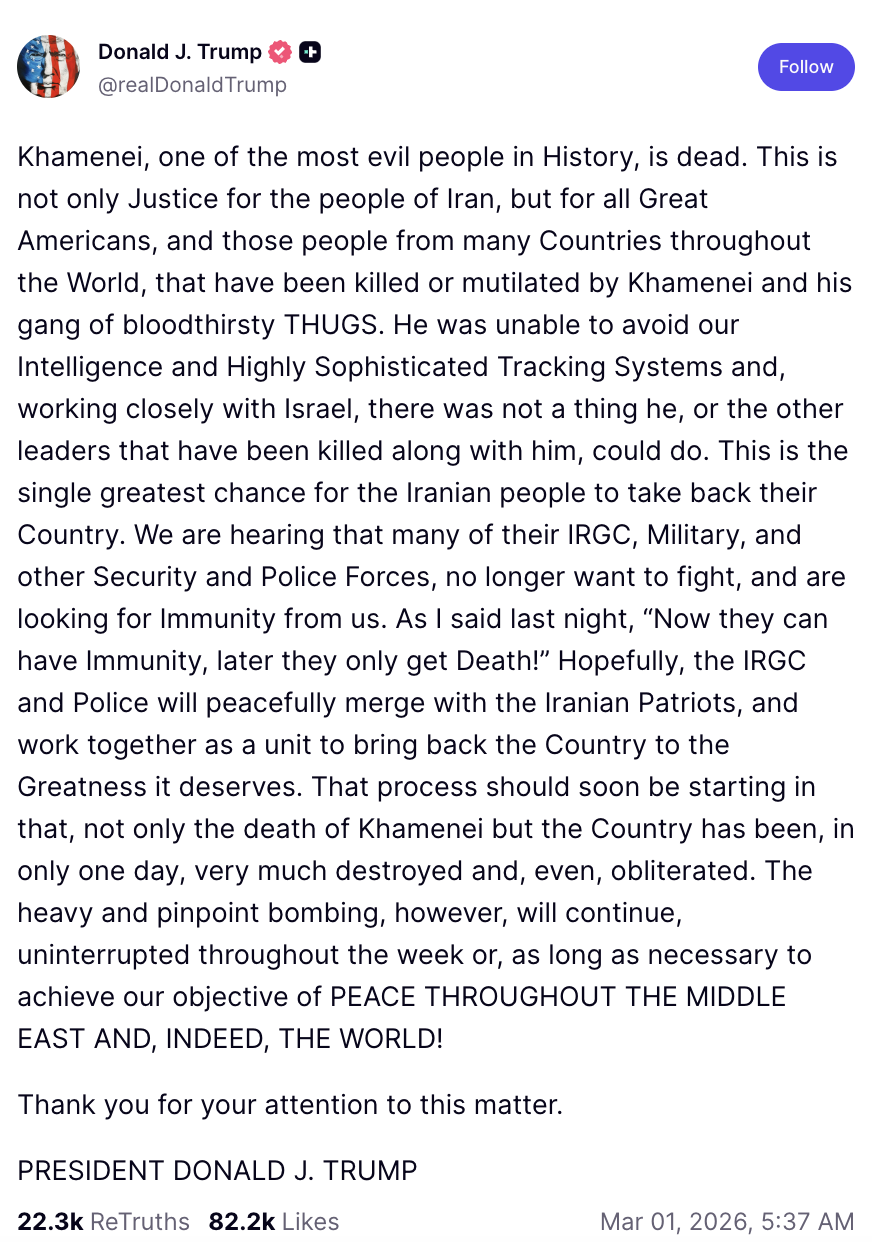
Image source: Truth Social/realDonaldTrump Trump posts claiming Iran’s Supreme Leader Khamenei was killed in the airstrikes
This military action prompted Iran’s retaliation, with Tehran launching multiple ballistic missiles and drones at U.S. military bases in Bahrain, Kuwait, Qatar, and the UAE. The conflict quickly spread across the Gulf region. The UAE and Bahrain confirmed intercepting several missiles, but debris hit Dubai’s famous Burj Al Arab hotel and Dubai International Airport, causing damage and injuries.
Cryptocurrency Market Turmoil and Leverage Liquidations
Geopolitical uncertainty triggered intense volatility in the crypto markets. Following the news of the U.S.-Israel airstrikes, Bitcoin ($BTC) plummeted from $65,500 to $63,000 within an hour, a nearly 4% drop. Ethereum ($ETH) also suffered, falling below $1,800.
According to CoinGlass data, over 150,000 traders were liquidated within 24 hours, with total liquidations exceeding $652 million, indicating a panic-driven leverage washout. About $300 million in Bitcoin and $163 million in Ethereum were liquidated. Due to the 24/7 nature of crypto trading, Bitcoin often acts as a risk hedge during weekends when traditional stock and bond markets are closed, serving as a “pressure release valve” for global investors adjusting risk positions amid geopolitical tensions.
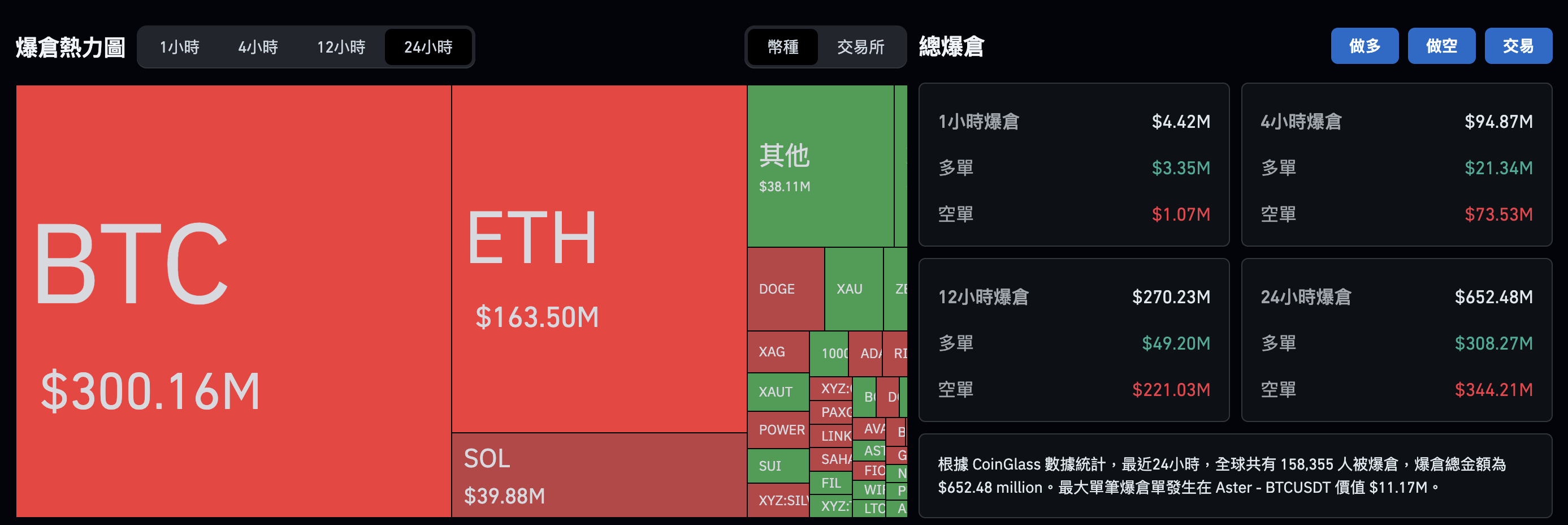
Image source: CoinGlass Over 150,000 traders liquidated in the past 24 hours
Market analysis suggests this sharp decline was not merely profit-taking but a chain reaction caused by collapsing economic confidence. Bitcoin futures trading volume surged to $68.2 billion, far exceeding the $7 billion in spot trading, indicating that derivatives markets amplified and accelerated the price decline.
However, once Iran’s official confirmation of Khamenei’s death shifted market sentiment toward expectations of regime change, Bitcoin rebounded sharply, briefly surpassing $68,000. This extreme volatility highlights the high-risk sensitivity of digital assets in crisis situations. While some investors have viewed Bitcoin as digital gold, initial reactions to the conflict leaned toward high-risk assets.
Energy Supply Threats and Global Inflation Concerns
Beyond military impacts, markets worry Iran may block the vital Strait of Hormuz, through which about 20% of global oil supplies pass. Iran’s Revolutionary Guard has issued warnings to nearby vessels, suspending traffic through the strait.
As a result, oil futures prices surged, with Brent crude approaching $72.80 per barrel. JPMorgan analysts warned that if the Strait of Hormuz is fully closed, oil prices could spike to $120–$150 per barrel. This surge in energy costs could trigger severe inflationary pressures, with U.S. CPI inflation potentially rising back to around 5%.
Economist Peter Schiff pointed out that the U.S. economy was already showing signs of weakness before the conflict, and now face supply chain disruptions and inflationary pressures, risking stagflation.
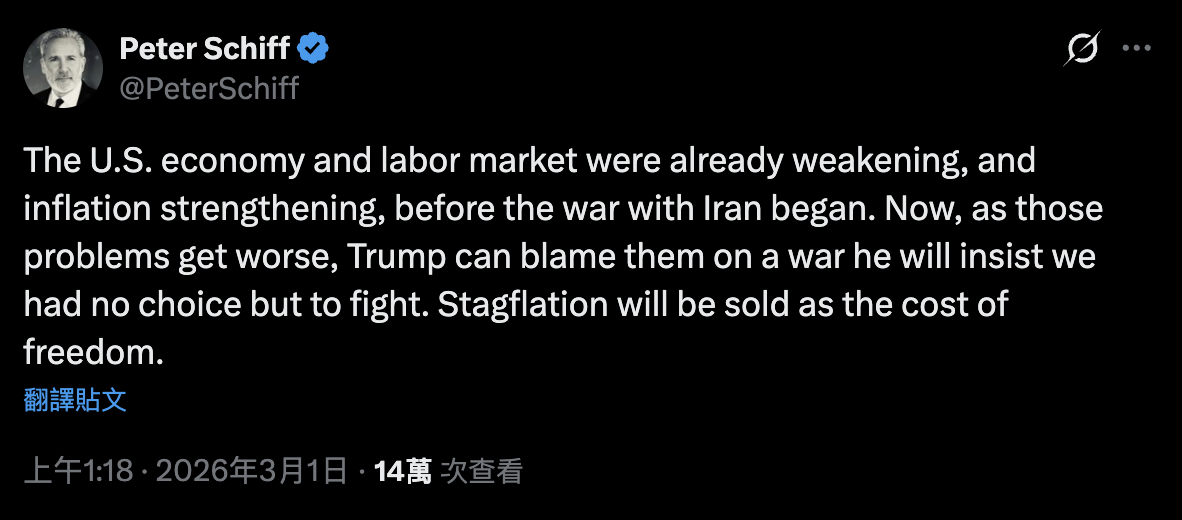
Image source: X/@PeterSchiff Peter Schiff notes that the U.S. economy was already weakening before the conflict
For crypto markets, rising inflation increases the likelihood of delayed rate hikes by central banks, tightening liquidity and exerting long-term downward pressure on risk assets like Bitcoin. While some experts like Daniel Lacalle believe Iran’s complete closure of the strait is unlikely—since China, Iran’s largest oil importer, would suffer significant losses—polls on Polymarket show nearly 56% of users expect partial or full closure of the strait before the end of March.
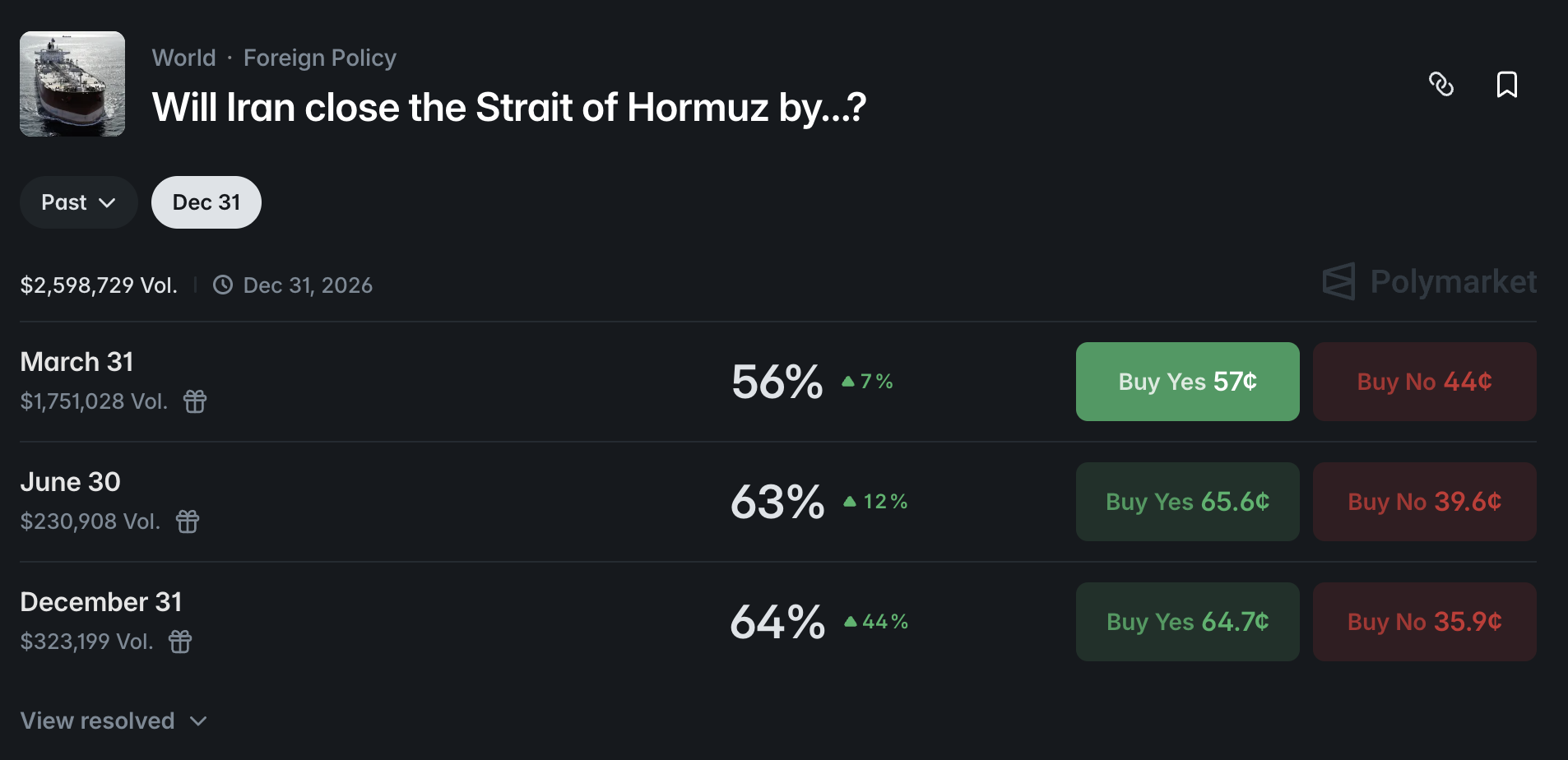
Image source: Polymarket Poll data shows nearly 56% of users expect the Strait of Hormuz to be partially or fully closed before the end of March
Iran’s Shadow Economy and Blockchain Applications
Amid ongoing conflict, Iran’s long-standing “shadow economy” based on cryptocurrencies has attracted renewed attention. According to Chainalysis, in 2025 Iran’s crypto ecosystem was valued at $7.78 billion, comparable to the GDP of some small countries. Since legalizing Bitcoin mining in 2019, Iran has used subsidized domestic electricity to mine cryptocurrencies, transferring the proceeds to the central bank to pay for imports or evade international sanctions. The report states that addresses linked to Iran’s Revolutionary Guard accounted for over 50% of the country’s crypto inflows in Q4 2025, showing deep military involvement in digital asset activities to sustain operations and expand abroad.
Ordinary Iranians see Bitcoin as a lifeline during the Rial’s collapse. With the Rial losing over 96% against the dollar, local exchanges saw a significant increase in Bitcoin withdrawals during turbulence. However, ongoing military conflicts threaten Iran’s fragile power grid, which could cause a short-term drop in the country’s Bitcoin hash rate, accounting for 2–5% of the global total. Stablecoin USDT also plays a key role; the Central Bank held over $500 million in USDT to hedge exchange rate risks and facilitate international trade. As U.S. military strikes expand to infrastructure, Iran’s longstanding crypto financial network faces unprecedented challenges.
Market Recovery and Future Technical Outlook
Despite initial massive liquidations, Bitcoin has shown strong resilience. Hours after the airstrikes, Bitcoin recovered to $65,000 and challenged higher levels. Currently, the Fear and Greed Index is at 14, indicating extreme fear, but also setting the stage for a technical rebound. Analysts warn that if the conflict escalates and traditional stock markets open sharply lower on Monday, crypto markets could face a second wave of risk-off selling.
Technically, key support levels are around $60,000 for Bitcoin and $1,750 for Ethereum. Breaking these levels could trigger another wave of forced liquidations. Additionally, trading volume for tokenized oil and gold contracts on decentralized platforms like Hyperliquid has surged, reflecting investor interest in instruments that can react quickly over weekends.
As Trump emphasizes ongoing targeted strikes in Iran until objectives are met, global markets remain closely watching the Middle East. For crypto investors, maintaining liquidity and practicing cautious risk management are crucial in this highly volatile environment.
Related Articles
【Morning Market Brief】 Cryptocurrency market fluctuates... Bitcoin $68,929, Ethereum $2,041
Bitcoin Holds $66,000 as Market Braces for March Rebound
Crypto Market Slides as Bitcoin Falls on War Tensions
Crypto Markets Surge Amid Middle East Tensions and Whale Accumulation
PEPE Holds $0.053796 Support After 12% Drop Amid $580M Trading Spike
ETH 15-minute sharp decline of 1.23%: leveraged long liquidations and on-chain capital outflows resonate, intensifying volatility