


Mining coin daily trading volume crashes to 11 million! 205 million coins unlocked, pressure peaks, demand continues to weaken
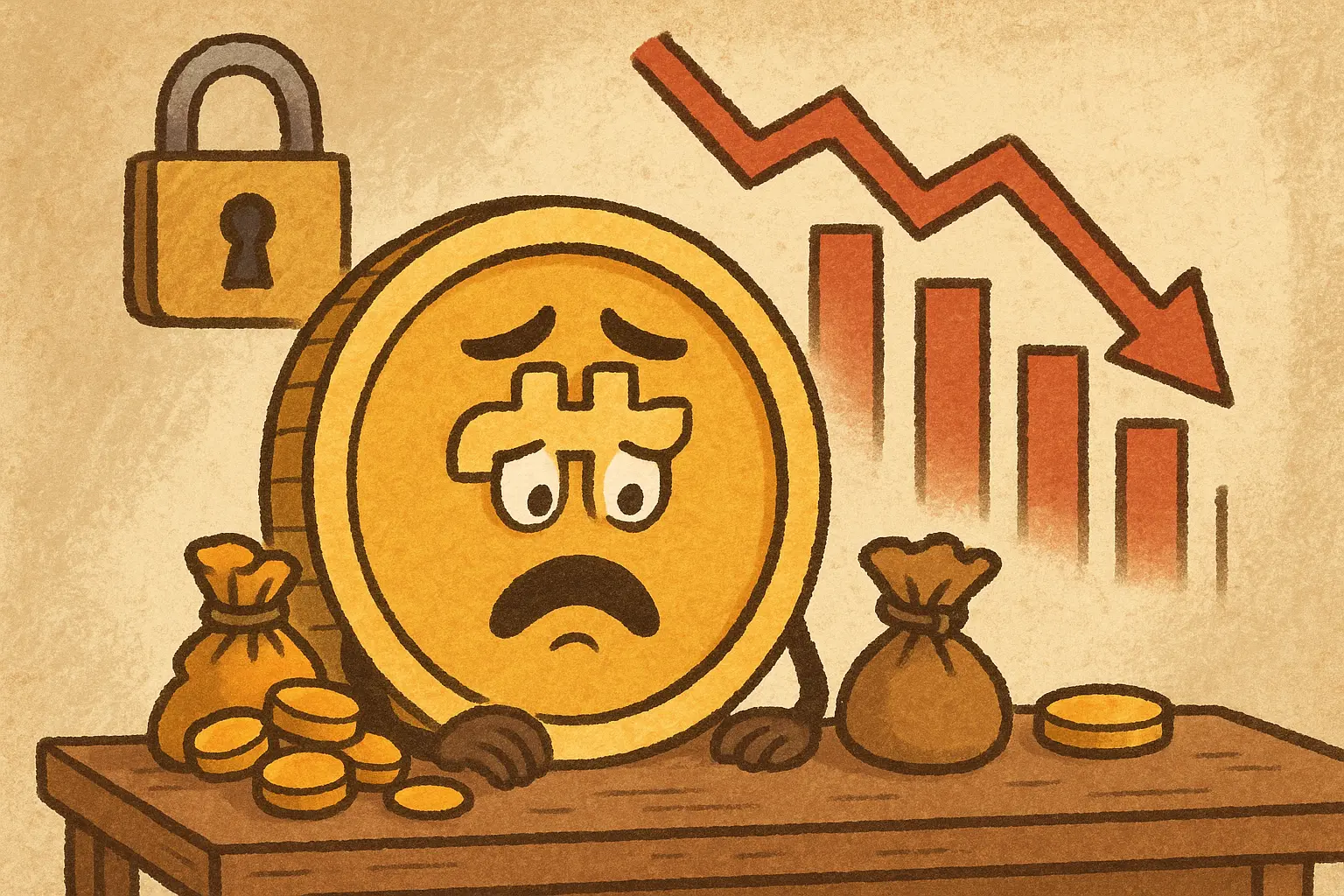
The PiCoin price has been plummeting for three consecutive days. As token unlocks continue and demand weakens, it is currently hovering near its all-time lows. On Wednesday, it dropped to $0.1330, down 96% from its all-time high, with billions of dollars in value evaporated. PiScan data shows that the network will unlock 205 million tokens worth over $27 million remaining this month, with most of these unlocking in the next two days, totaling over 37 million tokens.
205 Million Unlock and 37 Million Focused Release in the Next Two Days
PiCoin will unlock 205 million tokens worth over $27 million during the remaining days of this month. Most of these tokens will be unlocked in the next two days, during which the network will release over 37 million tokens. This “concentrated release” pattern could trigger sharp short-term sell-offs. If 37 million tokens flood the market within 48 hours, and the daily trading volume is only $11 million, it means the value of these unlocked tokens is about 3-4 times the daily trading volume (based on current prices).
This extreme imbalance between supply and trading volume almost certainly will cause prices to crash. Even if only 30% of the unlocked tokens are sold immediately (about 11 million), it would be equivalent to normal daily trading volume, enough to push the price down by 10-20%. If the sell-off ratio is higher, prices could drop 30-50 in a single day, testing or even breaking the psychological $0.10 level.
PiCoin will additionally unlock 1.3 billion tokens over the next 12 months, significantly increasing circulating supply. This 1.3 billion is about 46% of the current circulating supply of approximately 2.8 billion. Such a supply growth rate is almost impossible among mainstream crypto assets. In most cases, token unlocks lead to price declines, especially when demand is weak. PiCoin’s current situation is the worst combination: a flood of supply + demand dead silence.
Three Key Timing Points for PiCoin Supply Pressure
Next 2 days: Unlock 37 million tokens, 3-4 times daily volume
Remaining February: Total unlock of 205 million, the largest single-month unlock ever
Next 12 months: Unlock 1.3 billion tokens, a 46% increase in supply

(Source: Pi Core Team)
When developers initiate KYC verifier reward distribution in March, the token supply will increase. Most verifiers are likely to sell their rewards into the market. KYC verifiers are community members who assist in verifying other users’ identities, earning Pi tokens as rewards. If these rewards are concentrated in March, it will create a new wave of selling pressure.
Demand Collapse with Daily Volume of $11 Million
Meanwhile, more data shows demand for PiCoin continues to decline. CoinMarketCap compiled data indicates that trading volume over the past 24 hours has fallen below $11 million. This figure is extremely abnormal in the crypto market. For a project with a market cap still in the hundreds of millions (Pi’s circulating market cap is about $3.7 billion at $0.133), daily volume should typically be 5-10% of market cap, i.e., $185-370 million. Pi’s $11 million volume is only about 0.3% of its market cap, indicating extremely low liquidity and trading interest.
This disconnect between trading volume and market cap puts PiCoin in a “price without market” dilemma. Theoretically, Pi’s market cap is in the tens of billions, but in reality, selling large amounts (e.g., $1 million) could take days or weeks to fully execute and would severely impact the price. This liquidity crunch is the fundamental reason why PiCoin is ignored by mainstream exchanges and avoided by institutional investors.
This ongoing decline coincides with broader crypto market crashes, affecting Bitcoin and other altcoins. Data shows that total market cap of all tokens has fallen over 2.30% in the past 24 hours to $2.2 trillion. After the US released strong employment data, the economic downturn trend persists. The US Bureau of Labor Statistics reported 130,000 new jobs in January, well above the expected 70,000. This strong employment report suggests the Federal Reserve may not cut interest rates soon, which is unfavorable for risk assets.
A new round of listings on centralized exchanges (CEXs) could serve as a potential catalyst to boost prices. The company has included this in its listing roadmap under the “chain store” category. But this is only a “possibility”; no official timeline has been provided. Even if it does list, it may not fundamentally change PiCoin’s bleak outlook. Exchange listings often only bring short-term speculative gains, and if the project lacks real value, prices tend to continue falling after listing.
Breaking the $0.1537 Double Bottom to Test $0.10
(Source: Trading View)
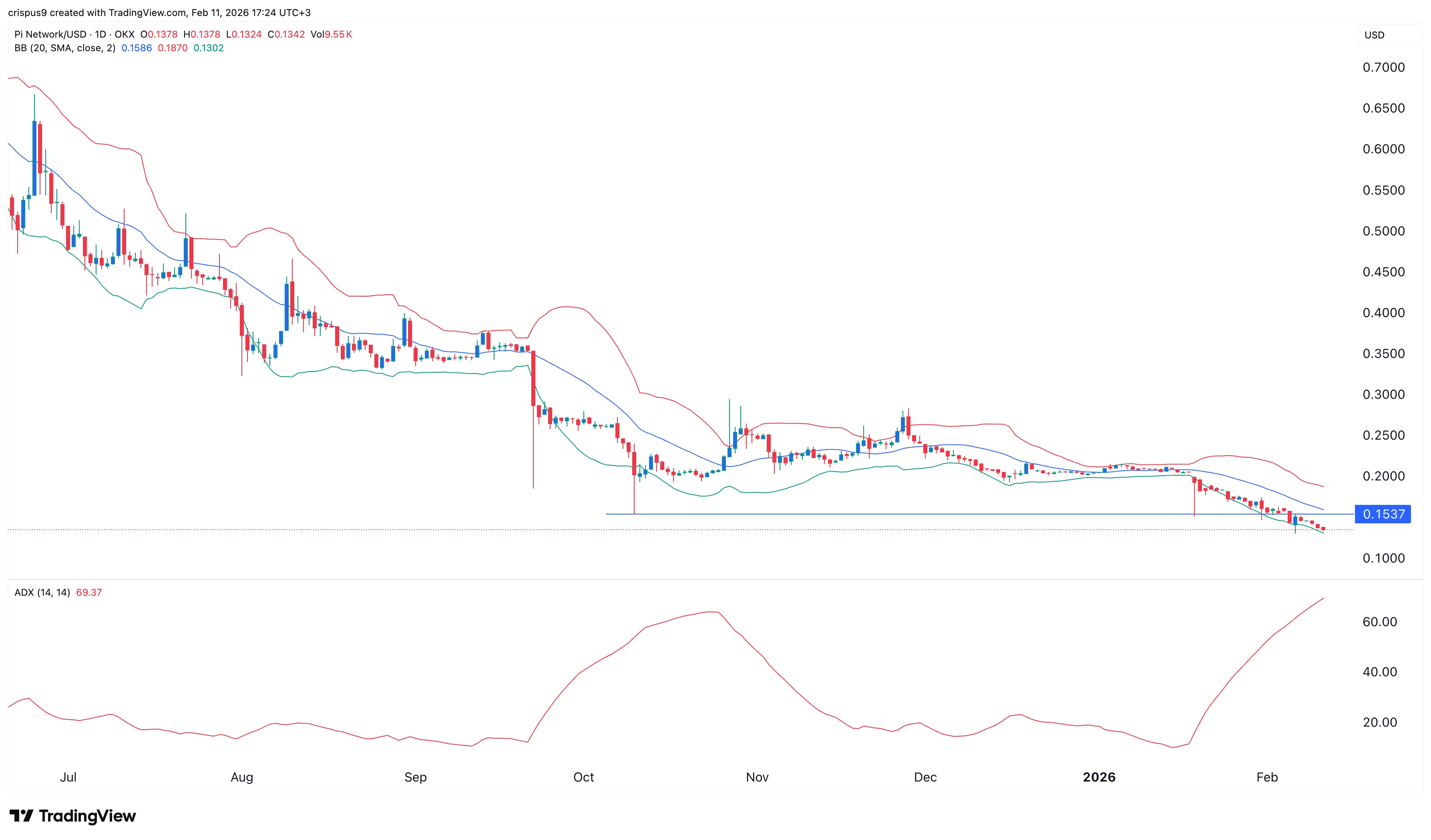
The daily chart shows that PiCoin’s price has fallen sharply since the main line was established in February. It has broken below the key support level of $0.1537 and formed a double bottom pattern at that level. The double bottom is one of the most common bullish reversal patterns in technical analysis, but PiCoin’s double bottom has been broken, indicating a “false double bottom” or “failed double bottom,” which usually signals deeper declines.
The currency pair has entered the lower Bollinger Band, indicating a bearish dominance. Bollinger Bands are volatility indicators; when prices touch the lower band, it often signals oversold conditions and potential rebounds. However, PiCoin’s situation is that the price continues sliding along the lower band, showing extremely strong and persistent selling pressure with no room for a rebound.
Additionally, the Average Directional Index (ADX, possibly referring to ADX) has surged to 70, indicating the downward trend is accelerating. ADX measures trend strength; higher values mean a stronger trend. A reading of 70 is an extreme level, showing the current decline is strong and speeding up, not a mild correction. Under this technical setup, any bottom-fishing is highly risky.
Therefore, bears may target the next key support at $0.100, with the price potentially continuing downward. A drop from the current $0.133 to $0.100 represents about a 25% decline. However, if the price breaks above the key resistance at $0.1537, the above analysis would be invalid. But given the current supply pressure and demand collapse, breaking above $0.1537 is highly unlikely.
For PiCoin holders, the current situation is extremely bleak. Technicals are fully bearish, supply pressure is at an all-time high, demand has hit rock bottom, and the overall market environment is unfavorable—all factors pointing toward further declines. The only hope lies in a new CEX listing or some unexpected positive catalyst, but such possibilities are very low and should not be relied upon for investment decisions.
Related Articles
Crypto Market Records 5th Consecutive Red Candle Amid Geopolitical Tensions
Wintermute: Despite a brief rebound on Monday, the market remains fragile. Caution is advised.
The community is buzzing about "Iranian war flames crippling Bitcoin hash rate," but analysts dismiss it: accounting for less than 1%, it's hardly noticeable.
Bitcoin Remains Resilient as Iran-US Conflict Fuels Risk-Off Sentiment
JPMorgan Highlights Potential Digital Asset Rally Under Clarity Act
Bitcoin Investors Face Loss, Market Shows Signs of Stabilization