


Bitcoin withdrawals surge amid Iran's economic turmoil and unrest
As protests, inflation, and currency collapse drive Iranian citizens to use cryptocurrencies as financial security, Iran’s Bitcoin withdrawal volume has surged.
As nationwide protests expand amid economic instability and financial uncertainty, Iran’s Bitcoin withdrawal volume has increased dramatically. Consequently, more people are turning to Bitcoin as a safe haven for value to cope with the currency collapse. According to Chainalysis data, as confidence in traditional banking systems wanes, cryptocurrency usage is rising nationwide.
Protests and Inflation Drive Cryptocurrency Activity
Initially, protests began around December 28, due to worsening economic conditions in multiple regions of Iran. Specifically, the Iranian rial hit a new low against the US dollar. As the protests grew in scale, authorities shut down the internet and carried out mass arrests nationwide.
Meanwhile, 40% to 50% inflation significantly reduced the purchasing power of urban and rural residents. As a result, citizens started seeking alternatives outside government-controlled financial systems. Chainalysis reports that the Iranian crypto ecosystem reached a value of $7.78 billion in 2025.
Related:* Crypto News: Iran’s Weapons Export Agency Proposes Using Cryptocurrency for Missile and Drone Sales | Real-Time Bitcoin News***
Additionally, during periods of political turmoil and economic pressure, daily cryptocurrency transfers increased markedly. Data shows that as protests intensified, transaction volumes also rose. Therefore, blockchain activity reflects real-time responses to domestic instability and uncertainty.
Notably, the report links the surge in crypto activity to major political and security events within Iran. For example, the Kerman explosion in January 2024, which resulted in about 100 casualties to honor victims of the oil and gas industry. Subsequently, during that tense national period, Iran’s cryptocurrency transfers also increased.
Similarly, a missile attack on Israel in October 2024 triggered another peak in crypto activity. After assassinations in Tehran and Beirut, this trend intensified again. Blockchain data shows immediate transaction responses.
Later, the conflict developments in June 2025 caused further fluctuations in Iran’s digital asset network. The US and Israel jointly targeted nuclear and missile facilities. Meanwhile, operations at Nobitex exchange and Bank Sepah were interrupted due to cyberattacks.
Bitcoin Withdrawals Reflect a Shift Toward Self-Custody of Finance
Importantly, in the current mass protest movement, withdrawal behaviors have changed significantly. The report compares activities before and after December 28, 2025. Amidst the unrest, transfers to individual Bitcoin wallets surged.
Most notably, withdrawals from Iranian exchanges to personal wallets accelerated. These wallets lack clear institutional attribution. Therefore, data suggests a growing preference among citizens for self-custody solutions.
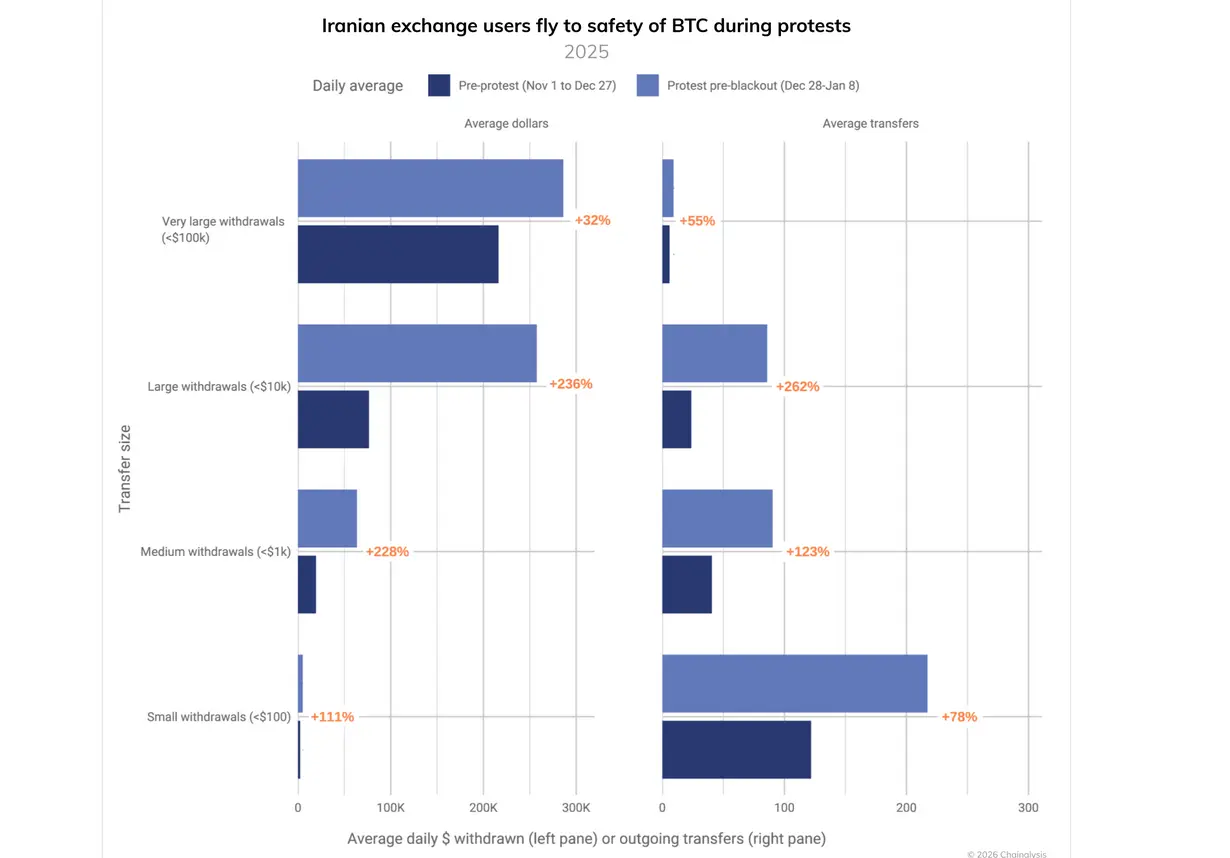
Source: Chainalysis
At the same time, the involvement of Iran’s Islamic Revolutionary Guard Corps (IRGC) in cryptocurrency has steadily increased. In Q4 2025, IRGC-related addresses received over 50% of Iran’s crypto value. In 2024, these addresses received over $2 billion on-chain.
By 2025, this figure has far exceeded $3 billion. However, analysts believe the actual total is still higher. Many associated wallets and intermediaries have not been publicly disclosed.
Nevertheless, ordinary citizens are increasingly using Bitcoin as a defense amid economic pressures. Bitcoin provides liquidity, inherent value, and portability during restrictions. Unlike banks, access can be maintained even during shutdowns or capital controls.
Finally, Chainalysis reports that similar trends are observed in other crisis regions worldwide. War, sanctions, and repression are often associated with increased cryptocurrency use. Therefore, Iran’s situation reflects broader global financial behavior trends.
As unrest continues, Bitcoin is likely to become an essential financial lifeline for many Iranians. Blockchain analysis continues to provide real-time insights into geopolitical and economic pressures.
Related Articles
Data: If BTC breaks through $69,504, the total liquidation strength of mainstream CEX short positions will reach $1.251 billion.
Strait of Hormuz Tensions Push Up Oil Prices, Bitcoin Faces Liquidity Tests from All Sides
Bitcoin's decline has yet to reach the pain point; March may present a strategic accumulation opportunity
BitMart Market Report: Altcoin Activity Shows Clear Segmentation, Mainstream Assets Still Dominate Overall Volatility
Bitplanet increases its holdings by 35 Bitcoins, reaching a total of 300 Bitcoins.