


The United Nations is using USDC to distribute funds! Stablecoins are transforming from speculative tools into financial infrastructure.

Circle report reveals that the United Nations has been distributing USDC to refugees in Ukraine and Latin America since 2020, promoting the DHoTS platform for cash aid in conflict zones. In 2025, stablecoin issuance increased by 59%, trading volume surged by 230%, with traditional financial institutions becoming the main growth drivers. Global regulation is in sync: US legislation, Europe’s MiCA, and Asian sandboxes all consistently incorporate stablecoins into a controllable framework.
United Nations USDC Distribution Sparks Humanitarian Revolution
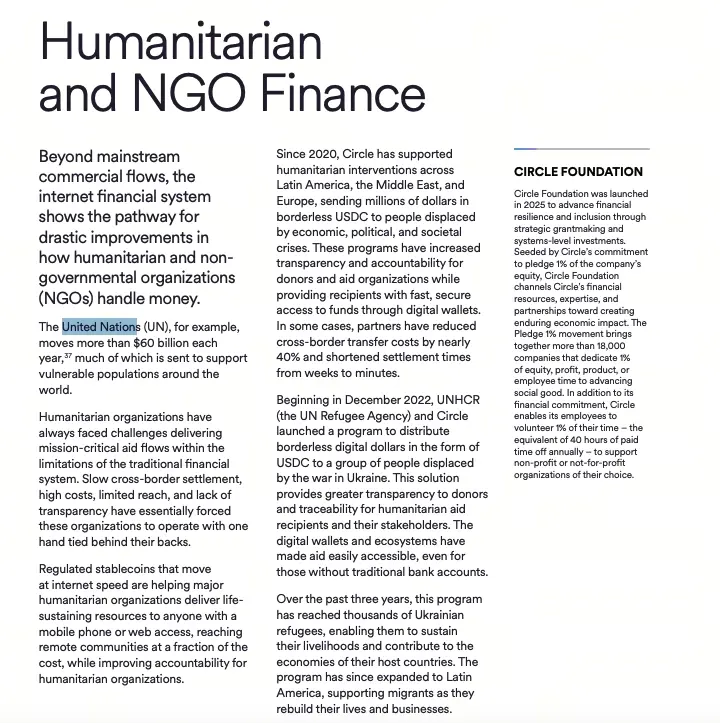
(Source: Circle)
Since 2020, Circle has assisted the United Nations in distributing USDC to refugees worldwide affected by various crises, including support for refugees in Ukraine and Latin America. This is not a pilot or proof of concept but a multi-year operational project. The UN’s choice of stablecoins over traditional bank transfers is driven by profound practical considerations.
Historically, UN disbursements have been challenging, with large sums often wasted. Under traditional aid models, funds are transferred from UN headquarters through multiple intermediaries (local banks, NGOs, contractors), and by the time they reach refugees, a significant portion has been siphoned off. Statistics show that 30% to 40% of aid funds are consumed by intermediary fees. Additionally, banks in conflict or disaster zones are often paralyzed or untrustworthy; even if refugees receive transfer notifications, they may be unable to withdraw funds.
Stablecoins fundamentally change this process. The UN can send USDC directly to refugees’ digital wallets, completing the entire transaction within minutes, with fees typically under $1. After receiving USDC, refugees can spend at local merchants accepting crypto or convert P2P into local fiat currency. This peer-to-peer distribution eliminates intermediaries, ensuring funds reach those in need.
Currently, the UN is promoting a DHoTS (Digital Humanitarian Transfers) platform that integrates digital wallets, stablecoins, identity, and compliance tools for cash aid in conflict, disaster, or underdeveloped financial infrastructure regions. This platform is used not only for emergency relief but also for long-term development aid, such as providing microloans, distributing subsidies to farmers, or funding healthcare providers.
Three Major Advantages of UN Stablecoin Aid
Reduced Intermediary Costs: from 30%-40% down to nearly zero, direct to beneficiaries
Instant Settlement: cross-border transfers completed in minutes, critical in emergencies
Transparent & Traceable: blockchain records every transaction, preventing corruption and misappropriation
The UN’s adoption is highly symbolic. As the world’s most authoritative international organization, its choice affirms the reliability and practicality of stablecoins. When the UN begins using stablecoins for disbursements, the stigma of “stablecoins are scams” will be thoroughly dispelled. This paves the way for stablecoins to mainstream into the financial system.
From Speculative Tool to Financial Infrastructure: A Paradigm Shift
Circle quickly disassociates itself from the crypto speculation scene, stating that stablecoins and blockchain are no longer “speculative tools” but “financial infrastructure.” Although crypto assets in 2025 haven’t seen much growth, stablecoin issuance has still risen by 59%, with trading volume exploding by 230%! Why is this happening? Because traditional financial institutions are becoming the main source of incremental capital.
Almost all major institutions are evaluating stablecoin strategies, and their focus is no longer whether to adopt stablecoins but how to do so. Will they “develop in-house,” “buy infrastructure,” or “partner with established issuers”? This shift from “whether to participate” to “how to participate” marks that stablecoins have crossed the threshold into mainstream adoption.
Circle believes stablecoins are fundamentally a network effect business, following Metcalfe’s Law: network value is proportional to the square of participants. As user numbers grow, liquidity in exchanges, payments, DeFi, and cross-border settlements deepens; higher liquidity reduces transfer costs, improves transaction speed and user experience; and increased utility attracts more merchants, institutions, and individuals.
Stablecoins are transforming the “nature” of finance, becoming a “hybrid layer” between TradFi and on-chain worlds: funds no longer only exist in bank accounts but become programmable, automatically flowing on-chain; settlement shifts from daily or business-day basis to 24/7 real-time; finance is no longer just ledgers and intermediaries but begins to operate and scale like software. This qualitative change makes stablecoins not only payment tools but also an upgrade to the financial operating system.
By 2026, not only stablecoins but also various asset tokenizations will enter practical stages. Whether government bonds, money market funds, or tokenized deposits, these products are likely to see a coordinated explosion in a clear regulatory environment in 2026. When traditional assets like sovereign bonds, money market funds, corporate bonds, and stocks can be traded 24/7 as tokens, market liquidity and efficiency will leap forward.
Institutionalization of Global Regulatory Resonance
In recent years, global financial regulation has exhibited a rare “resonance”: the US has advanced legislation on stablecoins, banking custody, and the redefinition of securities and commodities simultaneously; Europe’s MiCA has unified licensing and issuance rules; Hong Kong and Singapore in Asia emphasize compliance sandboxes and institutional participation. Regulatory priorities are highly aligned: ensuring reserves are real, redemption is clear, AML measures are in place, and consumer protection is upheld.
While countries follow different paths and paces, their core direction is highly consistent: integrating crypto assets, stablecoins, and on-chain finance into a controllable financial system. Stablecoins and on-chain finance are moving from “innovation” to “regulation.” Small players will gradually be weeded out by compliance thresholds, ushering in an era where giants like Circle, Tether, and PayPal dominate.
2026 will be a critical year for stablecoin regulation implementation. The US’s Gensler Act is expected to take effect, MiCA will be fully enforced in the EU, and Asian countries’ pilot projects will scale up. Once major economies establish stablecoin regulatory frameworks, cross-border stablecoin payments will truly become frictionless. At that point, stablecoin market cap could explode from the current $200 billion to $2 trillion or more.
The UN’s use of stablecoins for disbursements is still largely underappreciated. It’s not just a technological innovation but a reallocation of financial power. When funds can bypass banks and go directly to individuals, the value of traditional financial intermediaries diminishes. When institutions like the UN, representing the global order, embrace stablecoins, it signals the beginning of a new financial order.
Related Articles
ETH short-term increase of 1.52%: USDC large-scale burning and macro hedging sentiment resonate to boost buying interest
USDC Treasury burns approximately 61.5 million USDC on the Ethereum chain
Gate Research Institute: Will stablecoins be able to meet the marginal demand for US dollars as the US dollar weakens in 2026?
A certain wallet spent 1 million USDC in the past 5 hours to buy PAXG and XAUT.
A certain trader placed three bets on Arsenal to win within three days, with a total profit of 3.67 million USD