


Weakening US dollar and renewed expectations of Federal Reserve rate cuts, analysts: "Depreciation trades" in 2026 may drive a Bitcoin explosion
Against the backdrop of a weakening US dollar and rising expectations of Fed rate cuts, the market is beginning to reassess the medium- to long-term prospects of Bitcoin and cryptocurrencies. Analysts generally believe that 2026 could become a pivotal turning point for the digital asset market.
(Background briefing: Investment bank Cantor Fitzgerald: Bitcoin entering a “crypto winter” may continue to face pressure, but institutional interest is lighting the way for industry transformation)
(Additional context: Bloomberg strategist Mike McGlone warns: Bitcoin may first drop to $50,000 next year before crashing to $10,000)
Table of Contents
- Bitcoin enters consolidation, unable to keep pace with precious metals rally
- US dollar experiences largest annual decline in years, rate cuts become market consensus
- Divergence within Fed officials, interest rate policy remains uncertain
- Rising political uncertainty, US dollar dominance under scrutiny
- Analysts: Loose monetary environment benefits crypto assets
After experiencing a turbulent and underperforming year, Bitcoin and the overall cryptocurrency market are standing at a new crossroads. According to Forbes, as market expectations for future Fed rate cuts heat up and signs of a weakening dollar emerge, many analysts believe these macro factors could spark a new wave of upward momentum for Bitcoin in 2026.
Bitcoin enters consolidation, unable to keep pace with precious metals rally
Recently, gold and silver prices have continued to rise, but Bitcoin’s performance has been relatively weak, with prices lingering around $90,000 for a long time without a clear breakout. The market generally interprets this as investors still observing the Fed’s policy direction and whether global liquidity conditions are about to undergo a substantial change.
US dollar experiences largest annual decline in years, rate cuts become market consensus
Analysis indicates that the dollar has fallen nearly 10% against a basket of major currencies this year, marking the most dramatic annual decline since 2017. The market believes this trend is closely related to expectations of possible future rate cuts by the Fed.
In this regard, ING Chief International Economist James Knightley states that compared to other major central banks, the Fed remains relatively dovish in its policy stance, still operating in a “loose monetary mode.” Under this context, the potential for further dollar weakening has become a key focus for investors.
Divergence within Fed officials, interest rate policy remains uncertain
The latest Fed meeting minutes show that even though officials have decided to cut rates, there are clear disagreements within the Fed regarding whether to continue adjusting interest rates in the future. Some policymakers believe that after this (December) adjustment, rates may need to remain unchanged for a period to observe economic data changes.
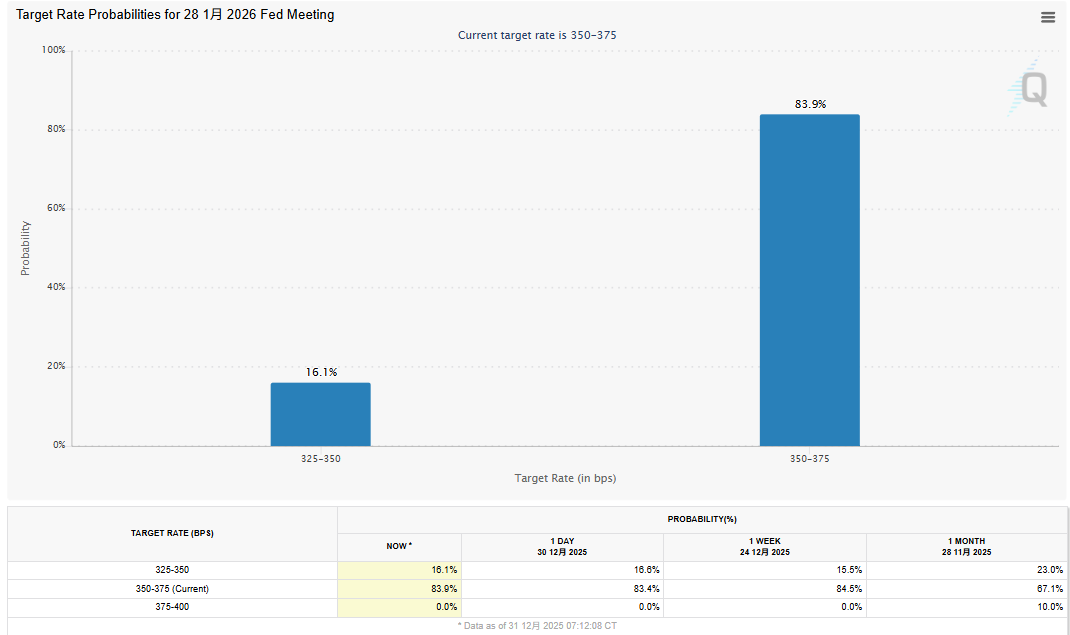
Meanwhile, according to CME FedWatch tool, investors currently assign over an 80% probability that the Fed will hold steady at the January meeting, but other prediction platforms suggest the possibility of another rate cut before mid-2026 remains high.
Rising political uncertainty, US dollar dominance under scrutiny
In addition to monetary policy itself, US political factors have also become a market variable. Recently, US President Trump has again pressured the Fed, sparking discussions about the independence of the central bank and its policy direction.
Former US Treasury official and think tank OMFIF US Chairman Mark Sobel pointed out that the influence of political factors on the dollar’s international status may be a long-term and slow process, but it is enough to exert pressure on market psychology.
Analysts: Loose monetary environment benefits crypto assets
Several crypto market participants believe that once the Fed officially enters a rate-cutting cycle, lower funding costs will benefit risk assets, with Bitcoin often seen as a primary beneficiary.
Timot Lamarre, Head of Market Research at crypto custody firm Unchained, stated that a shift to dovish monetary policy means more ample dollar liquidity in the market, and Bitcoin typically reacts first in such an environment.
Owen Lau, Managing Director of Clear Street, also pointed out that rate cuts could become a significant catalyst for the crypto market in 2026, potentially attracting retail inflows and increasing institutional participation in crypto assets.

Related Articles
3 Promising Crypto Picks That Could Skyrocket in 2026 — SOL, MNT, and LINK
Here’s How High Hedera (HBAR) Price Could Go This Week?
'Ponzi Scheme': Saylor's Strategy's New Dividend Policy Raises Criticism - U.Today
Bitcoin Drops Below $64K Amid Middle East Tensions
Polygon (POL) faces life-or-death threshold $0.90: Can the trend be reversed?