


Captain Bitcoin Revealed: Álvaro Pau Breaks the Silence After Being Doxxed and Attacks Sánchez
Capitán Bitcoin, an X profile with over 500,000 followers, has revealed his identity after being doxxed: Álvaro Pau, a nurse specialized in dialysis and kidney transplant, published his first YouTube video denouncing the repressive system of the Sánchez Government. The Capitán Bitcoin Twitter case has sparked a national debate on freedom of expression.
Who Is Capitán Bitcoin: The Identity Behind the Anonymity
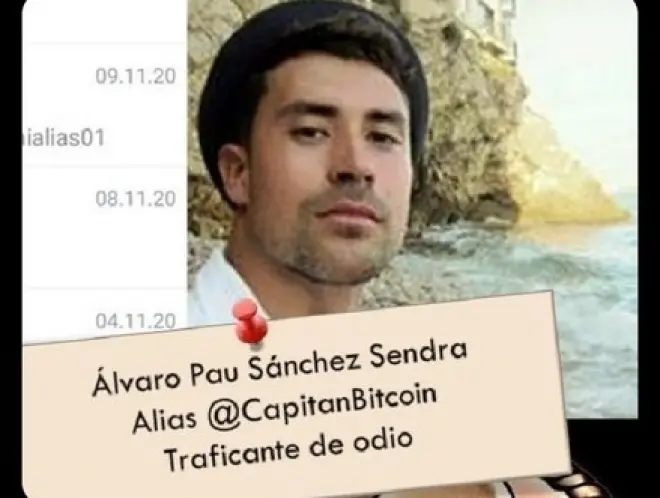
Capitán Bitcoin is Álvaro Pau, a 42-year-old healthcare worker who worked in the Spanish public sector before his identity was exposed. During an almost 12-minute speech in his first YouTube video, Pau thanked both the support he received and the attacks he suffered, including personal harassment and leaks of private data. “Thanks to those who doxxed me, you gave me a strong reason to keep going,” he stated calmly.
The Capitán Bitcoin Twitter profile began as an anonymous account dedicated to criticizing government policies, particularly on issues of immigration, crime, and pandemic management. His direct, unfiltered style earned him a massive following, but also political enemies who saw his anonymity as an unfair advantage to spread opinions without personal consequences.
Pau chose anonymity to separate the message from the messenger and to protect his professional and personal life in an increasingly hostile environment for critical voices. He explained that he has been subject to disciplinary proceedings for expressing opinions on immigration and crime, which shows that “freedom of expression is no longer for everyone.” In his account, he denounces that nowadays one can only speak freely if repeating the dogmas of the dominant “herd.”
Why Capitán Bitcoin Hid His Identity
Capitán Bitcoin’s anonymity was not a whim, but a professional and personal necessity. As a public healthcare worker, Pau faced real risks:
Reasons for Anonymity
Workplace reprisals: Disciplinary proceedings opened for opinions expressed on social media
Institutional pressure: Veiled threats from superiors about “inappropriate behavior” on digital platforms
Social cancellation: Risk of stigmatization in a workplace dominated by progressive ideology
Family safety: Protection of wife and children from possible harassment by radical activists
Expressive freedom: Ability to comment on politically sensitive issues without self-censorship
Pau reported that public employees who express opinions contrary to the Government face disproportionate professional consequences. He cited cases of colleagues sanctioned for posts on social media, creating an overall climate of self-censorship. The Capitán Bitcoin Twitter case perfectly illustrates this tension between freedom of expression and institutional pressure.
The Doxxing: How Left-Wing Groups Revealed His Identity
The doxxing of Capitán Bitcoin was carried out by an X account linked to far-left groups operating in apparent coordination. The revelation was not accidental: it included personal photographs, workplace, home address, and family information. Pau described the experience as “systematic intimidation designed to silence dissenting voices.”
Doxxing tactics have become a political weapon in Spain. Anonymous profiles critical of the Sánchez Government have been systematically exposed, while anonymous accounts aligned with the PSOE operate without interference. This asymmetry in the application of standards reveals, according to critics, a deliberate strategy of narrative control.
Other anonymous profiles came out in defense of Capitán Bitcoin. @Capitana_espana wrote: “Please report all accounts that are posting that image for violating privacy. Do not share the image. Respect his anonymity. This is not about ideologies, it’s about principles. Thank you.”
The Response from Óscar Puente: Controversy and Double Standard
The Minister of Transport, Óscar Puente, turned the Capitán Bitcoin case into a government matter with a response that many considered revealing. Puente responded to defenders of anonymity: “These scumbags who cheered on those who published photos of our underage daughters are now very upset because the real identity they were hiding to insult and defame has been unveiled. They are so brave.”
Puente’s response generated outrage for several reasons. First, he equated political criticism with harassment of minors without documentary evidence. Second, he openly celebrated the doxxing of a citizen for expressing political opinions. Third, he used derogatory language (“scumbags”) from a position of governmental power against a private citizen.
Critics pointed out the hypocrisy: the same Government that defends privacy and data protection celebrates when personal information of political opponents is exposed. The Capitán Bitcoin Twitter case became a symbol of what many perceive as a systematic double standard.
Pau’s Accusations Against the System
In his YouTube debut video, Pau launched strong accusations against institutions, subsidized media, and the use of hate speech as a political weapon. He rejected labels such as “fascist,” “sexist,” or “denier” that are systematically used to cancel alternative voices, and warned about a “moderate-toned dictatorship” led by Sánchez and legitimized from Brussels.
Pau specifically criticized
· The selective use of “hate speech” laws to silence criticism of the Government
· Public funding of media that act as official propaganda apparatus
· Coordination between activist groups and authorities to identify and punish dissenters
· Complicity of digital platforms in ideological censorship under the pretext of “combating disinformation”
· The creation of a social climate where speaking freely has serious professional consequences
“Nowadays, you can only speak freely if you repeat the dogmas of the dominant herd,” Pau said, describing a scenario where self-censorship has become normalized among public employees and professionals dependent on state institutions.
The Debate on Anonymity and Disinformation
The Capitán Bitcoin case reignited debates on the balance between freedom of expression and responsibility on social networks. Critics argue that anonymity enables irresponsible dissemination of hoaxes and disinformation without consequences. Defenders maintain that in increasingly authoritarian regimes, anonymity is an essential safeguard for expressive freedom.
The reality is that many X users, both left- and right-wing, who shield themselves in anonymity to share controversial opinions, are being targeted by profiles threatening to make their identities public. This practice intensified after the surge of hoax dissemination during crises like the DANA.
However, the Capitán Bitcoin Twitter case raises uncomfortable questions: Who defines what constitutes “disinformation”? Why is doxxing selectively applied to government critics but not to official propagandists? Is it legitimate for the State to celebrate exposing citizens for political opinions?
Conclusion: The Future of Digital Freedom of Expression
Álvaro Pau has announced that he will continue his activity as Capitán Bitcoin, now without masks. Far from intimidating him, the doxxing gave him strength to amplify his message on new platforms. His YouTube debut marks a diversification strategy in the face of censorship threats on X.
The case symbolizes growing tensions in Spain between expressive freedom and state control of public discourse. With Pau now exposed, the question remains: how many other professionals self-censor out of fear of reprisals? The silence generated by fear can be more dangerous than any controversial opinion.
Related Articles
Hamaney's assassination attempt shocks global markets, Bitcoin drops below $67,000, oil prices and gold surge simultaneously