
The Tisza Party (Tisza), led by Hungarian opposition leader Péter Magyar, won a decisive victory in the parliamentary election, ending Viktor Orbán’s 16-year rule. The strict “verification” system and criminal penalty mechanisms implemented by the Orbán government are widely viewed as going beyond the EU’s coordinated framework under the Markets in Crypto-Assets Regulation (MiCA), and are expected to be repealed after the new pro-EU government takes office.
Election Results and Political Shift: The End of a 16-Year Reign
Tisza’s victory is widely seen as one of the most historically significant political turning points in Hungary in recent years. Early predictions showed that Tisza would secure an absolute majority of seats in parliament, and Orbán is reported to have conceded defeat. Political analyst Ian Bremmer characterized the result as a “historic victory for the people of Hungary.”
EU Commission President Ursula von der Leyen also publicly said she expects to rebuild a relationship of coordination and alignment with EU institutions, stating, “Tonight, the heart of Europe is beating even stronger in Hungary.” This remark directly points to the years-long tensions between Hungary and Brussels over the rule of law and economic policy, which are expected to be fully normalized under the leadership of the new government.
Hungary’s Crackdown on Crypto: Controversial Rules Beyond the MiCA Framework
During Orbán’s time in power, Hungary’s financial regulator implemented a strict “verification” system requiring all cryptocurrency exchanges to obtain special certification, with criminal penalties for those who fail to comply. Legal observers and industry participants believe these measures go far beyond the scope of members’ obligations set by MiCA. The European Commission has brought infringement proceedings against Hungary over the additional restrictions mentioned above, becoming a rare precedent of the EU taking legal action due to a member state’s overreaching crypto regulation.
Key Controversies in Hungary’s Crypto Regulation During the Orbán Era
“Verification” Thresholds: Exchanges must obtain special certification to operate legally; the certification process is cumbersome and carries high administrative costs
Criminal Penalty Mechanism: Acts that fail to meet the verification requirements may face criminal prosecution, far exceeding the framework of administrative sanctions under MiCA
EU Infringement Proceedings: The European Commission has determined that the relevant provisions are incompatible with MiCA and has formally initiated legal procedures
Revolut Pauses Services: Global fintech platform Revolut paused its Hungarian crypto services during its crackdown action in 2025
Industry Impact: Revolut May Return, and the MiCA Unification Process Accelerates
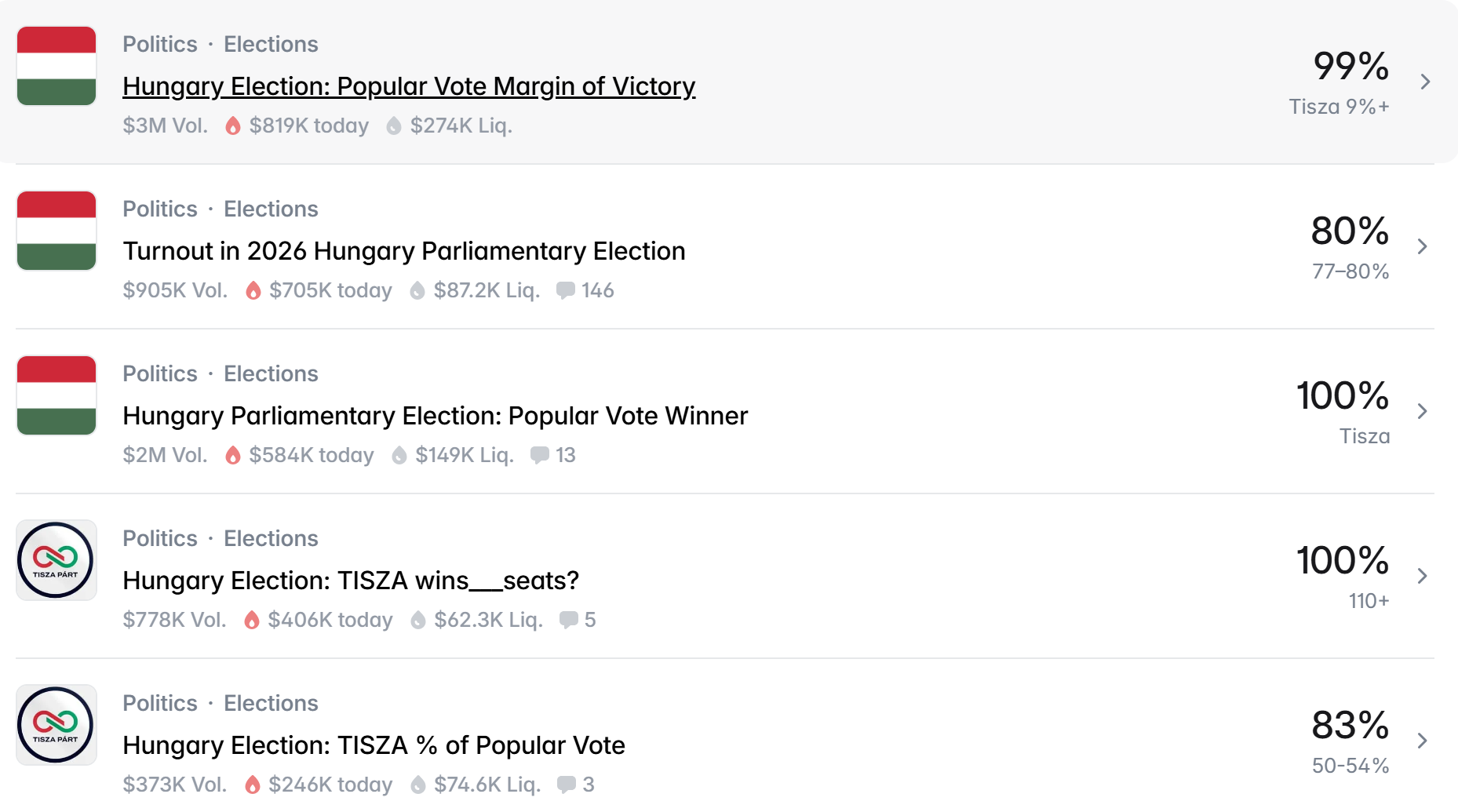 (Source: Polymarket)
The new pro-EU stance of the government brings three layers of predictable impacts. First, the “verification” regime and related criminal penalties are expected to be abolished, which would resolve the infringement proceedings with the European Commission and restore regulatory clarity for crypto businesses operating in Hungary. Second, platforms such as Revolut that paused Hungarian services due to regulatory barriers are expected to re-enter the market once institutional obstacles are removed. Third, unilateral expansionary regulatory policies beyond the MiCA framework—one of the EU’s most representative cases—are set to collapse with the change of government, strengthening the overall progress of the EU in promoting a unified digital assets market and reducing pressure on other member states to set up their own local rules.
Worth mentioning is that traders on the prediction market Polymarket previously bet millions of dollars that Orbán would not win; as the result was revealed, those bets were validated as forward-looking market judgments.
Frequently Asked Questions
How Will Viktor Orbán’s Departure Affect Crypto Regulation in Hungary?
The “verification” system and criminal penalty mechanisms led by the Orbán government are widely considered to go beyond the MiCA coordination framework, and the European Commission has brought infringement proceedings. The new pro-EU government is expected to repeal these overreaching measures, restore compatibility with MiCA, and resolve the existing legal disputes within the EU.
What Is MiCA, and Why Do Orbán’s Policies Conflict With It?
MiCA (Markets in Crypto-Assets Regulation) is the EU’s unified regulatory framework for crypto-assets, designed to establish consistent rules for all member states. On top of MiCA, Hungary introduced additional local “verification” rules and criminal penalties. The European Commission believes these measures are incompatible with MiCA’s coordination principles and has formally initiated infringement proceedings.
Will Revolut Return to Hungary’s Crypto Market?
Revolut suspended local crypto services during the Hungarian crackdown in 2025. If the new government abolishes the overreaching regime as expected, platforms such as Revolut could re-enter Hungary’s market, but the specific timeline depends on how quickly the relevant regulations are amended and on the compliance assessments of the businesses.
Disclaimer: The information on this page may come from third parties and does not represent the views or opinions of Gate. The content displayed on this page is for reference only and does not constitute any financial, investment, or legal advice. Gate does not guarantee the accuracy or completeness of the information and shall not be liable for any losses arising from the use of this information. Virtual asset investments carry high risks and are subject to significant price volatility. You may lose all of your invested principal. Please fully understand the relevant risks and make prudent decisions based on your own financial situation and risk tolerance. For details, please refer to
Disclaimer.
Related Articles
Galaxy Research Chief: U.S. OFAC Sanctions List Involves 518 Bitcoin Addresses
The U.S. Treasury's OFAC sanctions list includes 518 Bitcoin addresses that have significantly engaged in crypto transactions, currently holding about 9,306 BTC valued at $707 million, highlighting the relationship between cryptocurrency and financial regulation.
GateNews1h ago
French Finance Minister: Euro-Based Stablecoins Vital to European Financial Sovereignty
French Finance Minister Roland Lescure has called on European banks to aggressively develop euro-based stablecoins and tokenized deposits to challenge the overwhelming dominance of the U.S. dollar in digital payments.
Key Takeaways:
Roland Lescure urged EU banks to launch euro stablecoins
Coinpedia2h ago
Bitcoin Swings on Hormuz Strait Reports, Triggering $762M in Liquidations
Bitcoin rose to $78,000 but dropped to $76,091 following reports of tensions in the Strait of Hormuz. Iran's actions triggered $762 million in liquidations among traders, with implications for crypto markets as Iran accepts payments in bitcoin and other currencies to navigate sanctions.
GateNews3h ago
U.S. Military Plans to Board and Seize Iranian-Linked Vessels in International Waters
U.S. military officials announced plans to board and seize Iranian-linked vessels in international waters, marking an escalation in operations targeting Iran's maritime assets beyond the Middle East.
GateNews3h ago
Iran Reports 3,468 Deaths in U.S.-Israel Conflict, Official Register Updated
Iran's Martyrs and Veterans Affairs Foundation has reported 3,468 Iranian personnel casualties in the U.S.-Israel conflict, according to Chairman Mousavi and state media.
GateNews3h ago
Ukraine's Prosecutor General Classifies Kyiv Shooting as Terrorist Attack
Ukrainian Prosecutor General Irina Kravchenko announced that a shooting in Kyiv has been classified as a terrorist attack, prompting criminal proceedings under national law. The investigation is ongoing.
GateNews3h ago


