


Why did Bitcoin drop today? Trump threatens to deploy ground troops, Iran conflict uncertainty prolongs

U.S. President Trump refused to rule out the possibility of deploying ground troops to Iran during an interview on Monday, stating that it would be considered if necessary. On the same day, his administration provided conflicting estimates on the duration of military actions. This disrupted the market’s previous expectation that “conflict has been fully priced in,” causing risk assets like Bitcoin to face renewed uncertainty. Meanwhile, several technical analysts warned that Bitcoin’s recent rebound from $63,000 could be a sign of a “final wave of selling” before a larger decline.
Trump’s Contradictory Timeline Makes Market Pricing of Conflict Risk Difficult
On Monday, Trump told the New York Post that he is not opposed to deploying “ground forces” and would use them if necessary. Defense Secretary Hagel similarly refused to rule out this option at a Pentagon press conference, saying that publicly stating “how far we will go” would be “foolish.”
What further confuses the market is that Trump provided very different timelines within just a few days, making it difficult to assess whether the conflict is about to end or escalate further. This has increased uncertainty premiums.
Multiple Contradictory Statements on Trump’s Iran Actions
Early Saturday: The operation will be “large and ongoing” until all objectives are achieved.
Later Saturday: “I can end it in two or three days.”
Sunday: “This is a four-week process.”
Monday: “Four to five weeks,” but with an acknowledgment that it could be “longer.”
Same day: No exclusion of ground troops, with the White House taking a more hardline stance.
Additionally, U.S. Central Command confirmed that six American soldiers have been killed and 18 wounded, indicating that the conflict remains intense and far from over.
Bitcoin Technical Analysis: Triangle Resistance, $60,000 as the Last Line of Defense
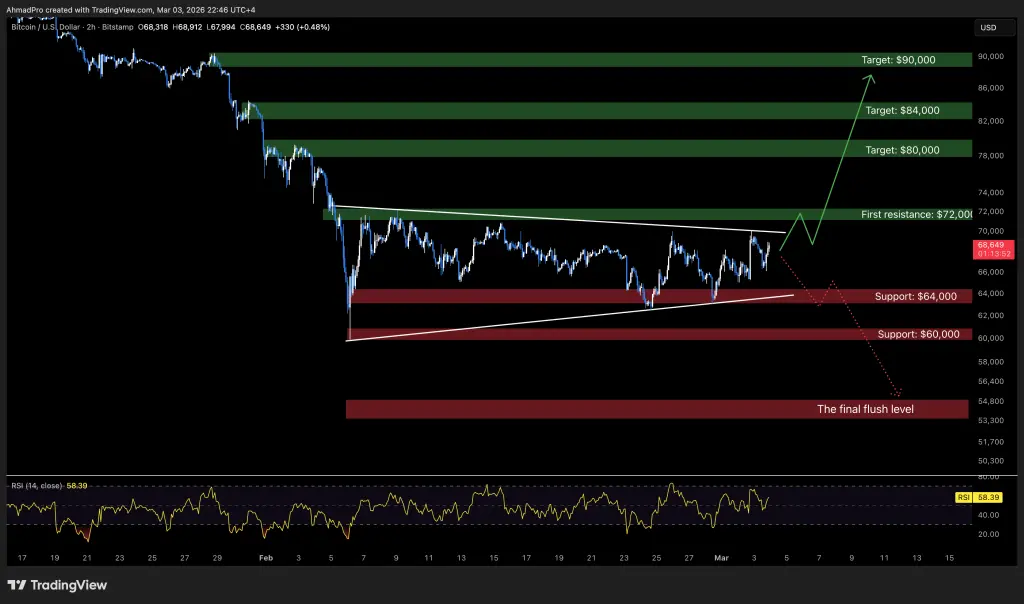
(Source: TradingView)
Amid ongoing macro uncertainties, Bitcoin’s technical signals do not provide enough support. Market analysts note that Bitcoin is currently trading within a contracting triangle pattern: resistance slopes downward from the January high, while support extends upward from the $60,000 bottom. Each rebound to the upper trendline resistance has been met with selling, indicating that sellers are actively suppressing upward movement.
If Bitcoin fails again to break through the resistance, the first downside target is $64,000. If that level is lost, the final test is the critical support at $60,000. A more bearish scenario is that a strong downward move could break below $60,000, potentially triggering the chain of liquidations warned by analysts, pushing the price further down to above $50,000—an extreme scenario aimed at clearing weak investors.
Notably, even bearish analysts view this as a potential “surrender sell-off” rather than the end of a bullish trend. If Bitcoin closes above $72,000 on the 2-hour or daily chart, it would break the descending resistance line, with subsequent targets at $80,000, $84,000, and even $90,000.
Frequently Asked Questions
Why did Bitcoin drop today?
Trump’s Monday statement that he does not rule out deploying ground forces to Iran, combined with conflicting signals from the government about the duration of the conflict (from “two or three days” to “four to five weeks or longer”), made it difficult for the market to assess conflict risk. This increased uncertainty premium, directly suppressing risk assets including Bitcoin.
What happens if $60,000 is broken?
Analysts warn that if Bitcoin drops below $60,000 with strong momentum, it could trigger chain liquidations, pushing the price below $50,000. However, most technical analysts see this as a cyclical “surrender sell-off” rather than the end of a bullish trend.
Does the current decline in Bitcoin mean the end of the bull market?
According to several analysts, the current decline is more likely a process of clearing out weak investors before a substantial bottom is formed. If Bitcoin can effectively break above $72,000, it would confirm a trend reversal to bullish, with targets of $80,000 to $90,000 still in sight.
Related Articles
Middle East conflict impacts Asian stock markets, Bitcoin holds at $67,000, Ethereum and Solana come under pressure and retreat
Gate ETF's February trading volume exceeded $16 billion, maintaining the top spot in ETF trading volume across the entire network. It now supports nearly 320 ETF trading pairs.
Japan's "Sanae Token" plummets 58%! Prime Minister Sanae Takashi denies any connection, as political meme coin regulatory risks intensify
PHA (Phala Network) increased by 34.79% in the past 24 hours
Former Trump advisor warns: Merely "supporting Bitcoin" is far from enough; the U.S. needs to actively advance a strategic Bitcoin reserve