


Brazilian Exchanges Receive New Bank Secrecy and Accounting Standards Provisions
The measures seek to fully integrate crypto exchanges into the established financial system and protect the identity information of the institution’s customers. The Central Bank states that this will promote “transparency, comparability, and predictability of information provided to the market.”
Brazil Issues Resolution Including Crypto Brokerages to Comply With Bank Secrecy Laws
Brazil is moving to integrate crypto exchanges into its financial ecosystem.
The National Monetary Council and the Central Bank of Brazil recently approved Resolution No. 5,280, which brings new compliance rules for virtual asset service providers in the country.
The resolution, which states that virtual asset service providers (VASPs) will be considered financial institutions under the Brazilian Bank Secrecy Act, seeks to establish an equivalent regulatory treatment for all exchanges operating in the local financial system and the mechanisms needed to protect it.
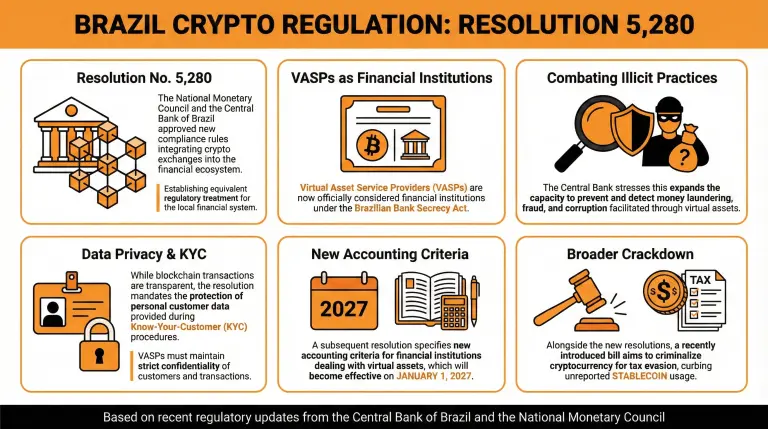
The Central Bank of Brazil stressed that this move “expands the capacity to prevent, detect, and combat illicit practices—such as money laundering, fraud, corruption, and other irregularities—that may be facilitated through the use of virtual assets.”
While blockchain transactions are transparent, given the nature of these structures, experts like Tiago Severo stressed that the identification and personal data of customers, provided when completing Know-Your-Customer (KYC) procedures, is what this resolution seeks to protect.
At the same time, it increases the responsibility of these institutions, which will have to take into account already established provisions regarding the confidentiality of their customers and their transactions.
In a subsequent resolution, the two institutions also approved a new resolution that specifies the accounting criteria that financial institutions dealing with virtual assets must follow.
The central bank states that regulatory clarity will contribute to investor confidence, assigning a clearer role to VASPs about the duties these institutions should fulfill.
The bank secrecy measure is already being applied, while the new accounting rules for financial institutions are set to become effective on January 1, 2027.
Recently, a bill criminalizing cryptocurrency for tax evasion was introduced into Congress, aiming to curb the usage of stablecoins for unreported payments and transactions.
FAQ
- What recent resolution has Brazil approved regarding crypto exchanges?
Brazil approved Resolution No. 5,280, integrating crypto exchanges into its financial ecosystem as virtual asset service providers. - How does Resolution No. 5,280 affect virtual asset service providers (VASPs)?
VASPs will now be classified as financial institutions under the Brazilian Bank Secrecy Act, requiring compliance with new regulations. - What is the goal of this regulatory change by the Central Bank of Brazil?
The aim is to enhance the detection and prevention of illicit practices, including money laundering and fraud, associated with virtual assets. - When will the new accounting rules for financial institutions dealing with virtual assets take effect?
The new accounting criteria for financial institutions will become effective on January 1, 2027.
Related Articles
U.S. 303-page Housing Bill Hidden CBDC Ban, White House Endorses
CLARITY Act deadline passed in March; stablecoin yield controversy hinders legislation
JPMorgan CEO Calls for Unified Regulatory Standards for Stablecoin Incentives
U.S. Court Rules: Uniswap is Not Responsible for Scam Tokens; Open-Source Smart Contracts Are Neutral Tools
Cracking down on 71% of illegal gambling! The UK Gambling Commission is considering using crypto payments to bring black market activities back into the compliant system
Senate Advances Housing Bill With CBDC Ban, Draws White House Backing