


XRP Today News: Ripple unlocks $1.37 billion worth of tokens, market reaction remains calm

Ripple plans to unlock a total of 1 billion XRP from the escrow account in three batches: 200 million, 300 million, and 500 million, with a combined value of over $1.37 billion at current market prices. Despite the large unlock size, XRP opened with a slight increase of 0.9%, maintaining narrow fluctuations throughout the session. As of press time, it is trading at $1.36, indicating that this release has had limited impact on spot supply pressure.
Ripple Monthly Unlock Mechanism: Routine Structural Supply Management
This XRP token unlock is not an emergency event but part of Ripple’s long-term supply management plan. Since 2017, Ripple has locked a large amount of XRP in escrow accounts, designed to unlock up to 1 billion per month, with actual amounts adjusted based on business needs.
Data from XRPL Services shows Ripple currently holds about 32.9 billion XRP, accounting for approximately 32% of the total supply, worth over $450 billion at current prices. Such a large single holding regularly attracts market attention during unlocks, but XRP’s near-flat response this time suggests the market has already priced in this periodic event and does not interpret it as immediate selling pressure.
XRP Market Performance and ETF Capital Flows
February was generally a weak month for XRP: a monthly decline of 16.45%, with a peak drop of over 33% mid-month, making XRP one of the lagging assets in the crypto market during that period. However, recent data shows demand is stabilizing.
From February 23 to 27, the cash flows for spot XRP ETFs were as follows:
XRP Spot ETF Net Inflows: $9.55 million
Bitcoin Spot ETF Net Inflows: $787 million (largest market cap)
Ethereum Spot ETF Net Inflows: $80.46 million
Solana Spot ETF Net Inflows: $44.44 million
While XRP ETF inflows are still modest compared to Bitcoin and Ethereum, continuous net inflows indicate institutional investors’ underlying interest in XRP remains intact, and they have not exited significantly due to February’s sharp correction.
On the regulatory front, Ripple CEO Brad Garlinghouse has recently contacted major banks to actively promote the bipartisan passage of the CLARITY Act, believing its approval will directly benefit XRP’s compliance prospects.
Technical Analysts’ Long-Term Bullish Outlook
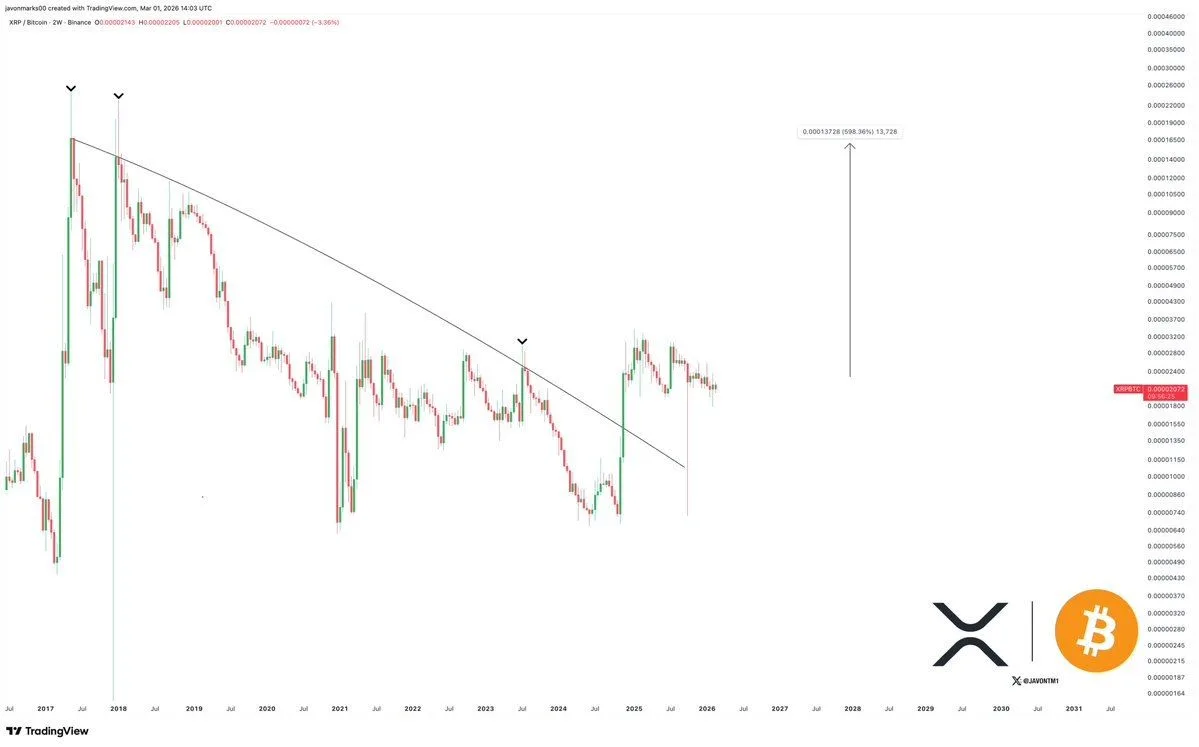 (Source: TradingView)
Crypto analyst Javon Marks issued a long-term bullish outlook on XRP when it fell below $1.30, based on over a decade of historical data.
Marks’ analysis centers on a historical “false breakdown” pattern: he notes that in early 2017 and 2021, XRP experienced brief dips below support levels followed by rapid rebounds to new all-time highs, and he sees strong similarities in the current structure. He compares XRP’s projected rise from about $0.55 at the end of 2023 to over $2.20 in 2024 with these past patterns, suggesting a larger upward cycle.
Based on long-term trend analysis, Marks forecasts a target price range of $15 to $18 for XRP; additionally, in the XRP/BTC exchange rate chart, he indicates the pair “seems to be brewing a gain of over 680%,” which could push XRP’s price above $10 if realized.
Frequently Asked Questions
Will all 1 billion XRP unlocked monthly enter the market circulation?
Not necessarily. Ripple can unlock up to 1 billion XRP from escrow each month, but actual use includes business development, ecosystem incentives, institutional financing, and some unused amounts being re-deposited into escrow. Historically, the actual market supply from Ripple’s unlocks has been much less than the maximum, which is a key reason why this large unlock has not caused significant market volatility.
The inflow of XRP spot ETF funds is relatively small; does this indicate weak institutional demand?
Compared to Bitcoin and Ethereum ETFs, XRP’s inflows are smaller, but it’s important to note that XRP ETF listings are relatively recent, and institutional coverage is still expanding. Continuous net inflows are a positive sign, showing ongoing institutional interest. If the CLARITY Act advances, it could establish clearer regulatory frameworks for XRP, further broadening institutional participation.
What is the basis for Javon Marks’ $15–$18 target?
Marks’ target is based on analysis of long-term historical trend structures, drawing parallels with the cycles in 2017 and 2021. He identifies “false breakdown” patterns before major bull runs and compares current formations to these precedents. This technical analysis relies on historical patterns rather than precise timing forecasts; actual outcomes depend heavily on overall market cycles and macroeconomic conditions.
Related Articles
ETH short-term surge of 1.30%: On-chain large transfers and concentrated liquidity drive price breakthrough of resistance
3 Cryptos to Invest in March 2026 — ETH, SOL, and XRP
Bitcoin, Ethereum, XRP Rally as ETF Inflows Hit $458M Amid Strait of Hormuz Crisis
ETH 15-minute decline of 1.25%: leveraged liquidation and on-chain fund outflows jointly drive short-term selling pressure