


Preparing for the Crypto Regulation! E.SUN Financial Holding: The banking industry will embrace three-track finance, not missing out on stablecoins and tokenization
E.SUN Financial Holding states that the financial industry will enter an era of “three-track finance,” encompassing physical, digital, and virtual assets. Recognizing the cross-border settlement needs of enterprises, E.SUN will actively invest in stablecoin issuance, blockchain services, and real asset tokenization, ensuring participation in future trends.
E.SUN Financial Holdings Reveals Three Major Directions in Response to Virtual Asset Regulation
As Taiwan’s Financial Supervisory Commission pushes to complete legislation on Virtual Asset Service Providers (VASP) by the end of the year, the domestic financial industry has begun actively preparing.
According to reports from the Economic Daily and iThome, E.SUN Financial Holdings Chairman Huang Nanzhou stated at a media briefing on February 24 that the future development of the financial industry will move toward “three-track finance”: the first track is traditional physical finance, the second is the highly developed digital finance, and the third is virtual asset finance.
Huang Nanzhou emphasized that both stablecoins and virtual asset regulations are global trends. Since the public has high trust in banks and securities systems, E.SUN Bank will definitely participate in stablecoin issuance and virtual asset fields.
E.SUN Financial Holdings Focuses on Cross-Border Settlement and Real Asset Tokenization
To prepare for the development of the third track of finance, E.SUN Financial Holdings has formulated specific strategies. Zhang Zhixing, Chief Technology Officer of E.SUN, said that to strengthen blockchain applications and cloud migration plans, the holding company has officially established a Technology Development Department to promote shared databases and cloud platforms.
E.SUN CFO Cheng Guorong further revealed that the company is focusing on three major directions in virtual asset finance:
- Addressing enterprises’ needs for cross-border payments and international trade settlement to reduce capital costs and improve operational efficiency
- Providing more convenient financial services in blockchain finance
- Integrating real asset tokenization (RWA) with Web3 technologies
Cheng explained that tokenizing real-world physical assets via blockchain and conducting on-chain transactions will be a new business opportunity for wealth management services, and E.SUN is actively preparing for this.
Taiwanese Businesses’ Stablecoin Payment Needs Rise, Financial Institutions Begin to Prepare
The Financial Supervisory Commission previously revealed that many import-export companies have already started actual stablecoin transactions.
According to statistics from the Taiwan External Trade Development Council, as of September 2025, 5.2% of companies are using stablecoins, with an additional 4.2% planning to adopt them. The total application rate approaching 10% indicates that stablecoins have moved beyond experimental stages into the early phase of trade settlement applications, with higher usage among Taiwanese and Taiwanese-American businesses.
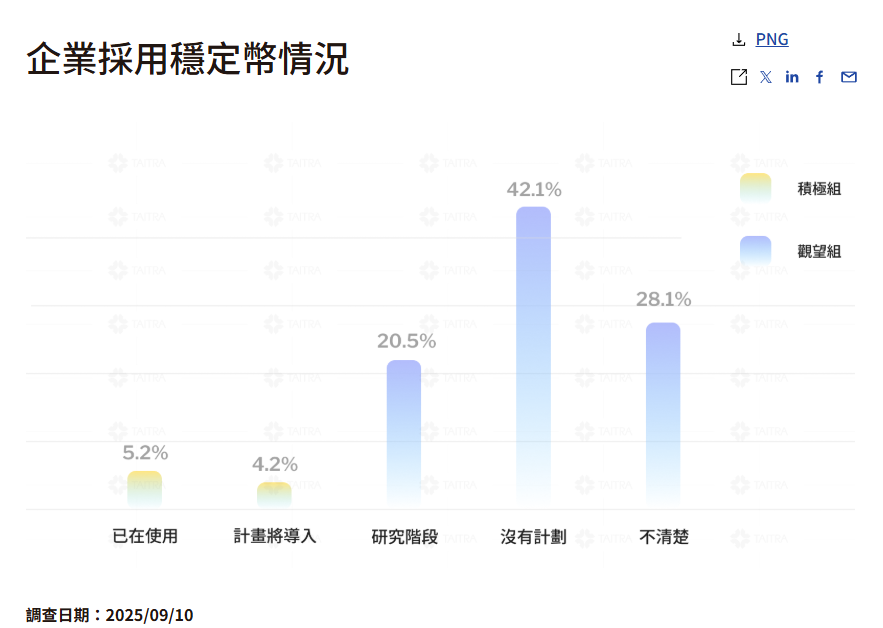
Source: Taiwan External Trade Development Council. According to statistics, as of September 2025, 5.2% of companies are using stablecoins, with 4.2% planning to adopt.
Since Taiwanese businesses mainly receive funds in USD-pegged stablecoins from abroad, once a certain volume accumulates, and based on trust in traditional financial systems, companies will prioritize storing these funds with trusted Taiwanese financial institutions.
In response to the trend of stablecoin trade, banks have begun exploring related opportunities. Several banks are quietly preparing to offer custody services as an entry point into the virtual asset market.
Vice Chairperson of the Financial Supervisory Commission, Chuang Xiuyuan, also pointed out that, for domestic suppliers’ payment and supply chain needs, there will inevitably be a demand for New Taiwan Dollar (TWD) stablecoins in the future. She is optimistic that, after the legislation passes, financial institutions will be able to provide seamless services connecting legal tender and stablecoins, greatly enhancing cross-border operational efficiency.
Regulatory Direction for Stablecoins Still Needs Consensus
Although industry demand is gradually expanding, the specific regulatory approach for stablecoins remains under discussion. During the 2025 Virtual Asset Service Law public hearing, various stakeholders engaged in in-depth discussions, but disagreements over legislative details persist.
The Director of the Central Bank’s Business Department, Xie Fengying, emphasized that stablecoins used for payments are gradually entering the real economy and should be regulated under the same principles as existing electronic payment institutions, following the same business, risk, and regulatory standards to prevent regulatory arbitrage and unfair competition.
However, organizations like the Taiwan Fintech Association advocate for a legislative framework that uses overarching laws with detailed sub-laws, aiming to balance fraud prevention with industry development.
Related Reports:
Public Hearing on Virtual Asset Service Law: 4 Key Discussion Points — How to Regulate Crypto Payments and Stablecoins?
Related Articles
Sui native stablecoin USDsui launched, promising to return asset yields to the Sui ecosystem
European banking giants join forces: Can the euro stablecoin reshape the global crypto landscape?
Angle Protocol will cease operations in March 2027. Within one year, you can exchange EURA and USDA at a 1:1 ratio.
Backpack announces support for US stock IPO share purchases
GMX DAO adjusts buyback and liquidity through governance proposals to restore price discovery
Tether and Lugano Launch Plan ₿ Phase II to Expand Crypto Integration
