


Tether USAT's first reserve proof is out! Over-collateralized with 17.6 million MGB, analyzing the reserve composition structure

Deloitte & Touche has issued its first reserve attestation for Tether’s USAt, showing $17.6 million in excess collateral, strengthening its compliance presence in the U.S.
Deloitte’s Endorsement of Tether’s Asset Backing Marks a New Milestone for USAt Transparency
Global stablecoin leader Tether has made progress in its pursuit of transparency. One of the Big Four accounting firms, Deloitte & Touche, has completed its first reserve attestation for Tether’s new compliant stablecoin USAt ($USAT). The report, published on February 27, reviews the asset status as of January 31 and confirms that the stablecoin is fully backed by sufficient assets. This is the first time a Big Four firm has provided certification services for a Tether-related stablecoin product, a symbolic step given Tether’s long-standing controversy over audit transparency.
USAt is a new product launched by Tether in January 2026, designed specifically for the U.S. regulatory environment, issued by federally licensed Anchorage Digital Bank. In the attestation letter, Deloitte states that the USAt reserve report’s representations are in all material respects consistent with the standards for asset-backed fiat-pegged tokens set by the American Institute of CPAs (AICPA) in 2025. The report is a third-party certification providing a snapshot of reserves at a specific point in time, differing from a full financial audit, and does not evaluate internal controls or overall financial health. Nonetheless, Deloitte’s involvement enhances the credibility of the token among institutional investors.
Further Reading
Tether Launches US Stablecoin USAT! Competing with Circle’s USDC and Entering Regulated Markets
Tether Releases Compliant Stablecoin USAT! Integrating into U.S. Federal Regulatory Framework with Transparent Reserves
This development reflects Tether CEO Paolo Ardoino’s active transparency strategy. Ardoino has previously stated that the Big Four firms declined to audit crypto companies due to reputation concerns. He also emphasized that securing support from top firms like Deloitte is a top priority. Through collaboration with Anchorage Digital Bank, Tether has established a system compliant with U.S. federal regulations.
Overcollateralization and High-Quality Assets: Analyzing the $17.6 Million Reserve Composition
Financial data shows that USAt is overcollateralized. As of the end of January, the total circulating USAt tokens numbered 17,501,391, while the reserve assets managed by Anchorage were valued at $17,604,716, resulting in a surplus of approximately $103,325, with assets exceeding issuance by about 0.6%. According to official documents, all issued USAt tokens are redeemable at any time, with no unredeemable tokens—neither temporary nor permanent. Since the report’s release, the stablecoin’s market cap has grown close to $20 million as demand increased.
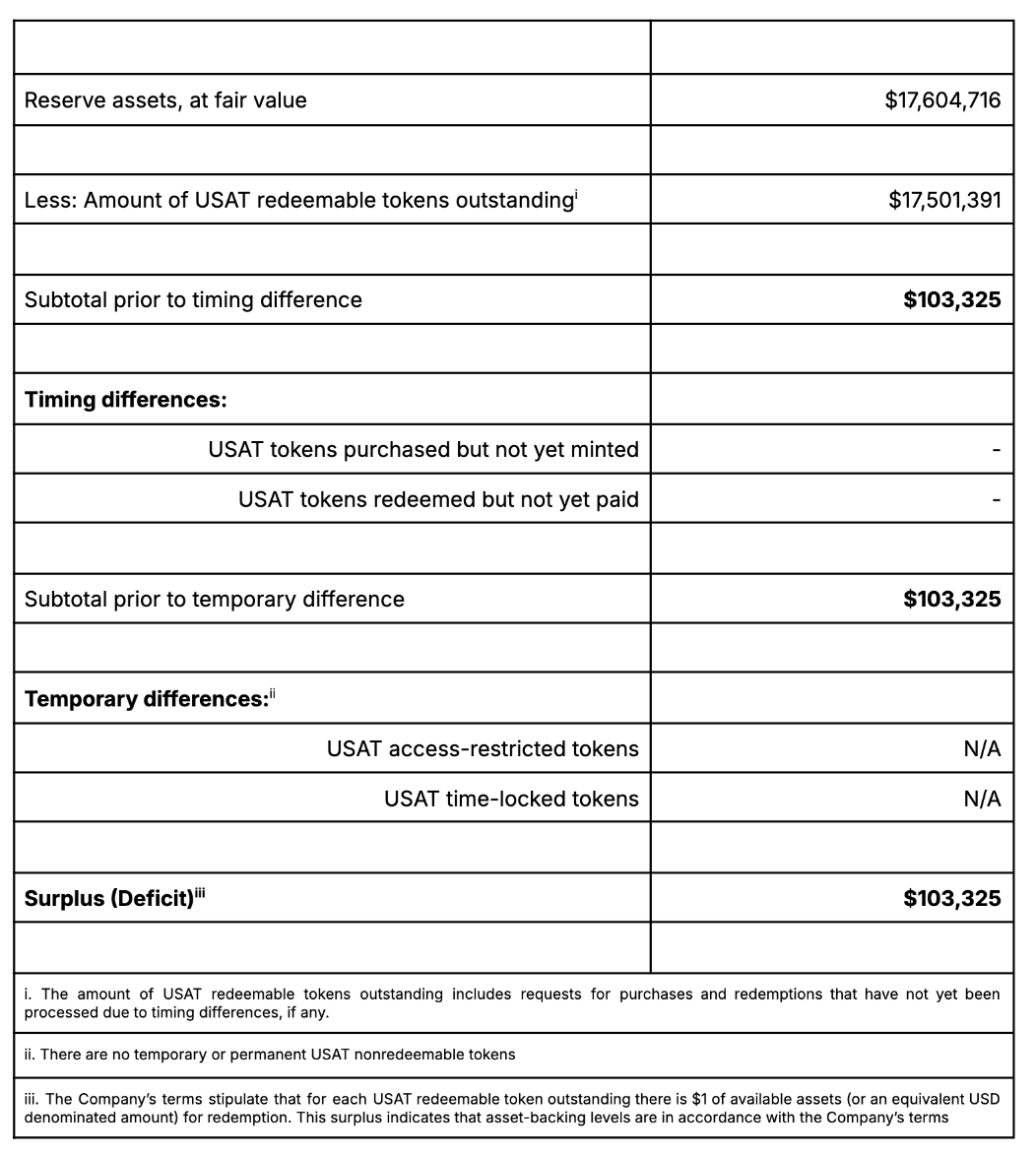
Image Source: Deloitte USAt Financial Overview
USAt’s reserve assets are streamlined and highly liquid, primarily to meet U.S. regulatory requirements for stablecoin collateral. The report details that reserves include $3.65 million in cash and $13.95 million in reverse repurchase agreements. These reverse repos are collateralized by U.S. Treasuries held by U.S. broker-dealers with very short maturities, mainly between January 30 and February 2. The cash is stored in FDIC-insured banks and brokerage accounts. While some balances exceed standard insurance limits, overall risk remains tightly controlled.
USAt’s asset management differs fundamentally from Tether’s flagship $USDT, which has a reserve of approximately $183 billion diversified across assets including Bitcoin ($BTC) and gold. USAt focuses solely on USD cash and U.S. Treasuries.
USAt CEO Bo Hines predicts that as demand for the token expands, USAt could become one of the major buyers in the U.S. Treasury market within this year. This asset allocation prioritizes safety to ensure a 1:1 peg with the U.S. dollar under any market conditions.

Image Source: Getty Images USAt CEO Bo Hines
How USAt Leverages the GENIUS Act and Federal Licensing to Break Through
USAt’s creation is closely tied to changes in U.S. regulation. In July 2025, the U.S. passed the GENIUS Act, establishing a federal regulatory framework with strict reserve requirements and operational standards for stablecoin issuers. USAt was designed to fully comply with this law, operating on the Ethereum network and regulated directly by the OCC through Anchorage Digital Bank’s federal banking license.
Tether’s “dual-track” strategy is clear. They recognize that while $USDT dominates overseas markets, it faces legal uncertainties within the U.S. Therefore, they are establishing a compliance threshold by creating USAt to attract regulated financial institutions and corporations sensitive to regulation. Anchorage, as the first federally chartered digital asset bank in the U.S., provides banking-level oversight and technical support.
Anchorage CEO Nathan McCauley emphasizes that transparent attestations and bank-grade supervision are essential for enabling large-scale institutional settlement of tokenized dollars.

Image Source: Getty Images Anchorage CEO Nathan McCauley
Regulatory Transformation Gives Tether a More Level Playing Field. Previously, Tether’s competitor Circle ($USDC issuer) hired Deloitte as an independent accountant in 2023. Now, Tether’s USAt has also received Deloitte’s certification, narrowing transparency gaps between the two. Although USDT remains structured to exclude U.S. users, the success of USAt provides a model for Tether’s future expansion in the U.S. market. Led by former White House digital assets task force director Bo Hines, USAt is defining the role of digital dollars within a regulated U.S. environment.
Stablecoin Market Expected to Reach $2 Trillion, Tether’s Dual-Track Strategy Expands Globally
The long-term potential of the stablecoin sector remains optimistic among financial institutions. Standard Chartered analysts reaffirm their forecast that the stablecoin market will reach $2 trillion by 2028. Currently, the total market cap is about $31.5 billion, with Tether’s $USDT leading at $183 billion, followed by Circle’s $USDC at $76 billion. Although USDT experienced a notable monthly supply reduction in early 2026, with about $1.5 billion less in circulation in February, Tether states this is a short-term adjustment. Meanwhile, USDC also saw a decrease of several billion dollars in supply during the same period.
In this environment, the launch of USAt fills a gap for Tether in the U.S. market. Tether is converting profits from stablecoin reserves into diversified investments, including a majority stake in Latin American agriculture firm Adecoagro, privacy health apps, shares in video platform Rumble, and a recent $200 million investment in digital marketplace Whop. Transitioning from a stablecoin issuer to a comprehensive digital asset conglomerate requires a solid trust foundation, which Deloitte’s partnership helps reinforce.
The application scope of stablecoins is expanding from crypto trading to global payments and cross-border settlements. As geopolitical tensions and regulatory frameworks evolve, products like USAt—featuring technological flexibility and federal bank backing—will play a significant role in institutional markets. Tether continues to deepen its international presence with USDT while building a compliant infrastructure domestically with USAt. This strategic layout ensures its ongoing growth in the digital asset space.
Related Articles
European banking giants join forces: Can the euro stablecoin reshape the global crypto landscape?
Tether and Lugano Launch Plan ₿ Phase II to Expand Crypto Integration
Tether makes a strategic investment of $1.5 billion in smart sleep technology company Eight Sleep
Tether reinvests 5 million Swiss Francs to advance Plan ₿ Phase 2, with Lugano, Switzerland, accelerating the development of the Bitcoin city
Tether and the city of Lugano, Switzerland, will invest up to $6.3 million to expand the Bitcoin program