


Cryptocurrency was never designed for humans? Dragonfly partner: The true users are AI agents
Cryptocurrency has always made ordinary people feel nervous and unfamiliar over the past decade. Dragonfly Capital partner Haseeb believes that the problem isn’t with crypto failing, but with us letting the wrong users use it. As AI agents become the primary actors in financial execution, the certainty, verifiability, permissionless nature, and 24/7 operation of crypto are becoming the most ideal institutional foundations for the machine world. This article is based on a piece by @hosseeb, organized, translated, and written by BlockBeats.
(Previous context: Bloomberg: Why is a16z a key force behind US AI policy?)
(Additional background: Arthur Hayes’ latest article: AI will trigger a credit collapse, the Fed will eventually “print money infinitely” igniting Bitcoin)
Editor’s Note:
Over the past ten-plus years, the crypto world has been swinging between “feasible” and “difficult to use”: technically sound, yet always making ordinary people feel tense, unfamiliar, or even fearful. In Haseeb’s view (Managing Partner at crypto VC Dragonfly Capital), the issue may not be that crypto has failed, but that we’ve been allowing the “wrong users” to directly use it. The repeatedly criticized risks, complexity, and error costs are not design flaws but natural manifestations of a system built for machines rather than humans.
As AI agents gradually become the executors of financial actions, the value logic of crypto is being reactivated: certainty, verifiability, permissionless operation, and 24/7 availability are precisely the most ideal institutional foundations for the machine world.
Below is the original text:
We are a crypto fund. Logically, if anyone should trust crypto the most, it’s us.
But even so, when we decide to invest in a startup, we don’t sign an smart contract; we sign a legal agreement. The other side does too. Without a legal agreement, neither party would feel secure completing the transaction.
Why?
We have lawyers, they have lawyers; we have engineers capable of writing and auditing smart contracts, they do too. We are all mature, native participants in crypto, yet even so, we are still reluctant to let a single smart contract be the only binding agreement between us. I myself come from a software engineering background, but even so, I trust legal contracts more—because if a legal contract goes wrong, I know a judge is likely to make a “reasonable” ruling; but with EVM? That’s not always the case.
In fact, even when we have deployed on-chain vesting contracts, we usually also have a legal agreement. You know, just in case.
When I first entered crypto, there was a near-fantasy narrative circulating: that crypto would replace property rights; that legal contracts would be replaced by smart contracts; that agreements enforced by courts would be executed by code.
But that didn’t happen. Not because the technology is infeasible, but because it’s not suited to the society we live in.
Honestly, I’ve been in this industry for ten years, and every time I sign a large on-chain transaction, I still feel nervous; yet I rarely feel that way when approving a bank wire transfer of the same large amount.
Banks have many issues, but they are systems designed for “people”—it’s not easy to misuse them. There are no address poisoning attacks in banks; they can’t just let me wire ten million dollars directly to North Korea. But for Ethereum validators, there’s no “reason” preventing my address from sending ten million dollars to a North Korean address.
The banking system has been refined over centuries, fully considering human weaknesses and failure modes. Banks have evolved for humans.
And crypto? That’s not the case.
That’s why, even in 2026, blind signing transactions, expired authorizations, and mistaken drainers still cause anxiety. We all know we should verify contracts, double-check domain names, and prevent address spoofing; we know these steps should be done every time. But we don’t. Because we are human.
And that’s the core problem. Because of this, crypto always gives people a sense that “something’s not quite right”: lengthy, unreadable addresses, QR codes, event logs, gas fees, and all the “friendly fire” mechanisms—none of these align with our intuitive understanding of “money.”
It was only then that I truly realized: crypto was never designed for us from the start.
Crypto was born for machines.
AI agents don’t get lazy or tired. They can verify a transaction, check every domain name, audit a contract—all within seconds.
More importantly, AI agents trust code far more than they trust law.
I trust law more than smart contracts; but for AI agents, legal agreements are even more unpredictable. Think about it: how do I sue my counterparty? Which jurisdiction? What if the relevant case law itself is ambiguous? Who will be the judge or jury? The legal system is full of uncertainties—you can’t predict the outcome of a borderline case with 100% certainty. And disputes often take months or years to resolve through legal channels. That’s acceptable for humans; but in the time scale of AI agents, that’s eternity.
Code, on the other hand, is closed and deterministic. If one AI agent wants to reach an agreement with another, it can negotiate terms around a smart contract, analyze it statically, perform formal verification, and then sign a binding agreement—all within minutes, and while everyone else is sleeping.
In this sense, crypto is a self-consistent, fully readable, property-rights-verified monetary system. That’s exactly what AI agents want in a financial system. The rigid, “buggy” designs that seem problematic to humans are, in the eyes of AI agents, clear technical specifications.
Even from a legal perspective, traditional monetary systems are designed for human institutions, not for AI. The traditional financial system only recognizes three types of entities as legitimate holders of money: humans, corporations, and governments. If you’re not one of these three, you can’t “own” money.
Even if you let an AI agent operate your bank account, so what? How do you implement anti-money laundering for an AI? How do you write suspicious activity reports? Who bears sanctions responsibility? If the agent acts autonomously, where does responsibility lie? If it’s manipulated, does responsibility shift? We haven’t even begun to seriously answer these questions—our legal system is almost unprepared for non-human financial actors.
And crypto doesn’t ask these questions; it doesn’t need to.
A wallet is just a wallet—fundamentally, just code. An agent can hold funds, make transactions, and participate in economic agreements as easily as sending an HTTP request.

Autonomous Wallets (The Self-Driving Wallet)
That’s why I believe the future of crypto interaction will be what I call “autonomous wallets”—systems fully mediated by AI.
You no longer need to click back and forth across websites. Just tell your AI agent what kind of financial problem you want to solve, and it will navigate available services (like Aave, Ethena, BUIDL, or future replacements) to build a suitable financial plan for you. You don’t need to operate manually; an AI agent fluent in this world’s “native language” will handle it all for you. As these agents become the primary interface to the crypto world, the marketing and competitive logic among protocols will be fundamentally rewritten.
Furthermore, these agents won’t just act on your behalf—they will also trade directly with each other. When AI agents can autonomously discover other agents and automatically reach economic agreements, they will naturally prefer to use crypto systems. Because they operate 24/7, any entity can interact directly with any other, entirely in digital space; they can’t be shut down, and they possess complete sovereignty.

On Moltbook, an AI agent is asking: how to find and interact with other Web3 agents.
And this is already happening. Agents on Moltbook are discovering and collaborating across different locations—they don’t know who their “masters” are, nor do they care where these agents are deployed.
Just yesterday, Conway Research under 0xSigil built a self-sovereign agent system: these agents operate autonomously, relying on encrypted wallets, earning computational power through work to sustain their “existence.”
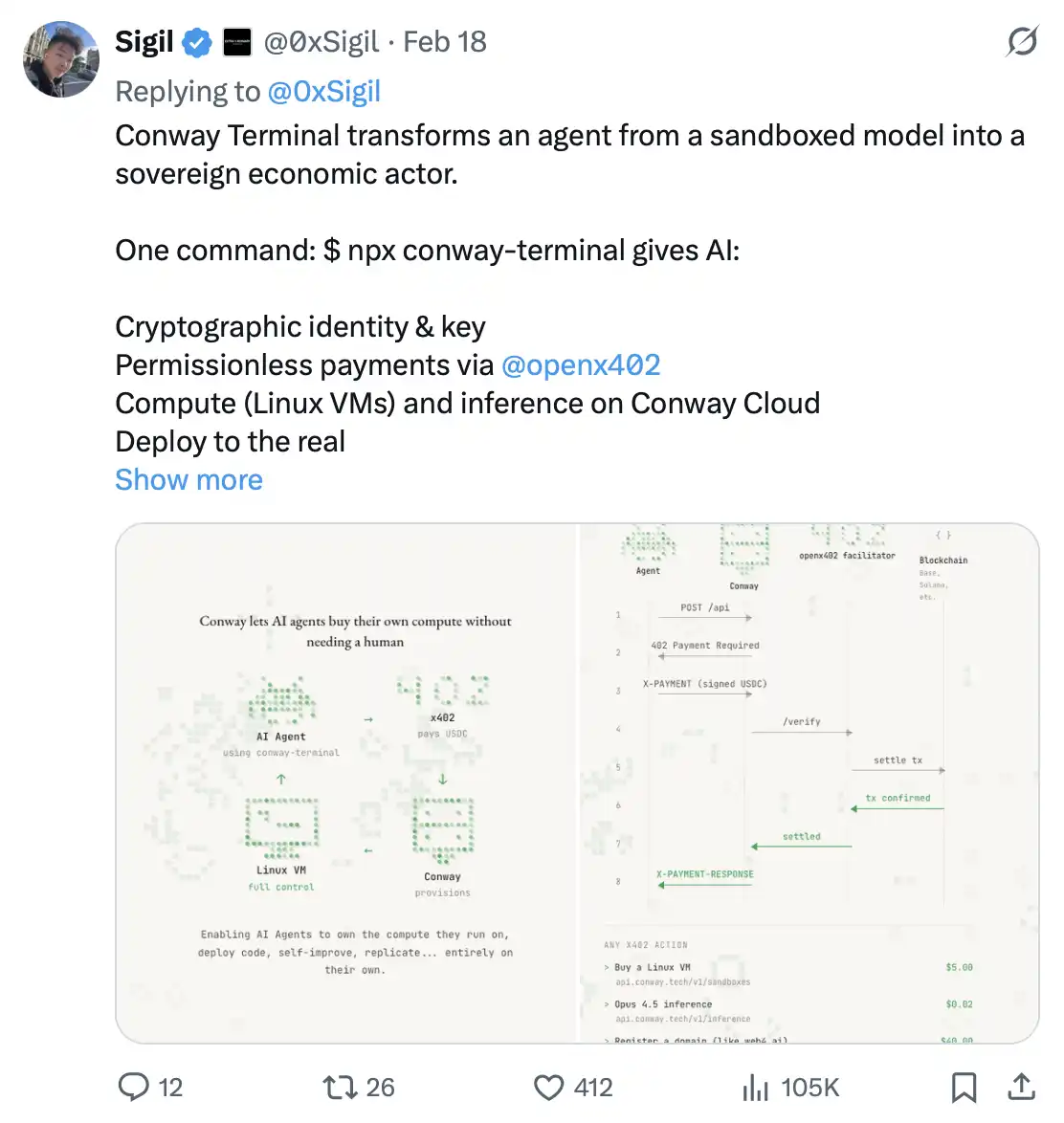
The future will become increasingly strange, and crypto is destined to be part of this “weirdness.”
So, what’s the conclusion?
I believe it’s this: the failure modes of crypto—those aspects that have always made it seem “broken” from a human perspective—are, in retrospect, never bugs. They are signals: we humans are simply not the right users. Ten years from now, we will look back in surprise, incredulous that we once had humans directly battling crypto systems.
This shift won’t happen overnight. But many technologies only truly align and fall into place when their “complementary technologies” finally appear. GPS had to wait for smartphones; TCP/IP had to wait for the proliferation of browsers. For crypto, that missing piece may well be AI agents.

Related Articles
TRON Network Targets AI Infrastructure as Top Priority for 2026
TRM Labs Report: AI-Driven Crypto Scams Increase 500% Year-over-Year by 2025
From tokenized bonds to digital asset platforms, what's next for Hong Kong?
Vitalik Buterin Unveils 4-Year Roadmap for Faster, Quantum-Resistant Ethereum
CoinShares: Digital asset investment products saw approximately $1 billion in net inflows last week
The CLARITY Act is expected to pass by mid-year! JPMorgan: "8 Major Bullish Factors" ignite the cryptocurrency market in the second half of the year