


Retail investors flee, whales scoop up the bottom! PEPE smart money returns, absorbing 23 trillion tokens in four months

PEPE meme coin has declined for six consecutive weeks, but on-chain data from Santiment shows that smart money accumulation remains strong. The top 100 largest wallets have collectively held about 23.02 trillion PEPE over the past four months. Hyperliquid’s well-known trader James Wynn predicted last month that PEPE’s market cap could reach $69 billion before closing his position and selling.
23.02 Trillion Accumulated: Top Wallets’ Contrarian Moves in PEPE
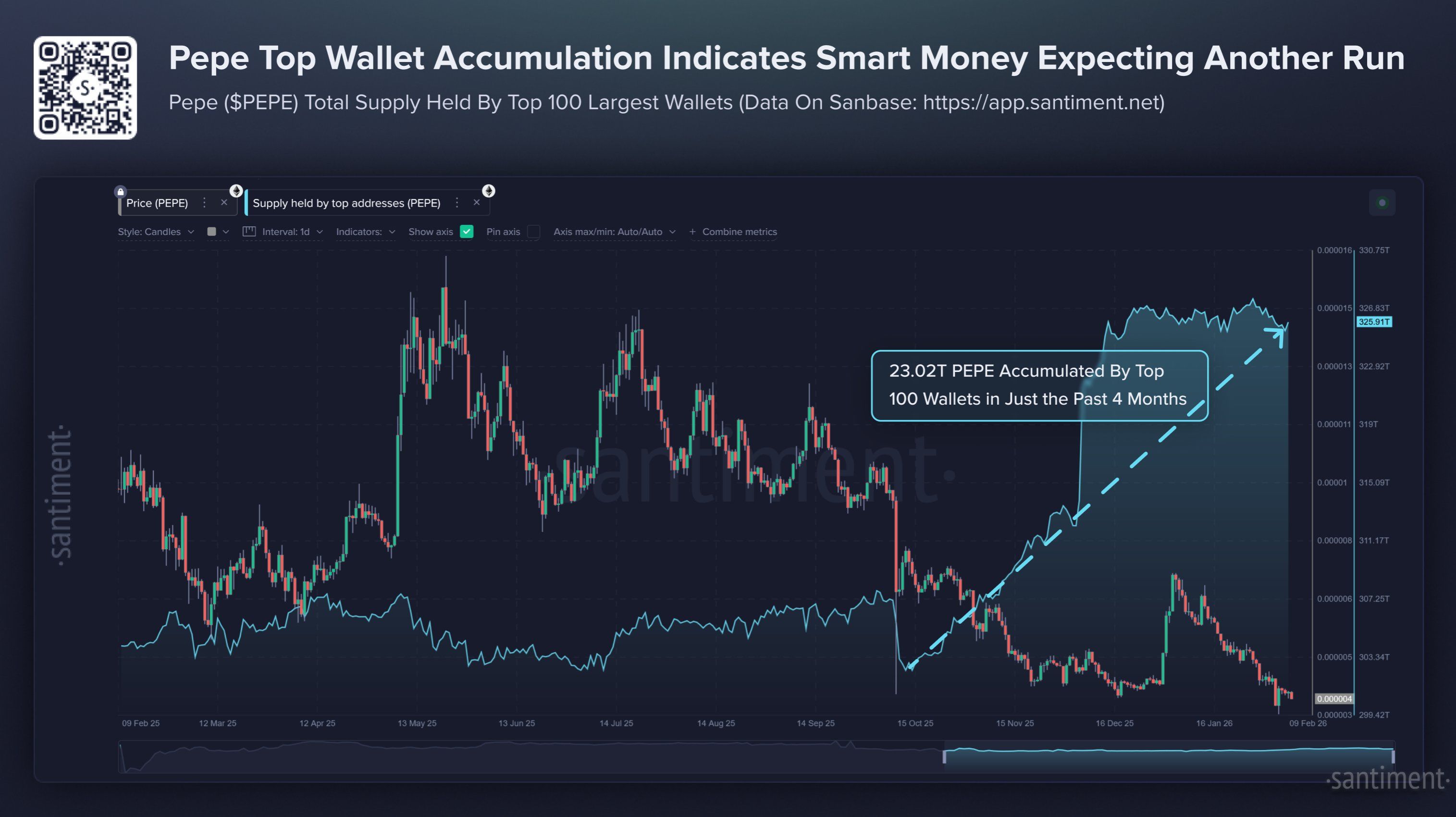
(Source: Santiment)
Despite some investors exiting, others continue to increase their holdings of PEPE. Santiment’s on-chain data indicates a significant change in behavior among the top 100 wallets. Over the past four months, following the overall market sell-off in October, these wallets have accumulated approximately 23.02 trillion PEPE. This figure is astonishing within the meme coin space.
The scale of 23.02 trillion is hard to grasp intuitively, so let’s convert it into a more understandable form. PEPE’s current circulating supply is about 420 trillion tokens, so 23.02 trillion accounts for roughly 5.5% of the circulating supply. This means that the top 100 wallets have absorbed over 5% of the supply in just four months. Such rapid concentration indicates that large holders are actively building positions, transferring tokens from retail investors to themselves.
Looking at the timeframe, this accumulation began after the October market-wide sell-off. During that period, Bitcoin started to retrace from around $126,000, and the entire crypto market entered a correction phase. As a high-risk meme coin, PEPE’s decline was much steeper than mainstream tokens. However, it was precisely during this market panic that top wallets started buying against the trend. This “fear when others are greedy” strategy is typical of successful investors.
Santiment points out that large wallets often play a decisive role in reversing altcoin trends and triggering strong price rallies. “Smart money wallets are crucial in the process of altcoins ultimately reversing their downward trend and experiencing significant gains. Currently, retail sentiment towards PEPE and meme coins is very pessimistic, but once Bitcoin sustains a rally, those heavily accumulated tokens are likely to break out again.”
This divergence—“whales accumulating vs retail pessimism”—is a classic bottom indicator. In market psychology, when retail investors are overwhelmingly pessimistic and selling off, it often signals that panic has peaked and further declines are limited. As market-savvy whales accumulate, their behavior typically leads to price reversals weeks or even months ahead. Tracking whale activity thus becomes an important method for predicting trend shifts.
Three Key Reasons Top Wallets Are Accumulating PEPE
Valuation Attractiveness: Price has fallen over 80% from its peak, improving risk-reward profile
Extreme Sentiment: Retail investors’ extreme pessimism often signals a good entry point
Bitcoin Correlation Expectation: Betting on Bitcoin’s rebound to trigger explosive growth in meme coins
In terms of concentration, controlling 5.5% of circulating supply with the top 100 wallets is just the beginning. If this accumulation trend continues, the proportion could rise to 10% or higher in the coming months. Greater concentration means less floating supply available for trading, and when demand rebounds, prices can surge more easily. This “supply tightening” mechanism is a key driver of rapid price increases.
James Wynn’s $69 Billion Prediction and Sudden Liquidation
Last month, James Wynn, a prominent trader at Hyperliquid holding large PEPE positions, predicted that PEPE’s market cap could reach $69 billion by 2026. This forecast was made just before PEPE’s price surged significantly. Two weeks later, he confirmed that he had closed all his PEPE long positions and sold everything. This “predicting a rally then exiting” move has sparked widespread discussion.
What does a $69 billion market cap mean? Currently, PEPE’s market cap is around $3–4 billion (based on price fluctuations). Reaching $69 billion would require a 17- to 23-fold increase. This would make PEPE surpass Dogecoin (market cap around $20 billion) to become the largest meme coin. Such a prediction is highly aggressive but not entirely impossible. During the 2021 bull run, Shiba Inu’s market cap skyrocketed from a few hundred million dollars to $40 billion within months, a gain of over 100 times.
Why did Wynn make such an optimistic forecast and then suddenly liquidate? Possible reasons include: first, he believes PEPE has already priced in the positive outlook and needs a correction before re-entering. Second, the overall market environment has worsened (Bitcoin started to retrace), so he chose to lock in profits and avoid losses. Third, his $69 billion target is a long-term projection; he may plan to reaccumulate at lower prices.
This phenomenon—famous traders making bold forecasts then selling off— is common in crypto markets. When traders publicly announce very optimistic predictions, it often attracts follow-on buying, pushing prices higher in the short term. The trader then sells to lock in profits, exploiting asymmetric information. Retail investors should be cautious of this pattern and avoid blindly following prominent traders’ forecasts, instead making independent judgments.
Market impact-wise, Wynn’s liquidation could exert short-term downward pressure on PEPE’s price. As a well-known whale on Hyperliquid, his holdings could be worth millions or even tens of millions of dollars. The selling pressure during liquidation may cause declines, which could partly explain PEPE’s recent downward trend. However, once the whale’s sell-off completes, the pressure eases, and prices may stabilize or rebound.
Liquidity Tightening Warning: Meme Coins Could Disappear Entirely
Market analyst Benjamin Cowan warns that in a liquidity-constrained environment, meme coins could face severe shocks, with some potentially vanishing altogether. This warning is very serious, as it points not just to price declines but to the possible death of certain tokens. When a crypto’s liquidity dries up and trading volume drops to zero, it effectively “dies,” even if it still exists on the blockchain.
Why are meme coins most vulnerable during liquidity tightening? Meme coins generally lack real-world utility; their value is entirely based on community consensus and speculative sentiment. When liquidity is abundant and risk appetite is high, meme coins can attract large speculative flows. But when liquidity shrinks and interest rates rise, investors tend to favor assets with actual use cases or yields, abandoning meme coins first.
Data from CryptoQuant shows that meme coins currently account for only 3–5% of the total altcoin market cap, far below the 10–15% peak during the 2021 bull run. This low dominance suggests two interpretations: pessimists see it as meme coins losing favor, while optimists see it as undervaluation, with huge upside potential if market sentiment reverses.
If this dominance ratio begins to rebound, it would signal a broader recovery in PEPE and the meme coin sector. Investors should closely monitor this indicator, as it provides an early signal of whether meme coins are regaining market attention.
Analysts believe PEPE has recovery potential but warn that liquidity tightening could pressure meme coins. PEPE’s rebound appears supported by some fundamentals, but given the current market environment, investors remain cautious about deploying funds into meme coins. Short-term, PEPE’s price may bounce back, but a new local bottom could form before a sustained recovery.
For investors considering PEPE, the current stage is highly uncertain. Whale accumulation is a positive sign, but Wynn’s liquidation and Cowan’s warning are negatives. The most prudent approach is to take small positions, set strict stop-losses, and closely watch Bitcoin’s trend. Only when Bitcoin resumes its upward trajectory will high-risk meme coins like PEPE have a real chance for a rebound.
Related Articles
Dogecoin Price Compresses Near $0.10 as Open Interest Drops
Dogecoin Drops 9.6% to $0.08885 as Adam and Eve Pattern Tests Key Neckline
Dogecoin and Avalanche Show Signs of Recovery but Pepeto Is The Best Crypto To Buy Now
Breakout Pushes $0.09656 DOGE Above Converging Trendlines as Price Trades Between Key Levels