


Pi Network price hits a new all-time low! 59.4 million tokens unlocked may trigger another wave of selling
Pi Network price hits a new all-time low of $0.132, a 95.6% crash from $3 a year ago. PiScan data shows that in the next three days, 59.4 million tokens will be unlocked, far exceeding the average of 8.5 million per month. On February 12, 18.9 million tokens will be unlocked; on February 13, a record 23.6 million will be unlocked; and on February 14, 16.9 million will be unlocked.
$0.132 All-Time Low: Pi Network Down 95.6% in One Year
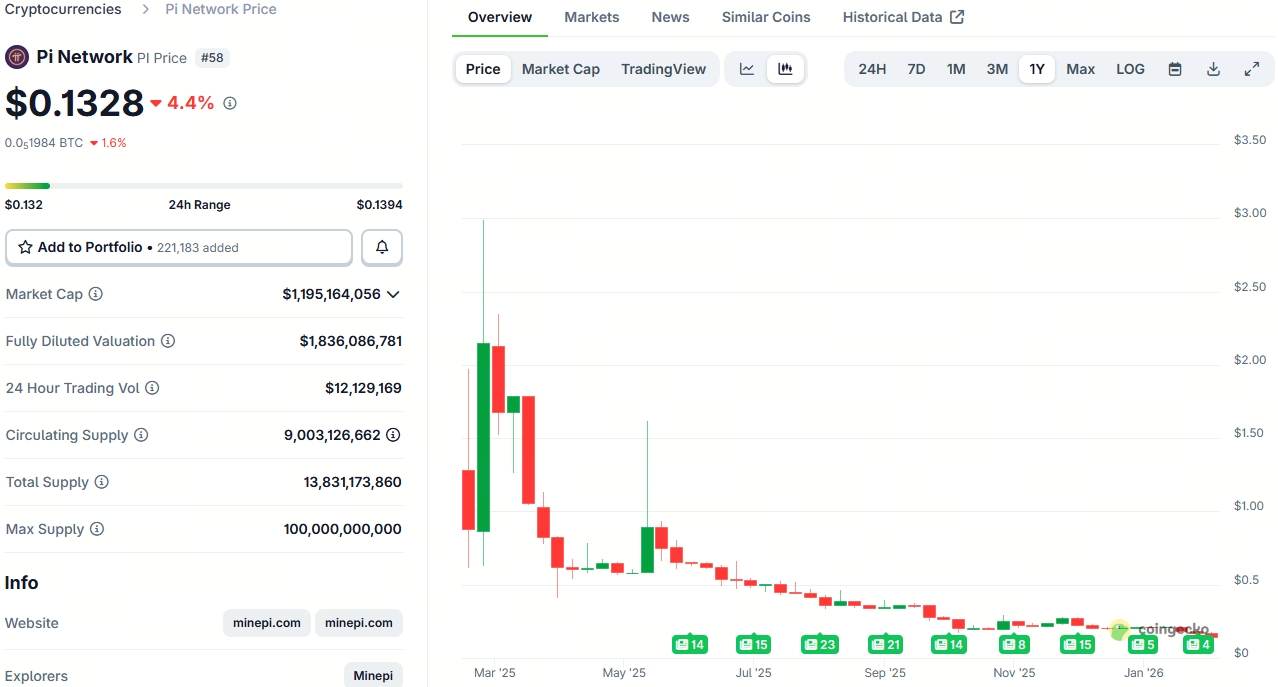
(Source: CoinGecko)
The overall market correction in the past roughly 12 hours has not been friendly to many altcoins, but Pi Network stands out in particular, possibly the biggest victim of this brutal industry reality. The native token of Pi Network was close to $3 less than a year ago, but has since plummeted. According to CoinGecko data, the latest price crash on February 11 set a new all-time low of $0.132.
Falling from $3 to $0.132 represents a 95.6% decline, an extremely rare collapse in the crypto market. Even during the 2022 crypto winter, most mainstream altcoins declined by 80-90%. Pi Network’s over 95% drop means investors have nearly lost all their principal. An investor who put in $10,000 at the high now has only $440, losing $9,560.
This catastrophic price performance stems from multiple factors. First, the mainnet migration progress is slow, with many users unable to transfer tokens to the mainnet due to KYC failures, creating a paradox of scarce circulating tokens and even scarcer demand. Second, Pi Network lacks real-world use cases; its tokens are mainly used for speculation rather than utility, so once speculative enthusiasm wanes, prices naturally collapse. Third, ongoing token unlocks provide continuous selling pressure, and without new buying support, prices can only trend downward.
Recent criticism of Pi Network and its team has also worsened market confidence. Community complaints about KYC delays, unclear mainnet launch timelines, and lack of transparency have been mounting. Some early supporters even question whether Pi Network is a carefully crafted scam, and this trust collapse has a significant negative impact on the price.
Technically, Pi Network’s price chart shows a perfect downward trend, with no effective rebounds or bottoming patterns. Every small rally is overwhelmed by larger sell-offs. This unidirectional decline indicates the market has lost confidence in Pi Network; any rebound is seen as a chance to escape rather than an entry point.
Three Days of Unlocks: 59.4 Million Tokens on February 13, Black Friday
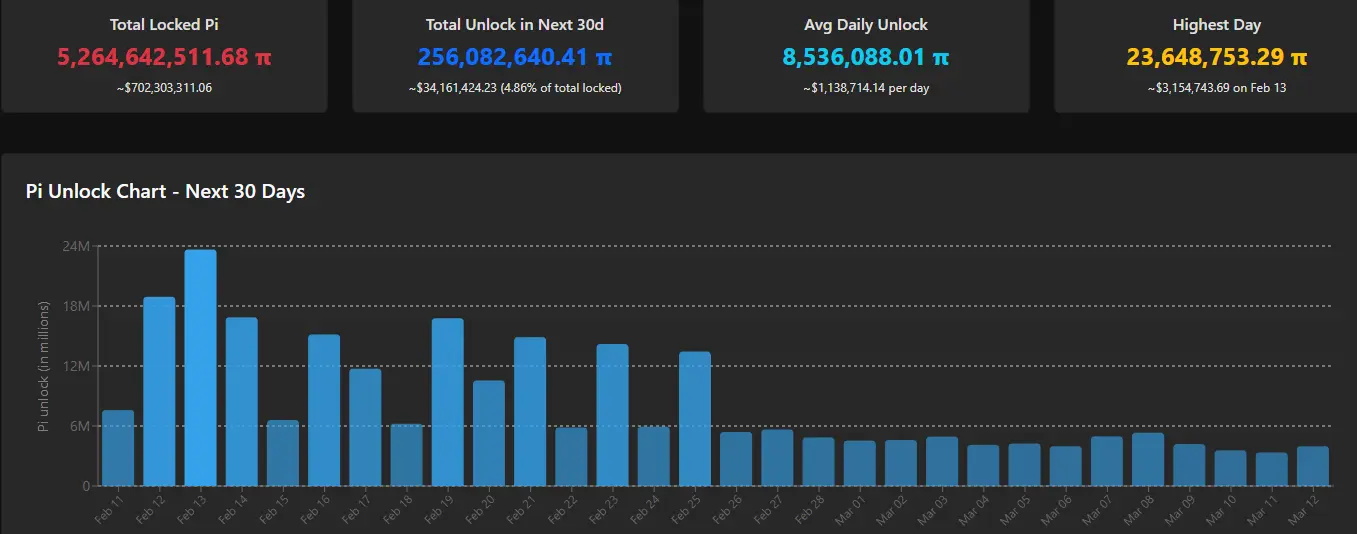
(Source: PiScan)
Although this disaster is already severe, on-chain data suggests it may not be the end of Pi Network’s troubles. PiScan is a website dedicated to increasing project transparency, especially regarding daily and monthly token unlock schedules. On average, next month’s token releases will total slightly over 8.5 million, significantly higher than the previous few months’ 4-5 million.
However, the token unlocks on February 12, 13, and 14 will be substantially higher. Specifically, 16.9 million tokens will be released on February 14, and 18.9 million on February 12. Coincidentally (or perhaps not), February 13 falls on a Friday the 13th, and will set a record with 23.6 million tokens unlocked—an ominous “Black Friday.”
In total, 59.4 million tokens will be unlocked over these three days—about seven times the average monthly unlock of 8.5 million. Such concentrated unlocking is rare; most projects distribute unlocks evenly daily or monthly to reduce sell pressure. Pi Network’s choice to concentrate such a large amount over three days is unexplained, but possible reasons include: specific vesting schedules, ties to KYC batch releases, or mere timing coincidence.
The unlocking of 23.6 million tokens on February 13 (Black Friday) is highly inauspicious. “Black Friday” and the number 13 are considered unlucky in Western culture, though superstition has no real basis, the psychological impact is significant. When market participants see “February 13” combined with “record unlock,” panic may be further amplified.
It’s important to note that once these tokens are issued, they are freely tradable. While this doesn’t guarantee immediate selling, given the overall market conditions, rising panic sentiment, and recent criticism of Pi Network and its team, concerns are inevitable. Rational analysis suggests most of these holders are early supporters, team members, or investors with an average cost basis of $1-2 or higher.
Future Three-Day Unlock Schedule
February 12: Unlocks 18.9 million—66 times the average daily unlock
February 13 (Black Friday): Unlocks 23.6 million—record single-day unlock
February 14: Unlocks 16.9 million—Valentine’s Day sell-off day
This concentrated unlocking could have a disastrous impact on market liquidity. Pi Network’s daily trading volume is around $50 million to $100 million. If, for example, 20% of the 23.6 million tokens unlocked on February 13 are sold, at the current price of $0.132, that’s about $6.2 million in sell orders. While seemingly modest, in an already fragile market with extremely low buy support, it could trigger further price collapse.
From the holders’ psychology, after a 95.6% decline, locking in the remaining 4.4% of value might seem rational. Many may adopt a “dying pig not afraid of boiling water” mentality, holding on in hope of a miracle. Others might prefer to cut losses early, selling immediately after unlock. As long as some proportion of holders sell, it can be enough to push the fragile market further down.
Sell or Hold? The Prisoner’s Dilemma of Unlock Holders
Considering overall market conditions, rising panic, and recent criticism of Pi Network and its team, the risk of token sell-offs upon unlock is very high. The broader crypto market remains in correction, with Bitcoin struggling between $60,000 and $70,000, Ethereum below $2,000, and risk aversion high. In this environment, investors tend to prefer holding mainstream coins or cash rather than high-risk altcoins.
Market panic indicators are flashing red. The crypto fear and greed index is in “extreme fear,” social sentiment is very pessimistic, and stablecoin balances on exchanges are at record highs, indicating funds are on the sidelines. In such a fearful atmosphere, any event that could trigger selling is magnified. The three-day unlock coincides with this sensitive period.
Recent criticisms of Pi Network focus on several issues: low KYC approval efficiency, with many users waiting months or over a year; vague timelines for full mainnet launch, initially promised for 2025; lack of transparency from the team, with few public responses to community concerns; and slow ecosystem development with no killer app to attract users.
These criticisms have eroded holder confidence. When deciding whether to sell upon unlock, they consider: what is the project’s long-term outlook? Is the team trustworthy? Is there potential for price rebound? Given current negative sentiment, the answers tend toward pessimism. Many may choose to sell immediately after unlock to lock in remaining value.
From a game theory perspective, unlock holders face a classic prisoner’s dilemma. If everyone holds, prices might stabilize or rebound; but if they fear others will sell, preemptive selling becomes the best strategy. This often leads to collective panic selling, even if individually everyone hopes for stability.
For investors still holding Pi Network, the next three days are critical. If the price doesn’t drop significantly after February 12’s unlock, it might indicate holders are choosing to continue holding, providing confidence for the subsequent days. Conversely, if a large sell-off occurs on February 12, the record unlock on February 13 could trigger panic selling, potentially pushing prices below $0.10 or even lower.
Related Articles
Ollama adds the "ollama launch pi" command to quickly start a minimalist programming agent.
Pi Network mainnet supply exceeds 9 billion coins! 50 million Pi coins are mapped daily to accelerate migration
Pi Network Maps 50M Coins Daily as Mainnet Tops 9B
Pi Coin Eyes March 2026 Upside on V23 Upgrade and Ecosystem Expansion
Pi Network Urges Mainnet Node Operators to Upgrade Before Key Deadline

