


Zetahash Era Arrives! Bitcoin Mining Hashrate Breaks Records, Miners Suffer Heavy Losses
Bitcoin mining will reach Zetahash by the end of 2025, but profits are collapsing, with revenue per unit hitting new lows. Transaction fees account for less than 1%, and the hash price has fallen to a historic low of $35. S21 miners are shutting down at prices between $69,000 and $74,000, with electricity costs at $0.08 per kWh, making $70,000 a critical threshold.
Industrial Shift: Bitcoin Mining Hashrate Breaks 1 Zetahash
(Source: GoMining)
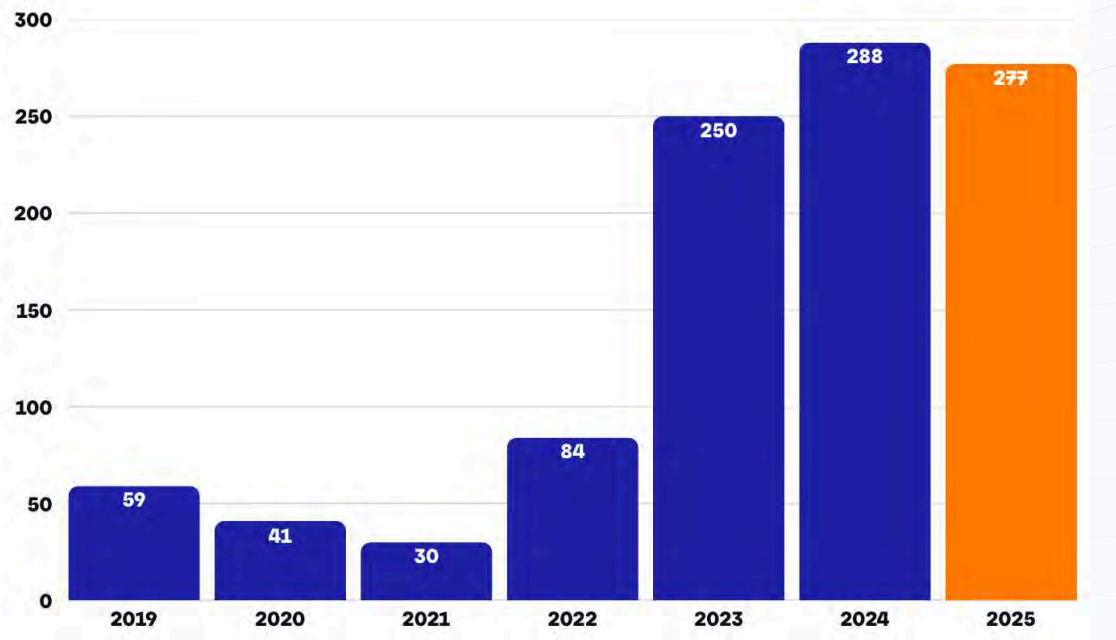
Bitcoin mining crossed a historic threshold by the end of 2025. According to a recent report from GoMining, the network has entered the Zetahash era, with total computing power exceeding 1 Zetahash per second. The report shows that the seven-day average transaction speed of the Bitcoin network remains above 1 ZH/s, indicating a structural change rather than a temporary spike.
This growth reflects active hardware upgrades, new data centers, and expanding industrial operations. The Bitcoin mining industry is no longer dominated by a few fringe companies; it has evolved into an industry akin to energy infrastructure. As a result, competition for block rewards has intensified dramatically. 1 Zetahash equals 1,000 Exahash, a figure that was considered unattainable just a few years ago.
The arrival of the Zetahash era demonstrates that Bitcoin network security has reached an unprecedented level. Higher hash power means attacking the network requires more computational resources, making 51% attacks economically nearly impossible. However, this increase in security comes at the expense of miner profitability. As more hash power competes for fixed block rewards, each miner’s share naturally diminishes.
Contradiction Between Hashrate Growth and Revenue Decline
Hashrate Breakthrough: Network hash power exceeds 1 ZH/s, reaching a new high, security peaks
Revenue Collapse: Per-unit earnings drop to a historic low, miner profitability sharply declines
This contradiction reveals the harsh reality of the Bitcoin mining industry: the arms race in hash power has no end. Miners must continually upgrade equipment to stay competitive, but total industry revenue remains fixed (about 900 BTC in block rewards daily plus a small amount of transaction fees). This zero-sum game continually compresses profit margins, leaving only the largest, lowest-cost, most efficient mining farms able to survive.
Transaction Fee Share Falls Below 1%, Miners Rely Entirely on Coin Price
(Source: GoMining)
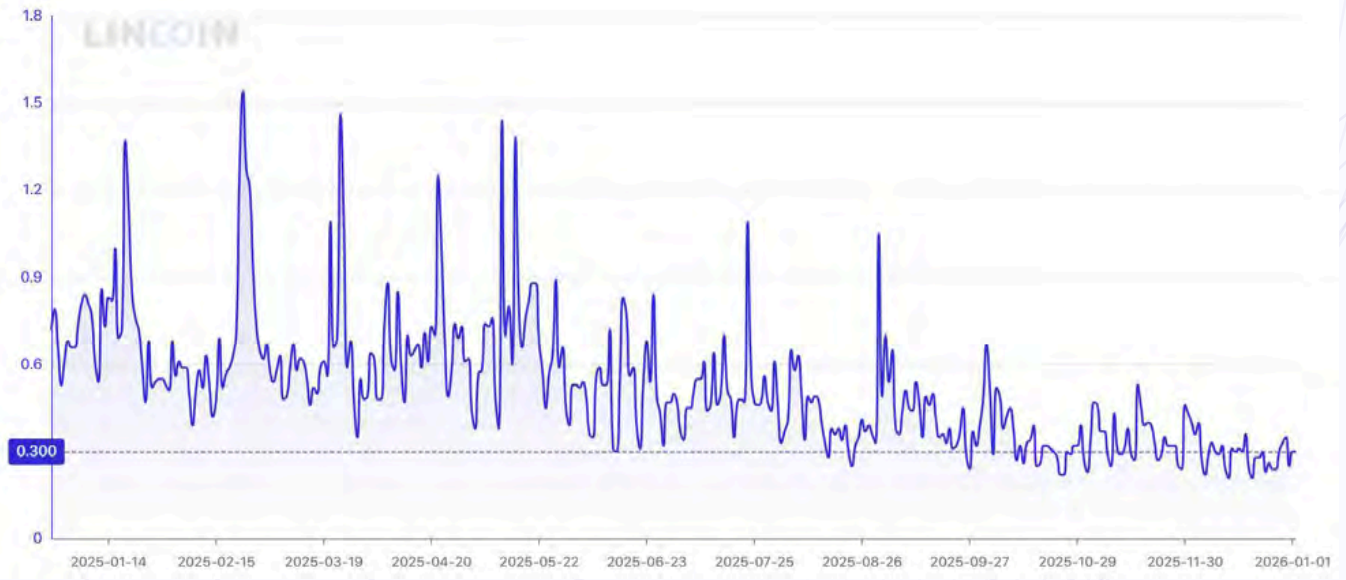
Despite the increase in hash power, revenue per unit of computation has entered one of the narrowest ranges on record. The report emphasizes that miners’ income is increasingly dependent on Bitcoin’s price and mining difficulty. Other buffers, such as surging transaction fees and block subsidies that once eased profit pressures, have disappeared. This compression means that even with more capital and energy投入, miners’ profit margins are shrinking.
The post-halving period has further intensified this pressure. With block rewards halved to 3.125 BTC, transaction fees have failed to make up for the revenue shortfall. The report notes that for most of 2025, fees accounted for less than 1% of total block rewards. Therefore, miners’ economic viability is directly affected by Bitcoin’s price fluctuations, with fewer internal stabilizers.
According to GoMining, this impact is evident in the mempool. Since April 2023, Bitcoin’s mempool has been emptied multiple times for the first time in 2025. This indicates that the network is very quiet; even with minimal fees, transactions are confirmed immediately. As a result, miners can hardly profit from fees and rely almost entirely on Bitcoin’s price and block subsidies for income.
The collapse of fee revenue contrasts sharply with 2021. Back then, the NFT craze and DeFi applications drove Ethereum fees soaring, and although Bitcoin does not support smart contracts, the emergence of Ordinals and inscriptions temporarily boosted Bitcoin fees. However, these use cases shrank significantly in 2025, causing fees to fall to negligible levels. This reliance on a single income source (block rewards) makes miners extremely sensitive to Bitcoin’s price swings.
Market pressure is clearly reflected in the hash price (daily income per hash rate). The report shows that in November, the hash rate hit a historic low, approaching $35 per TH/s per day, and continued to weaken into the end of the year. By the end of the quarter, the hash price was around $38, well below the historical average. This leaves very little room for operational errors.
Shutdown Price of $70,000 Becomes Industry’s Life and Death Threshold
At current mining difficulty and electricity costs close to $0.08 per kWh, the breakeven point for widely used S21 series miners per Bitcoin mined ranges between $69,000 and $74,000. Falling below this range, many mining farms will cease to be profitable. More efficient high-end miners have seen prices drop significantly but still remain competitive. However, mid-tier miners face imminent pressure.
This shutdown price calculation depends on multiple variables: miner efficiency (power consumption per TH/s), electricity costs, mining difficulty, and Bitcoin’s price. When Bitcoin’s price drops below this shutdown point, mining revenue cannot cover electricity costs, and continuing to operate results in losses. Rational miners will shut down their equipment, waiting for prices to rebound or selling assets to cut losses.
This makes Bitcoin’s price very critical now. It does not establish a price floor; market trading prices may fall below the break-even point. But it creates a behavioral threshold. If Bitcoin’s price remains below this critical shutdown level, weaker miners may sell reserves, shut down equipment, or reduce investments. In a liquidity-tight environment, these actions could further exacerbate market volatility.
As profit margins tighten, mining companies become more vulnerable to price declines, increasing the risk of shutdowns and sell-offs near key economic levels. When Bitcoin approaches $70,000, a chain reaction could occur: some miners shut down → hash power decreases → mining difficulty adjusts downward → remaining miners’ profits improve. This dynamic adjustment is a self-correcting mechanism of the Bitcoin network, but the process can involve sharp price swings.
Bitcoin mining is more powerful and industrialized than ever before. But this scale also introduces sensitivity. As hash power grows and fees decline, the impact of price fluctuations on miner stability becomes more pronounced. This makes levels like $70,000 economically significant, not just as shown on charts, but because the network’s cost structure makes it so.
Related Articles
Core Scientific Plans to Sell Nearly All 2,500 BTC in Q1 2026: Here’s Why
Crypto News Today: Bitcoin Soars To $69k, NEAR Spikes, and DeepSnitch AI Leads Among 2026 Promising Presales With 250x Explosive Potential
BTC 15-minute sharp decline of 1.60%: Bullish liquidation and risk aversion sentiment intensify short-term selling pressure