


The hottest market since 1979, why does it appear in gold, silver, and copper?
Author: Eli5DeF
Compilation: Yuliya, PANews
Driven by the “perfect storm” of supply scarcity, booming artificial intelligence (AI) infrastructure, and central banks around the world distancing themselves from the US dollar, gold, silver, and copper are experiencing their hottest market since 1979.
This article will analyze over 40 research reports, distill key insights, and explore future trends.
TL;DR
- Data Perspective: Since 2025, gold prices have risen 72%, silver up 120%, and copper up 40%, marking the first time in 45 years that all three have simultaneously hit record highs.
- Core Argument: This is not a cyclical rebound but a fundamental shift in the valuation logic of hard assets.
- Investment Opportunities: In 2025, silver mining ETFs have returned as much as 195%, and this rally is not over yet.
- Risk Warning: Peace agreements, the emergence of material substitutes, and short-term market corrections could lead to a 20% to 40% price pullback.
From AI to Energy, Gold, Silver, and Copper Become the New “Three Pillars”
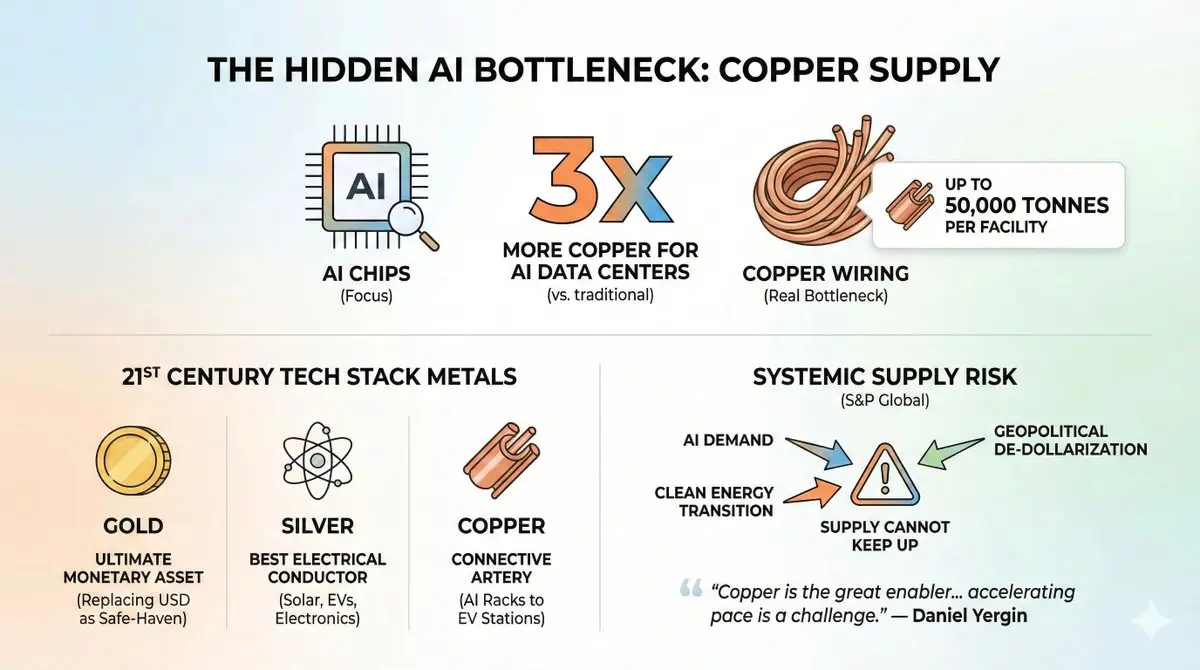
Currently, everyone’s focus is on AI chips, but the real supply bottleneck lies in the copper wiring connecting these chips.
A startling data point: AI data centers consume three times more copper than traditional data centers, with a single facility potentially using up to 50,000 tons of copper. For example, Microsoft’s $500 billion “Stargate” project could consume more copper than the annual output of some small countries.
Moreover, the demand is driven not only by AI. The entire tech stack of the 21st century is built on these three metals:
- Gold: The ultimate monetary asset, replacing the dollar during geopolitical crises and becoming the primary safe haven.
- Silver: The best conductor of electricity on Earth, vital for solar panels, electric vehicles, and data center electronics.
- Copper: The “artery” connecting all electrification systems, from AI server racks to EV charging stations.
The convergence of AI demand, clean energy transition, and de-dollarization of geopolitics has created what S&P Global calls a “systemic risk” in the global economy, with supply unable to keep pace with demand.
“Copper is a great driver of electrification, but the acceleration of electrification poses increasingly severe challenges to copper supply.”
—— Daniel Yergin, Vice Chairman of S&P Global
This is no exaggeration. Let’s analyze the data one by one.
1. An Unsolved Supply Crisis
Silver: Fifth consecutive year of supply deficit
Since 2020, the silver market has never achieved supply-demand balance, and the situation is worsening.
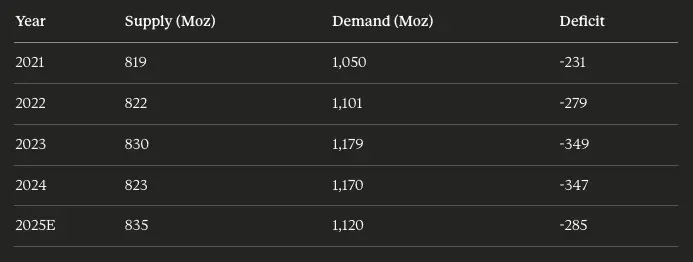
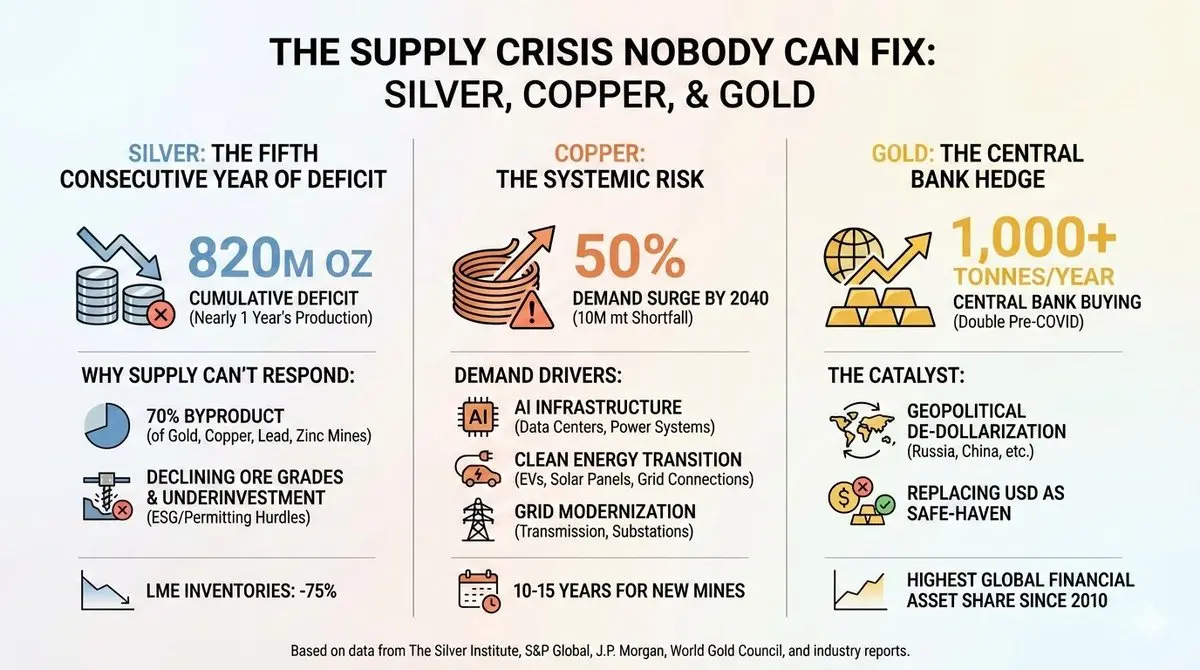
From 2021 to 2025, the cumulative supply shortfall approaches 820 million ounces, nearly equivalent to a full year of global production. LME silver inventories have plummeted 75% from their 2019 peak. In October 2025, silver prices briefly hit a record high of $54.24/oz before retreating.
Why can’t supply keep up?
A little-known secret of the silver mining industry is that 70% of its output is produced as a byproduct of gold, copper, lead, and zinc mines. This means that when the market needs more silver, it’s not as simple as just opening new silver mines; the primary metal must also be economically viable to mine, which in turn drives silver production. Currently, this is not the case.
Native silver deposits also face many challenges: declining ore grades, severe underinvestment in exploration over the past decade, and environmental, social, and governance (ESG) and permitting hurdles, which could delay new projects by more than ten years.
The Silver Institute bluntly states: “Over the past decade, investment in silver mines has been insufficient.”
Copper: Systemic risk
If silver’s situation is worrying, then copper’s problem is a matter of survival.
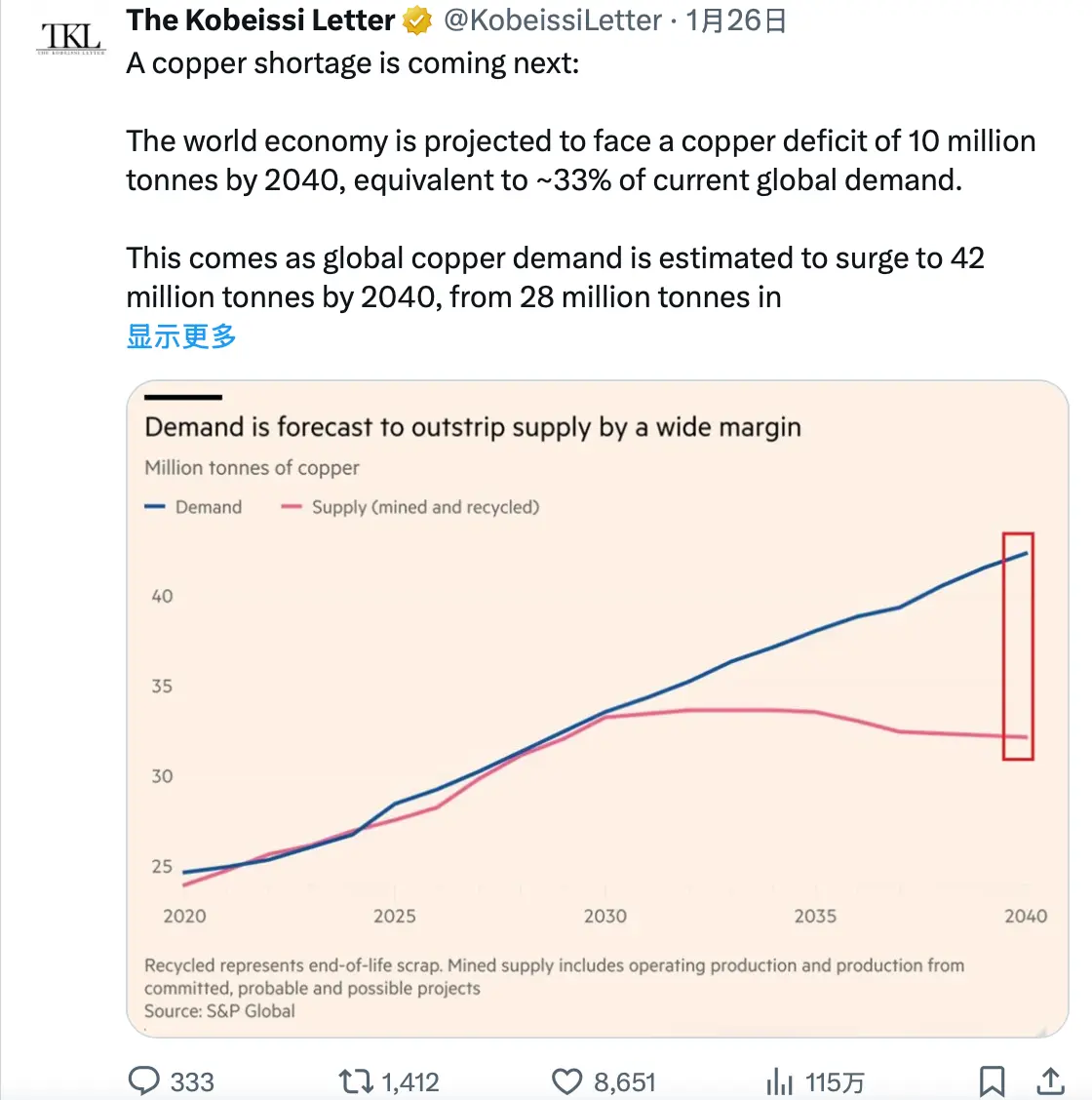
A January 2026 report from S&P Global forecasts that by 2040, global copper demand will surge 50%, from 28 million tons to 42 million tons, while supply growth will slow or even decline.
By 2040, the copper supply gap could reach 10 million tons, nearly 40% of current global output.
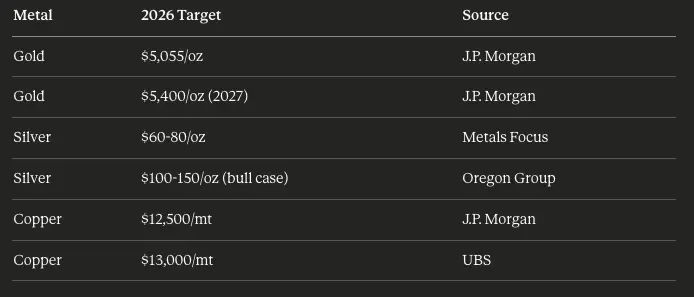
J.P. Morgan predicts that in 2026 alone, refined copper will face a shortfall of 330,000 tons, with prices possibly reaching $12,500 per metric ton mid-year.
What is driving demand?
Three macro trends converge:
- AI Infrastructure: In 2025, half of US GDP growth comes from AI-related spending, including data centers, chips, and power systems. A large-scale AI facility consumes 27 to 33 tons of copper per megawatt (MW). The data is stark: global data center electricity demand is projected to grow from 2% of total electricity consumption today to 9% by 2050.
- Clean Energy Transition: Copper use in EVs is 2.9 times that of internal combustion engine vehicles, with about 60 kg of copper per vehicle. Solar panel installations have exceeded 500 GW annually, with each GW requiring thousands of tons of copper in panels, inverters, and grid connections.
- Grid Modernization: Delivering power to AI data centers consumes more copper than the data centers themselves. Upgrading grids, transmission lines, and substations are heavily copper-dependent.
Why can’t supply keep pace?
New copper mines take 10 to 15 years from discovery to production, and few projects are currently in development. Major disruptions in 2025—such as the Grasberg mine in Indonesia experiencing a mudslide, ongoing issues at the Kamoa-Kakula mine in Congo, and drought at Chile’s El Teniente—exacerbate shortages.
The Resolution Copper project in the US could be a major domestic source, but legal battles over sacred Apache lands have delayed it by at least ten years.
As one analyst notes: “Mining companies are promoting a compelling long-term shortage story—and the market believes it. But belief and fundamentals are not the same.”
However, the fundamentals currently support this belief.
Gold: A Hedge for Central Banks
Gold’s situation is different. It does not face an industrial supply crisis; production remains stable at about 3,000 tons annually.
The real change is in who is buying.
Since Russia’s invasion of Ukraine in 2022 and the freezing of its foreign reserves, central banks worldwide have been accumulating gold at an unprecedented pace. For three consecutive years, global central bank gold purchases exceeded 1,000 tons annually—more than double pre-pandemic levels.
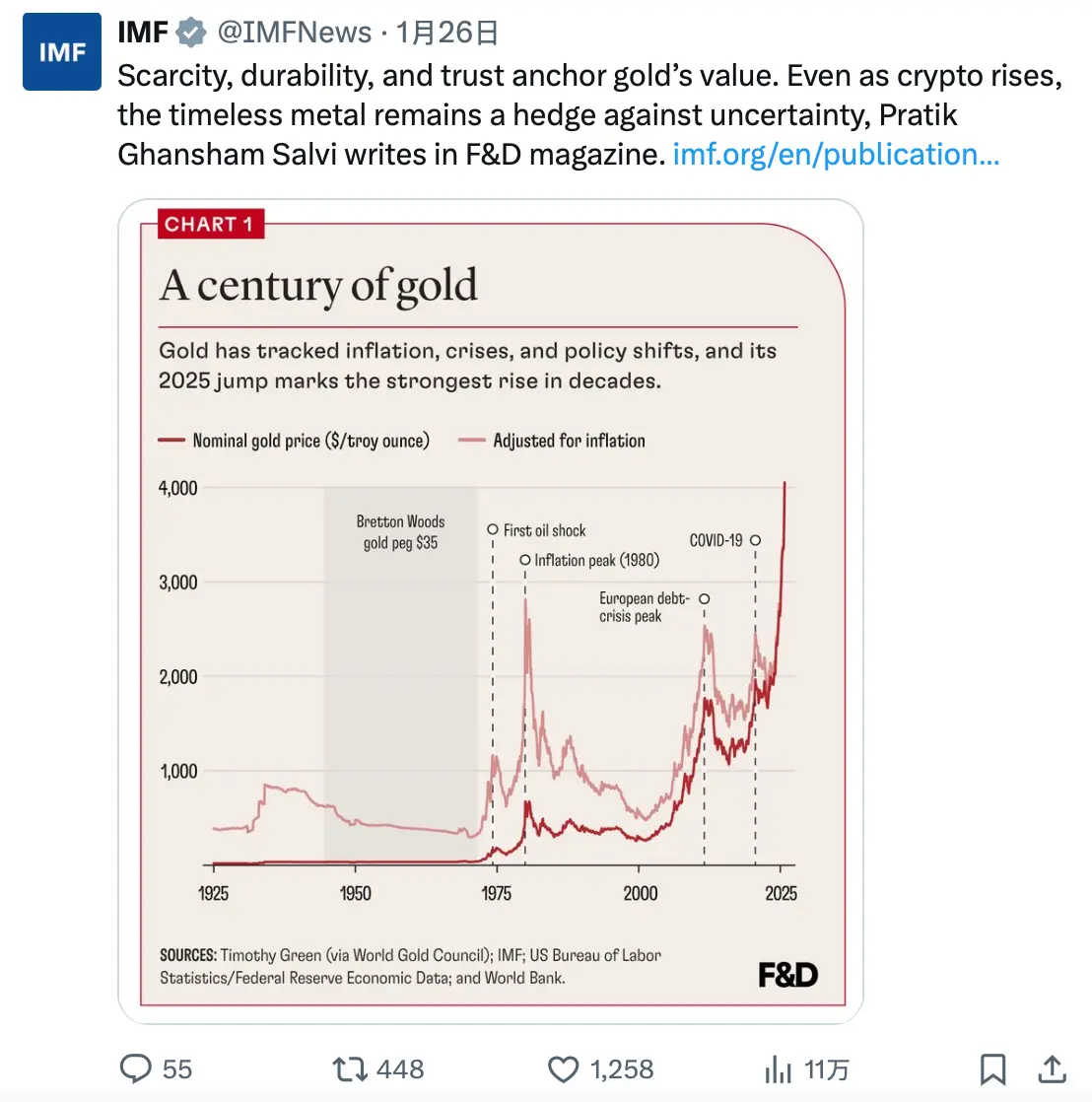
China alone has increased its gold holdings for 13 consecutive months, while reducing its US Treasury holdings to the lowest in 17 years (by the end of 2024, $688 billion).
This is not speculation but a structural shift in how sovereign wealth managers view reserve assets.
Data from the World Gold Council shows that gold’s share of total financial assets has risen to 2.8%, the highest since 2010. J.P. Morgan forecasts that in 2026, central banks will continue to buy around 755 tons, and gold prices could reach $5,055 per ounce in Q4.
An under-discussed catalyst:
Before 2022, the US dollar was the primary safe-haven asset during geopolitical crises. Now, that has changed. During the 2025 Venezuela crisis—when the US detained Nicolás Maduro—gold prices surged while the dollar exchange rate remained nearly unchanged.
Gold has replaced the dollar as the market’s preferred safe haven during rising geopolitical risks.
2. Unexpected AI Demand
For readers interested in tech, the following will be particularly compelling.
Data Centers: New Copper Consumers
Traditional data centers are already heavy copper users, relying on copper for power distribution, cooling, and networking. AI data centers are on an entirely different scale.
Relevant data:
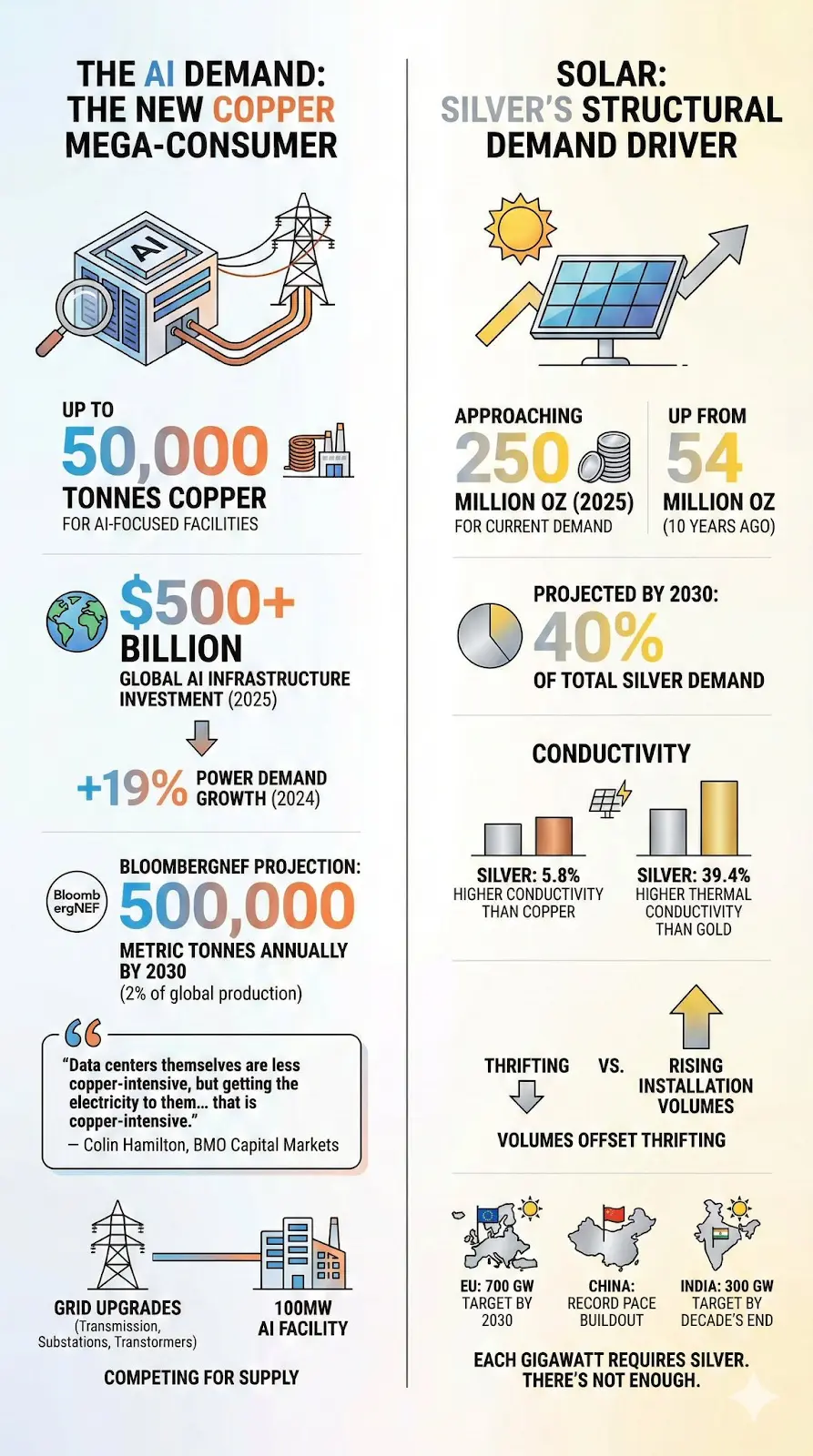
- A typical hyperscale data center uses 2,000 to 3,000 tons of copper.
- AI-focused facilities can use up to 50,000 tons.
- Global AI infrastructure investment exceeds $500 billion in 2025.
- In 2024 alone, data center electricity demand grew 19%, compared to 8% in 2022.
BloombergNEF predicts that by 2030, data centers could consume 500,000 tons of copper annually—about 2% of global production, up from nearly zero ten years ago.
But the real demand is driven not just by data centers themselves but by the grid infrastructure needed to power them.
“While the copper intensity of data centers is gradually decreasing, the process of transmitting power to data centers is extremely copper-intensive.” — Colin Hamilton, BMO Capital Markets
Each 100 MW AI facility requires large-scale grid upgrades, including transmission lines, substations, and transformers—all competing for limited copper supplies.
Solar Power: Structural Demand Driver for Silver
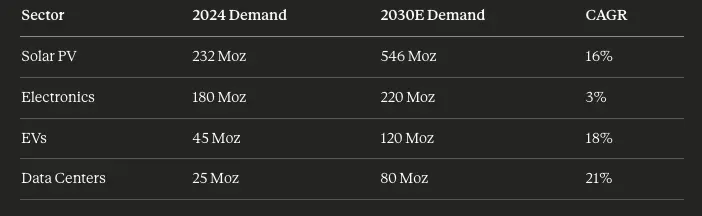
The solar PV industry has profoundly transformed the silver market. Ten years ago, solar used 54 million ounces of silver annually. By 2025, this has grown to nearly 250 million ounces, and demand continues to rise.
Forecasts suggest that by 2030, solar could account for 40% of global silver demand.
Silver’s excellent electrical (5.8% better than copper) and thermal (39.4% better than gold) conductivities make it irreplaceable in high-efficiency applications. Despite efforts by solar manufacturers to “reduce silver usage,” the increasing installed capacity offsets these savings.
The EU aims for 700 GW of solar capacity by 2030; China continues at an unprecedented pace; India plans to reach 300 GW by the end of this decade.
Each GW of capacity requires silver, but supply is tight.
3. Geopolitical Catalysts
“De-dollarization” Is Real
The Russia-Ukraine war not only disrupted commodity supplies but also triggered a fundamental reassessment by sovereign wealth managers of reserve asset allocations.
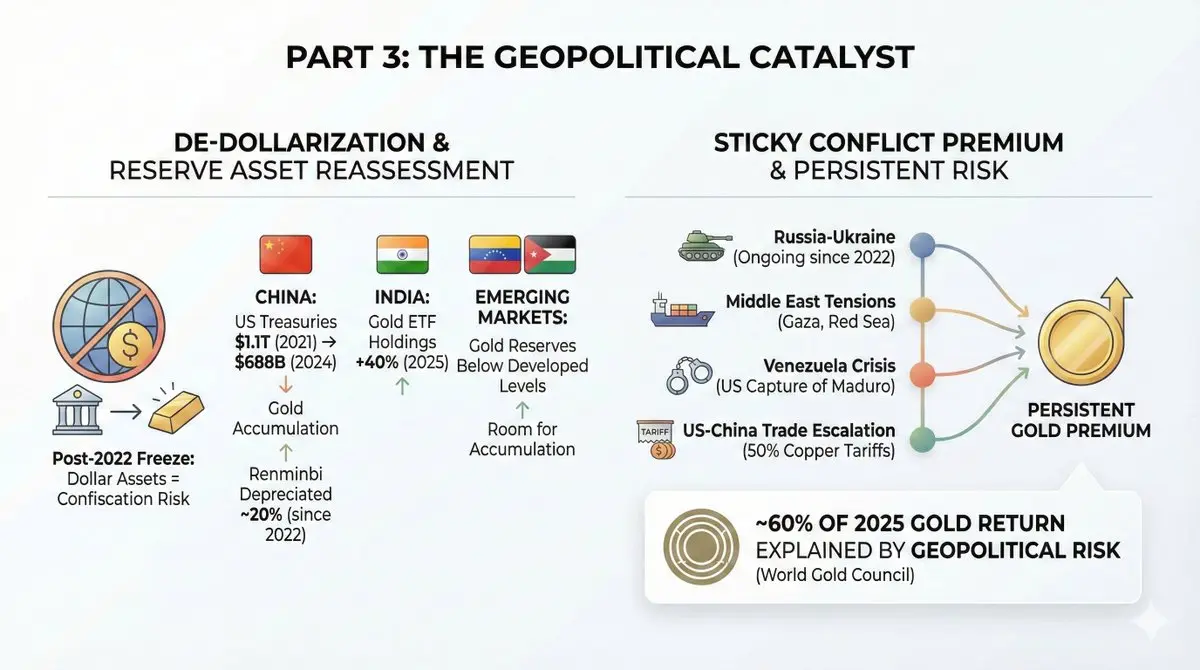
When Western countries froze Russia’s foreign reserves in 2022, central banks worldwide took notice. The message was clear: assets denominated in dollars face confiscation risks.
Responses have been explicit:
- China: Reduced US Treasury holdings from $1.1 trillion in 2021 to $688 billion in 2024, while accumulating large amounts of gold.
- India: Increased its gold ETF holdings by 40% in 2025.
- Emerging Markets: Their gold reserves are well below those of developed economies, indicating room for continued accumulation.
Since early 2022, the renminbi has depreciated nearly 20%, making gold a more attractive store of value for Chinese savers and institutions.
Conflict Premium Is Sticky
Traditional thinking suggests that once headlines fade, geopolitical risk premiums in commodities quickly dissipate. But that’s not the case now.
2025 has seen multiple geopolitical hotspots:
- Russia-Ukraine conflict (ongoing since 2022)
- Middle East tensions (Gaza, Iran attacks, Red Sea shipping disruptions)
- Venezuela crisis (Maduro’s detention)
- Escalating US-China trade tensions (50% tariffs on copper announced)
Each event reinforces gold’s safe-haven status. The cumulative effect: even during calmer periods, a persistent premium remains.
The World Gold Council’s analysis shows that geopolitical risk explains about 60% of gold’s return in 2025—the highest contribution on record.
4. Investment Logic
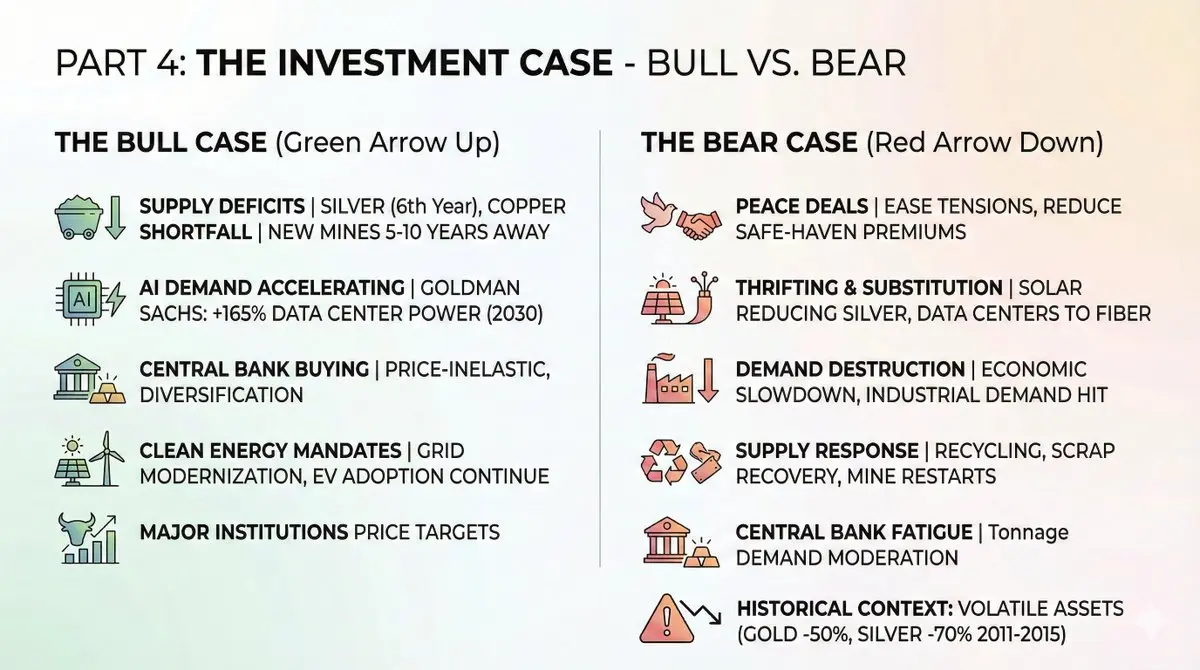
Bullish Reasons
Persistent structural drivers:
- Ongoing supply deficits: Silver is expected to see a sixth consecutive deficit in 2026. Copper shortages are widening. New mine supply takes 5–10 years to come online.
- Accelerating AI demand: Goldman Sachs forecasts a 165% increase in data center power demand by 2030. Every watt of power needs copper.
- Central bank buying continues: Even if gold surpasses $4,000/oz, central banks are insensitive to price. Diversification needs outweigh short-term price sensitivity.
- Clean energy policies remain effective: Despite geopolitical shifts, grid modernization and EV adoption continue globally.
Price targets from major institutions:
Bearish Risks
Before investors go all-in, consider potential risks:
- Peace agreements: Easing of Russia-Ukraine tensions, Middle East de-escalation, or US-China trade thaw could significantly reduce safe-haven premiums.
- Efficiency and substitutes: Solar manufacturers are actively reducing silver use. Data centers are shifting some applications to fiber optics. These trends will accelerate at high prices.
- Demand destruction: Economic slowdown could severely impact industrial demand—remember, 60% of silver demand is industrial.
- Supply response: High prices will stimulate recycling, scrap recovery, and marginal mine reactivation. Some deficits may be offset by above-ground inventories.
- Central bank fatigue: When gold exceeds $4,000/oz, central banks need fewer tons to reach dollar allocation targets, potentially slowing demand.
Historical context: after the post-GFC rebound, gold fell 50% from 2011 to 2015, and silver plummeted 70%. These are highly volatile assets.
How to Position
Risk-profiled investment tools:
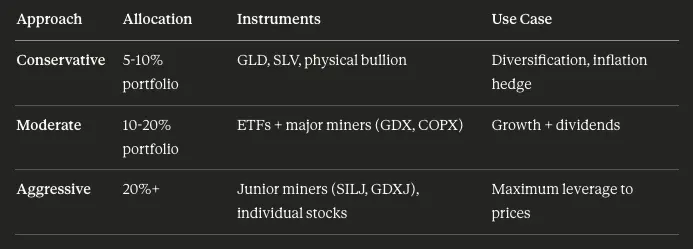
Selected ETFs:
1. Physical Exposure:
- $GLD (SPDR Gold Shares)—largest and most liquid gold ETF.
- $SLV (iShares Silver Trust)—most liquid silver ETF.
- $PSLV (Sprott Physical Silver)—redeemable for physical gold/silver.
2. Mining Exposure:
- $GDX (VanEck Gold Miners)—major gold miners, up 166% in 2025.
- $SILJ (Amplify Junior Silver Miners)—junior silver miners, up 195% in 2025.
- $COPX (Global X Copper Miners)—broad copper miners, up 80% in 2025.
3. Notable Stocks:
- Wheaton Precious Metals ($WPM)—metal streaming model, lower operational risk.
- Pan American Silver ($PAAS)—largest primary silver producer.
- Freeport-McMoRan ($FCX)—blue-chip copper exposure.
4. DeFi Perspective: For on-chain exposure:
- PAXG (Paxos Gold)—1:1 backed token, usable in DeFi.
- XAUT (Tether Gold)—institution-grade tokenized gold.
- Trading HIP-3 on HyperliquidX allows long/short commodity positions.
These tools enable yield strategies on gold positions within DeFi protocols—something physical gold and silver cannot do.
Risk Warning
It’s essential to acknowledge potential risks:
- Volatility risk: These are not stablecoins. During 2011–2015 corrections, gold fell 50%, silver 70%. Position sizing is crucial.
- Timing risk: This rally is historic. Entering after 72% gold and 120% silver gains means paying high prices.
- Liquidity risk: During market stress, junior miners may have poor liquidity, widening bid-ask spreads when most needed.
- Operational risk: Mining companies face cost overruns, permitting delays, labor disputes, and resource nationalism. ETFs can mitigate but not eliminate these risks.
- Macro risk: A soft landing with falling inflation and rising real interest rates could pressure gold prices.
Conclusion
The bullish case for gold, silver, and copper is not based on speculation but on mathematics.
Demand is structurally higher: AI infrastructure, clean energy, and de-dollarization are not cyclical but long-term structural shifts with a decade-long tailwind.
Supply is structurally constrained: new mines take over a decade to develop, ore grades are declining, and recycling cannot fill the gap.
Markets are beginning to price this in. In 2025, mining ETFs outperform physical metals significantly, signaling that mature capital is positioning for sustained commodity strength.
This is more than a trade; it’s a transformation of the hard asset valuation system amid AI infrastructure buildout, energy transition, and fiat currency devaluation.
The window of opportunity is open but will eventually close.
Investors should adjust their positions accordingly. NFA + DYOR.
Related Articles
Dalio: "There is only one kind of gold," Bitcoin is not a true safe haven tool for central banks
Why did Bitcoin drop today? Trump threatens to deploy ground troops, Iran conflict uncertainty prolongs
Crypto Fear Index drops to 10, market "Extreme Fear" has lasted nearly a month
ETF Launch Fails to Stem Tide As XRP Sinks to $1.81, Lowest Since April
Here’s Where Gold Price Could Head Next After the $300 Drop
Analyst Says Not Buying Kaspa (KAS) Here Is a “Disservice” – Here’s Why