


Big Brother Ma Ji gets liquidated and adds more! 25x ETH long position suffers a massive loss of 25 million but refuses to admit defeat
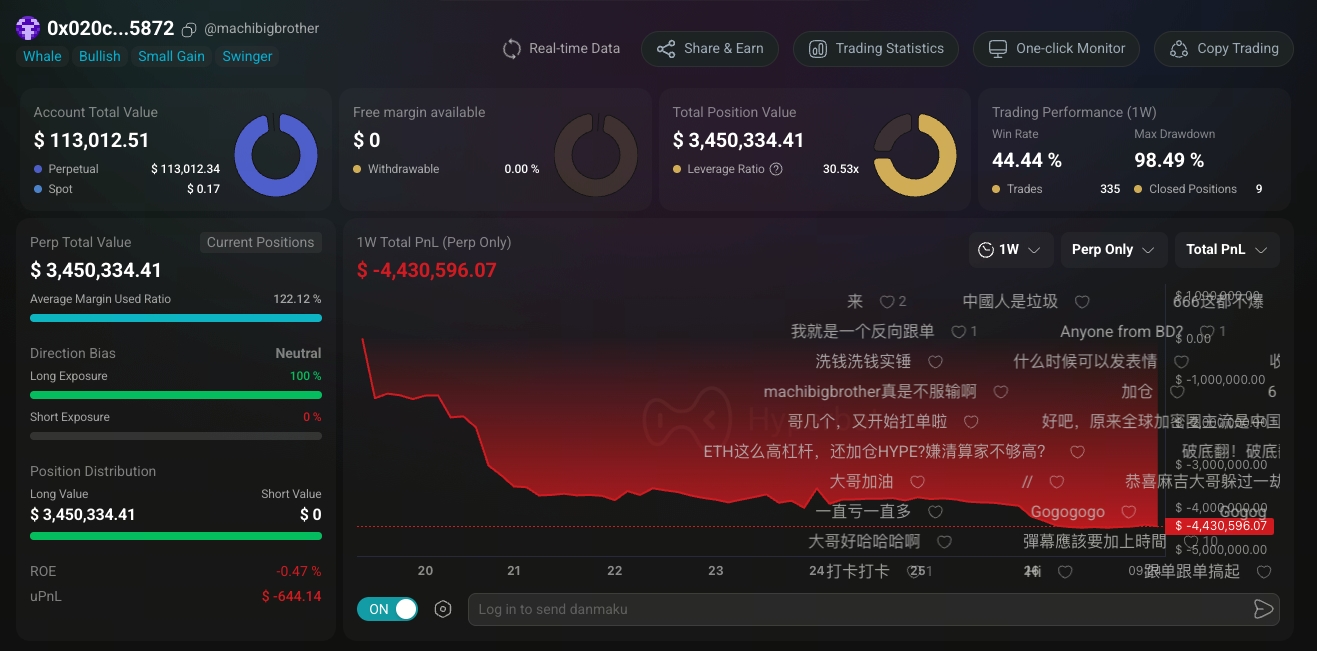
“Brother Maji” Huang Licheng experienced two liquidations in one night on January 25-26, losing a total of 580,000 USD. Immediately after liquidation, he reopened a 25x leveraged ETH long position and was soon liquidated again. Year-to-date losses amount to 25 million USD; a 4% move against his position at 25x leverage would trigger liquidation. He holds 9,990,000 ETH in spot, with total assets of 130 million USD.
Brother Maji Liquidated Twice in One Night, 580,000 USD Vanished
(Source: Hyperbot)
Taiwanese entertainer and crypto whale “Brother Maji” Huang Licheng was liquidated twice in quick succession on the decentralized derivatives platform Hyperliquid from late night January 25 to early morning January 26. After ETH price dropped below 2,900 USD, his 25x leveraged long position was fully liquidated by the system, with his paper gains evaporating over 580,000 USD within hours. According to Onchain Lens monitoring, as the market declined, Brother Maji’s 25x leveraged ETH long was once again completely liquidated.
Data from Coindesk shows that Bitcoin’s price suddenly plummeted around midnight on the 26th, briefly falling below 87,000 USD and reaching a low of 86,253.29 USD; Ethereum’s price also declined sharply, briefly dropping below 2,800 USD and hitting a low of 2,789.61 USD. This collective crypto market crash created a perfect environment for high-leverage traders to be liquidated. According to a recent post by on-chain analysis team Lookonchain, due to the market decline, Huang Licheng was liquidated again, losing 1,000 ETH (worth 2.88 million USD).
Currently, Huang Licheng holds 3,750 ETH (worth 10.84 million USD), with a new liquidation price of 2,858.32 USD. This means that if ETH drops about 2% more, he will face a third liquidation. Monitoring data shows that at 25x leverage, a mere 4% adverse move can trigger a margin call. When ETH breaks psychological thresholds, Hyperliquid’s system immediately confiscates collateral to cover debts, leaving the position worthless.
More remarkably, after the first liquidation, he almost immediately reopened a new position with the same leverage; as the market continued to decline, the new position was quickly partially liquidated, creating a chain reaction of “liquidation—adding margin—liquidation again.” This behavior is extremely rare among professional traders, as experienced traders typically analyze market conditions and adjust strategies after a liquidation, rather than re-entering immediately with the same leverage.
Gambler’s Fallacy Driving a Continuous High-Stakes Cycle
Behavioral finance calls this kind of repeated betting the “Gambler’s Fallacy.” Data shows he attempted to catch rebounds before prices stabilized, hoping to recover losses with a single successful trade. However, Hyperliquid’s mechanism is unforgiving; under high leverage, maintenance margin is very low, and if the market moves against expectations, the algorithm acts ruthlessly. Compared to conservative margin rules in traditional finance, this event highlights the stark differences in DeFi’s liquidity and risk management: transparent but extreme.
Reviewing from October to November 2025, he recorded 71 liquidations in a single month, totaling 145 instances during turbulent market conditions. Moving into 2026, the pattern persisted. On January 20, ETH hovered around 2,960 USD, and he experienced 5 partial liquidations in one day. Such multiple liquidations in a single day are extremely rare, indicating that after each partial liquidation, Brother Maji added more collateral in an attempt to salvage his position rather than cut losses.
To maintain his position, he added 260,000 USDC in collateral on January 23, trying to “hold on,” but this only increased his sunk costs. In total, his losses over the past few weeks exceeded 25 million USD. This behavior of adding collateral is known in trading psychology as “Sunk Cost Fallacy”—the invested funds cannot be recovered, but traders continue to pour in more money to try to reverse the situation, leading to a spiraling loss.
The core logic of the Gambler’s Fallacy is “I’ve lost so many times, the next one will be a win.” This completely ignores the independence of market movements—past losses do not increase the probability of future gains. Brother Maji’s repeated longs suggest he believes ETH has fallen enough and will rebound. But markets do not care about individual losses or hopes; prices are determined by supply and demand. When macroeconomic conditions worsen and capital continues to flow out, assets can decline far beyond most expectations.
A 25x leverage means only a 4% adverse move can trigger liquidation. Such extreme leverage amplifies any normal market fluctuation into a life-or-death test. ETH’s 5-10% hourly volatility is common; under 25x leverage, this can trigger multiple liquidations. Professional traders usually keep leverage between 3-5x to leave room for unexpected swings. Brother Maji’s choice of 25x leverage indicates his trading approach is more akin to gambling than rational investing.
Deep Capital Cannot Counteract High Leverage Amplification
Although he still holds about 99.9 million USD worth of ETH in spot and various altcoins, with total risk assets estimated at 130 million USD, short-term liquidity pressure has emerged. Wealth cannot shield against the amplified volatility caused by high leverage. Even with substantial capital, macro uncertainties from new policies, such as those from the Trump administration, have increased market volatility, exemplifying recent crypto traders’ challenges.
This case reveals a harsh truth: capital size and trading discipline are two different things. Someone with 130 million USD in assets can theoretically withstand huge losses, but that does not mean they should endure them. The accumulated 25 million USD loss accounts for nearly 20% of his total assets, an unacceptable drawdown under any professional asset management standard. Traditional hedge funds would typically dismiss a manager with 20% losses.
More importantly, if Brother Maji had used that 25 million USD for spot holdings or low-leverage strategies, he might not have lost anything, or even profited. ETH has experienced volatility over the past year but has not been in a one-way downtrend. The problem with high-leverage strategies is that they magnify short-term fluctuations into deadly risks; even if the long-term trend is correct, traders can be liquidated mid-way. This “correct direction but still losing” tragedy is the biggest trap of high-leverage trading.
His case also highlights the characteristics of DeFi derivatives platforms: transparent but extremely ruthless. All trades on platforms like Hyperliquid are recorded on-chain, allowing anyone to track large traders’ positions and liquidations. This transparency is absent in traditional finance and makes Brother Maji’s losses a public topic. But these platforms’ liquidation mechanisms are merciless—no matter if the user is a well-known figure or a major client, no leniency is granted. Algorithms execute rules coldly; when prices hit liquidation levels, positions are closed immediately.
From a risk management perspective, even if he recognizes the macro uncertainties from new policies, Brother Maji did not adjust his aggressive trading strategy. When market volatility increases, the rational response is to reduce leverage rather than maintain or increase positions. His behavior of “knowing there’s a tiger on the mountain but charging ahead” may stem from past successes in other fields (music industry, NFTs), leading to overconfidence and the belief that he can beat the market. But financial markets are different; they do not bend to personal confidence or past victories.
Related Articles
Iran strongly denies secret negotiations with the United States! The US-Iran conflict may escalate for a long time, Bitcoin breaks through $73,000, and Ethereum surpasses $2100
ETH short-term increase reaches 2.38%: Macroeconomic safe-haven capital inflows and ETF institutional funds resonate to drive prices higher
Bitcoin, Ethereum, XRP Rally as ETF Inflows Hit $458M Amid Strait of Hormuz Crisis
Over the past hour, the entire network has experienced liquidations exceeding $75 million, mainly short positions.
Bitcoin briefly breaks through $72,000, Ethereum approaches $2,100! The entire network experiences $420 million in liquidations as short positions are wiped out.