


October liquidation event shocks the market! Altcoin funds flee in panic, retail investors return to Bitcoin
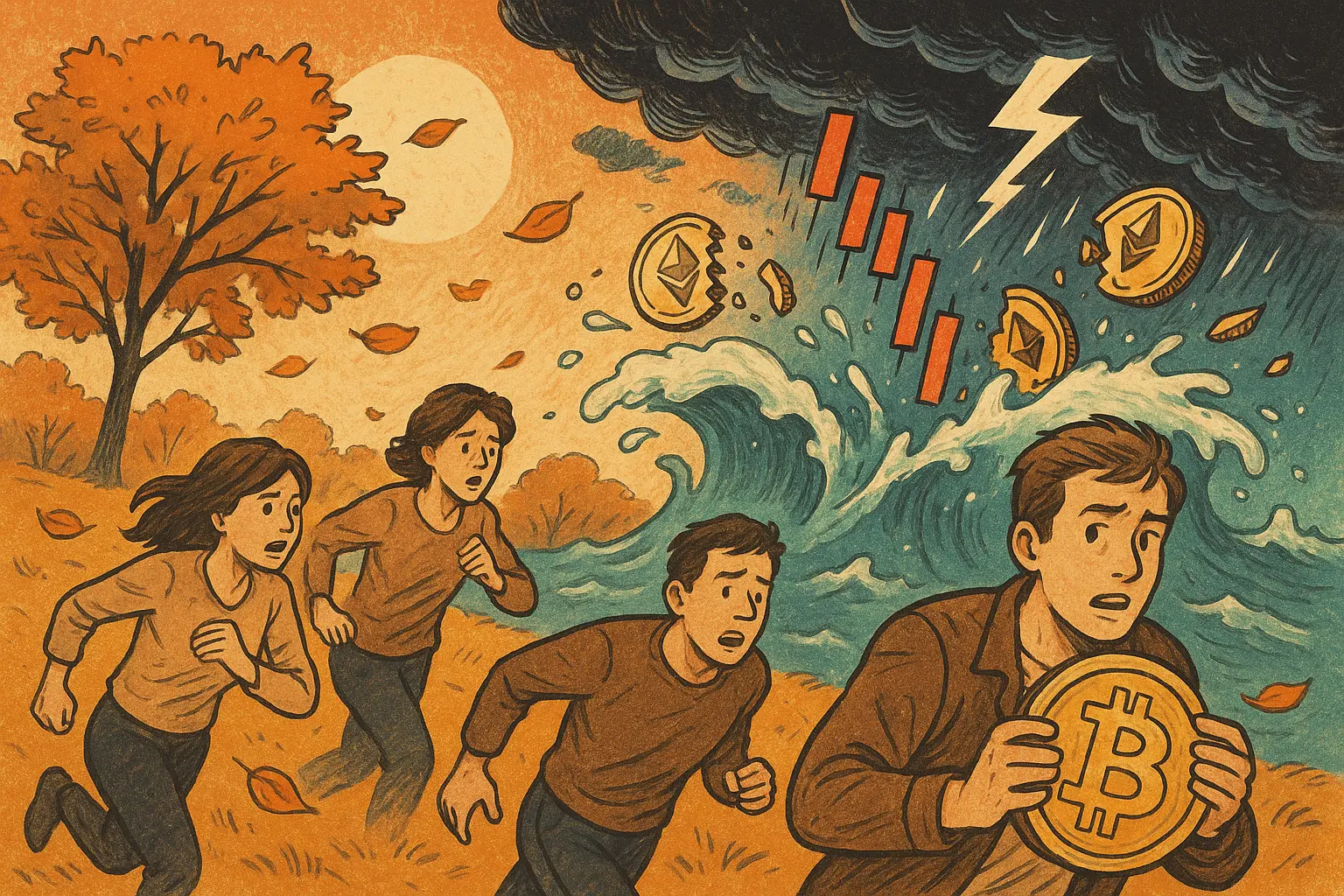
Wintermute report indicates that the October 10 liquidation event marked a turning point, with retail investors shifting from altcoins to Bitcoin and Ethereum. Since 2022, retail preference for altcoins was prevalent but was broken by 2025. Adopting a defensive stance aligned with institutions, prioritizing liquidity over marginal risks. The duration of altcoin rallies shortened from 60 days to 19 days, reflecting declining confidence.
Defensive Turning Point of the October 10 Liquidation Event
(Source: Wintermute)
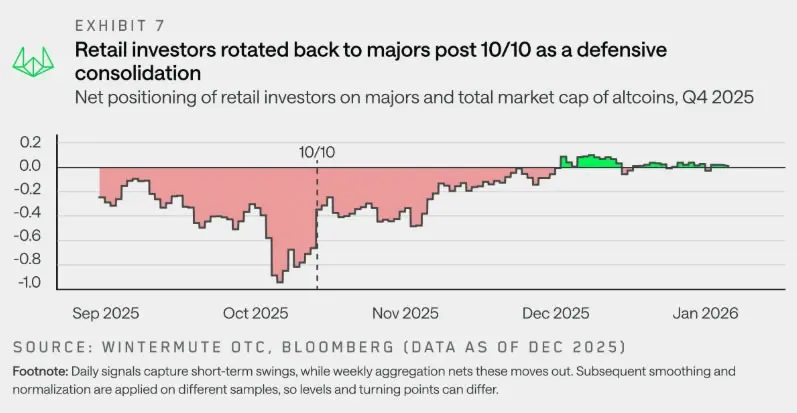
Wintermute states that, frightened by the large-scale cryptocurrency liquidation event on October 10, retail traders retreated to mainstream cryptocurrencies as their hopes for altcoins were shattered. According to the report, since around 2022, retail traders have been net sellers of major cryptocurrencies like Bitcoin and Ethereum, favoring altcoins, but this pattern was broken in 2025.
The company notes that the October 10 liquidation event and market crash “marked a clear turning point,” accelerating retail reallocation towards Bitcoin and Ethereum. Data shows that retail investors were actively reducing their investments in major assets at that time, but after a record-breaking leverage wave, they quickly re-entered these assets. “This indicates that, following the liquidation shock, the market immediately adopted a defensive posture, increasingly worried about the pandemic spread and the upcoming bear market.”
What happened on October 10? On that day, the global crypto market experienced massive liquidations, with hundreds of billions of dollars in leveraged positions forcibly closed. Bitcoin dropped over 10% in a single day, Ethereum fell more than 15%, and some altcoins declined over 30%. This extreme volatility rekindled memories of the 2022 bear market, making retail investors aware of the fragility of altcoins in extreme market conditions.
Three Main Reasons Retail Investors Flee Altcoins to BTC/ETH
Liquidity Exhaustion: Altcoins lose buying support during crashes, unable to exit at reasonable prices
Fundamental Doubts: Most altcoins lack real-world applications; bullish narratives are fragile in bear markets
Institutional Hedging Demonstration: Institutions lead selling of altcoins and shift to BTC/ETH, retail follow
Wintermute reports that by the end of the year, retail positioning has become aligned with institutions, “prioritizing liquidity and resilience over marginal risks.” This shift from “pursuit of quick riches” to “seeking safety” is a typical bear market psychology. When markets are filled with uncertainty, investors instinctively flee to the safest assets. In crypto, Bitcoin and Ethereum serve as such “safe assets”—they have the best liquidity, highest recognition, and greatest survival probability.
Altcoin Rallies Shrink from 60 Days to 20 Days, Confidence Collapse
(Source: Wintermute)
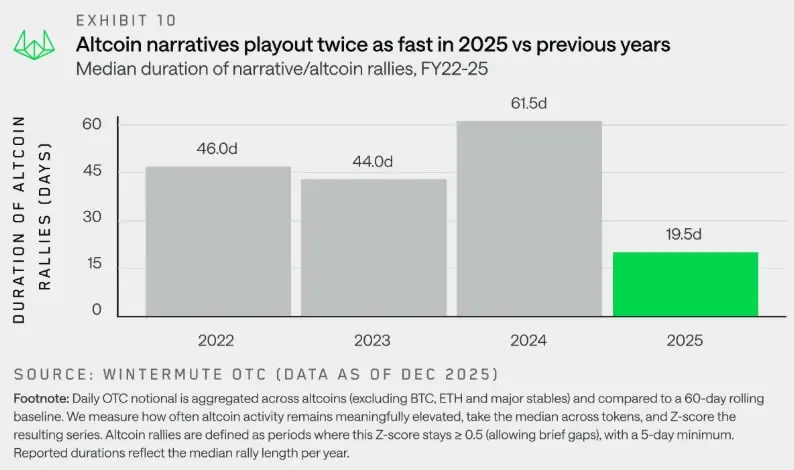
The return to mainstream currencies prevented any altcoin emergence during this cycle, with altcoins performing significantly below expectations in 2025. The report states: “Various narratives emerged, but none persisted.” Wintermute adds that the average duration of altcoin rallies in 2025 was about 19 days, down from around 60 days the previous year, “reflecting declining market confidence and more tactical risk-taking.”
This does not mean there is a lack of stories, but rather that the market “shows clear fatigue,” with rebounds quickly fading. From 2022 to 2024, altcoin rallies typically lasted 45 to 60 days and were accompanied by ongoing themes like meme coins and AI tokens. However, in 2025, the average duration of altcoin rallies is only 20 days. “This makes altcoin rallies feel more like tactical trades rather than high-confidence trends.”
The shortening of altcoin rally durations from 60 days to 20 days signifies what? First, a shortening of narrative life cycles. During the 2021 bull market, narratives like DeFi Summer and NFT craze could last for months, attracting continuous new capital. But in 2025, even seemingly strong narratives like AI tokens and RWA only sustain a few weeks before being forgotten by the market.
Second, the acceleration of capital rotation. When rallies last only 20 days, investors must complete the full cycle of “discovering opportunities → buying → selling” in a very short time. This high-frequency rotation makes it difficult for retail investors to keep up, often leading to chasing highs at the end of narratives and getting caught. Over time, retail investors learn the lesson of “not chasing altcoins.”
Third, systemic confidence collapse. When each altcoin narrative can only last 20 days, investors begin to question “Will the altcoin bull market return?” This skepticism reinforces itself: because of doubt, funds are reluctant to hold altcoins long-term; because funds avoid long-term holding, rallies become shorter; shorter rallies deepen skepticism. This vicious cycle makes 2025 a nightmare for altcoin investors.
Market Cap of $3.34 Trillion and Consolidation of Bitcoin Dominance
Although altcoins have not shown any real growth momentum in 2026, concerns and panic from the October crash have subsided, restoring confidence in the future. Earlier this month, Bitwise Chief Investment Officer Matt Hougan said: “I think one of the reasons for our rally at the start of this year is that investors have already put October 10 behind them.”
According to CoinGecko data, as of Wednesday, the total global market capitalization reached $3.34 trillion, a 10% increase since January 1, adding $300 billion, hitting the highest level this year. This overall market recovery is mainly driven by Bitcoin and Ethereum, which account for most of the growth in market cap. Bitcoin’s market cap increased from about $1.7 trillion to $1.9 trillion, and Ethereum from about $370 billion to $400 billion.
Bitcoin dominance (the proportion of Bitcoin’s market cap relative to the entire crypto market) continued to rise in 2025, from around 50% at the start of the year to nearly 58% by year-end. This consolidation of dominance reflects a fundamental shift in market structure: funds are no longer broadly rotating into altcoins but are concentrated in the safest assets—Bitcoin and Ethereum. This “flight to quality” phenomenon typically occurs during periods of high market uncertainty.
Retail investors’ defensive shift is not blind following but a rational choice based on painful lessons. When altcoins plunged 50%-80% during the October crash, while Bitcoin and Ethereum’s declines were contained within 10%-20%, the risk difference was clear. When altcoins’ rallies only last 20 days, but Bitcoin and Ethereum can sustain trends for months, the difference in holding costs is also obvious. Smart retail investors are beginning to realize that, in uncertain market environments, abandoning the dream of getting rich quick and protecting principal is the way to survive.
Related Articles
Data: In the past 24 hours, the total liquidation across the network was $371 million, with long positions liquidated at $241 million and short positions at $130 million.
Vitalik: Ethereum should build a "shelter-type technology"
Data: If ETH breaks through $2,084, the total liquidation strength of long positions on mainstream CEXs will reach $982 million.
ETH short-term surge of 1.30%: On-chain large transfers and concentrated liquidity drive price breakthrough of resistance