


Ethereum & Quantum Threat: Vitalik Buterin Urges Early Upgrades – Is the Risk Real Yet?
Ethereum co-founder Vitalik Buterin has renewed his call for the network to prioritize quantum-resistant cryptography at the base layer, warning that delays could create irreversible security risks down the line.
In a January 12, 2026 post on X, Buterin introduced the “walkaway test” — the idea that Ethereum’s protocol must remain secure, functional, and valuable for decades even if core developers and major institutions eventually step away. Central to this vision is achieving full quantum resistance soon, rather than waiting for practical quantum threats to materialize.
(Sources: TradingView)
Buterin argues strongly against postponing upgrades for short-term efficiency gains: “We should resist the trap of saying, ‘Let’s delay quantum resistance until the last possible moment in the name of eking out more efficiencies for a while longer.’” He stresses that while individual users can wait, protocols like Ethereum cannot — the goal is to reach a point where the network is cryptographically safe for the next hundred years as soon as possible.
Vitalik Buterin’s Evolving Stance on Quantum Threats
Buterin’s position marks a clear shift from his 2019 views, when he downplayed quantum risks as distant. Today, he sees them as serious enough to justify proactive action, even amid efficiency trade-offs from post-quantum algorithms (e.g., lattice-based, hash-based schemes that are bulkier and slower than current elliptic-curve cryptography like ECDSA).
His roadmap includes seven key milestones over the next few years:
- Full quantum resistance to protect against future attacks on public-key cryptography.
- Scalability via ZK-EVM validation and PeerDAS for thousands of TPS.
- Durable long-term state architecture.
- Account abstraction improvements.
- Censorship-resistant block building.
- DOS-resistant gas pricing.
- Decentralized proof-of-stake economics that can last decades.
These upgrades aim to make Ethereum “ossifiable” — stable enough that future innovation happens mostly through client optimizations and parameter tweaks, not constant hard forks.
The Debate: Proactive vs. Premature – Is the Quantum Risk Overstated?
Critics argue that rushing post-quantum schemes is premature. Candidate algorithms often increase transaction sizes, validation times, and hardware demands on nodes, potentially harming usability in the short term. Some experts maintain that practical, cryptographically relevant quantum computers remain 10–20+ years away, with median forecasts around 2040 and a ~20% chance of earlier breakthroughs by 2030 (per platforms like Metaculus).
Industry consensus in early 2026: No immediate threat exists. Current quantum machines lack the qubit scale, error correction, and stability needed to break ECDSA signatures or Keccak-256 hashes used in Ethereum. Progress is accelerating (e.g., Google breakthroughs), but experts like those cited in Deloitte reports and Chainalysis assessments place the realistic timeline at 5–15 years before meaningful risk emerges.
My analyst view: Quantum computers do pose a genuine long-term existential threat to cryptocurrencies relying on vulnerable primitives, but 2026 is not “Q-day.” Panic upgrades aren’t warranted, yet deliberate planning and staged migration (starting with research, hybrid approaches, or layered protections) make sense for high-stakes protocols like Ethereum. Buterin’s urgency aligns with a “better safe than sorry” philosophy for a base layer securing trillions in value.
Ethereum Price Action: Still Range-Bound in January 2026
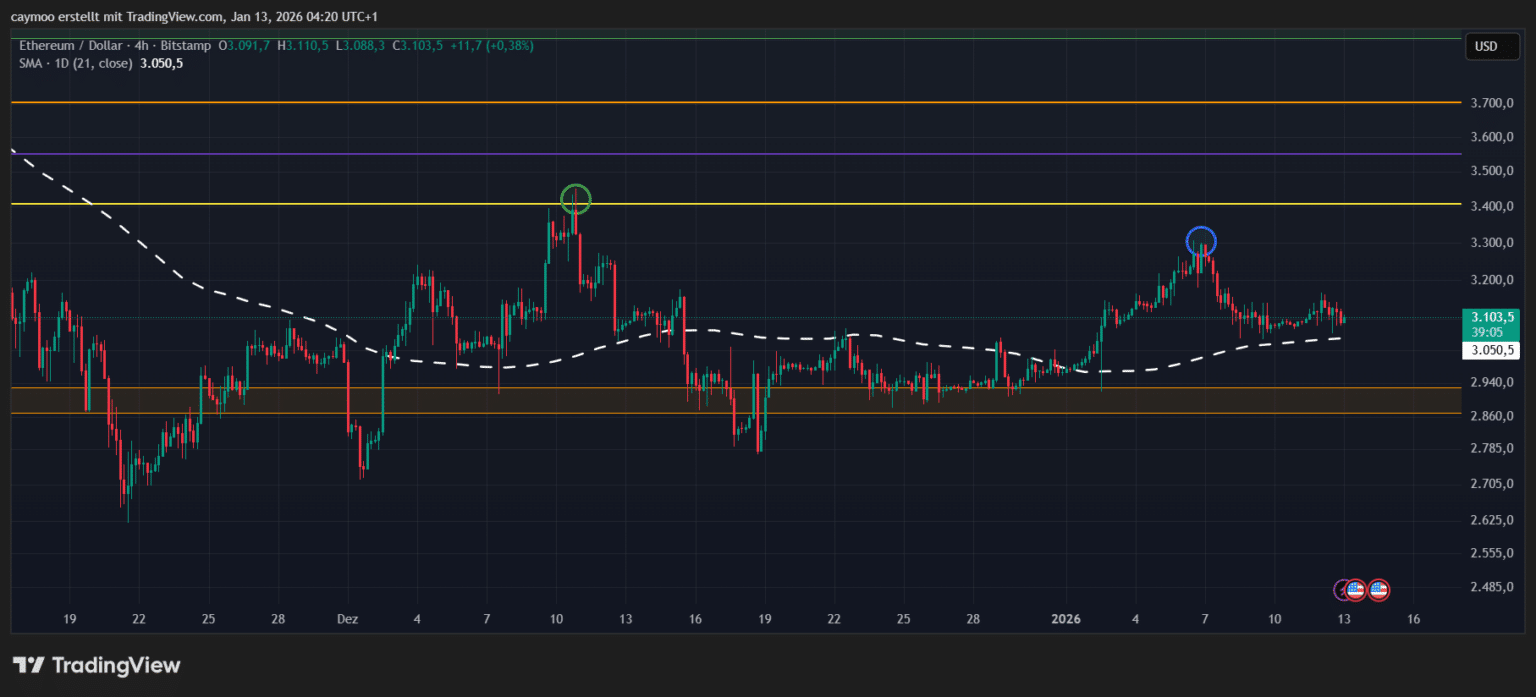
Technically, Ethereum (ETH) remains trapped in a multi-month sideways channel after the late-2025 volatility. As of January 13, 2026, ETH trades around $3,090–$3,120, down slightly in recent sessions after failing to sustain above $3,300–$3,400 resistance.
- Support: The 21-day EMA near $3,050 has held as a key floor; a break below risks deeper pullback to the channel bottom (~$2,850–$2,900).
- Resistance: $3,300–$3,400 zone caps upside; a daily close above would signal breakout potential toward higher levels.
- Momentum: RSI and MACD show neutral-to-bullish flattening, but no strong directional conviction yet.
Until a clear impulse arrives — from macro factors, ETF flows, upcoming upgrades (e.g., Pectra/Fusaka), or altcoin rotation — Ethereum stays range-bound. Long-term tailwinds (RWA growth, stablecoin dominance, scaling progress) support a bullish bias, but near-term indecision dominates.
Final Takeaways on Ethereum, Quantum Computers, and Vitalik Buterin
Vitalik Buterin’s push for early quantum-resistant upgrades reflects Ethereum’s long-term security ethos: prioritize cryptographic durability now to pass the “walkaway test” and ensure the protocol outlives its creators. While quantum computers represent a real future risk, the immediate threat to Ethereum in 2026 is low — timelines point to years of preparation window ahead.
Near-term, ETH’s price remains technically neutral, with $3,050 support and $3,400 resistance as pivotal levels. This positions Ethereum as a high-conviction long-term hold for 2026 rather than a short-term breakout play.
For investors tracking both crypto fundamentals and emerging threats, secure multi-asset management tools like Bitget Wallet offer seamless oversight of ETH positions alongside tokenized assets and broader portfolio tracking. Stay vigilant on protocol roadmaps and quantum developments — preparation today secures resilience tomorrow.
Related Articles
Ethereum on-chain RWA surpasses $15 billion, with tokenized gold contributing over $4 billion
AIXBT (aixbt) 24-hour increase of 16.20%
Bitmine Accumulates 4.47 Million ETH, Representing 3.71% of Circulating Supply
Bitcoin briefly surged past $70,000 before falling back! Iran's capital outflow surged by 700%, VanEck calls it "building a bottom"
Huang Licheng deposited 250,000 USDC into HyperLiquid again 7 hours ago and increased his ETH long position.