
The American Bankers Association urgently wrote to the Senate warning that if stablecoins can pay interest, it could lead to up to $6.6 trillion in deposits fleeing the banking system and impacting lending capacity. However, financial giant JPMorgan Chase holds a different view…
American Bankers Association warns of stablecoin risks, concerns over deposit outflows
Last week, “Crypto City” reported that the Community Bankers Committee under the American Bankers Association (ABA) sent a letter to the Senate on January 5th, urging Congress to take action to address loopholes in the stablecoin regulatory bill “GENIUS.”
Banking industry players worry that although the “GENIUS Act” restricts stablecoin issuers from paying interest, crypto companies still offer incentives similar to deposit interest through various means, attempting to draw large amounts of funds out of traditional banking systems.
Related report:
Genius Bill bans stablecoin issuers from paying interest! Two platforms exploit loopholes: “We now issue ‘rewards’ instead”
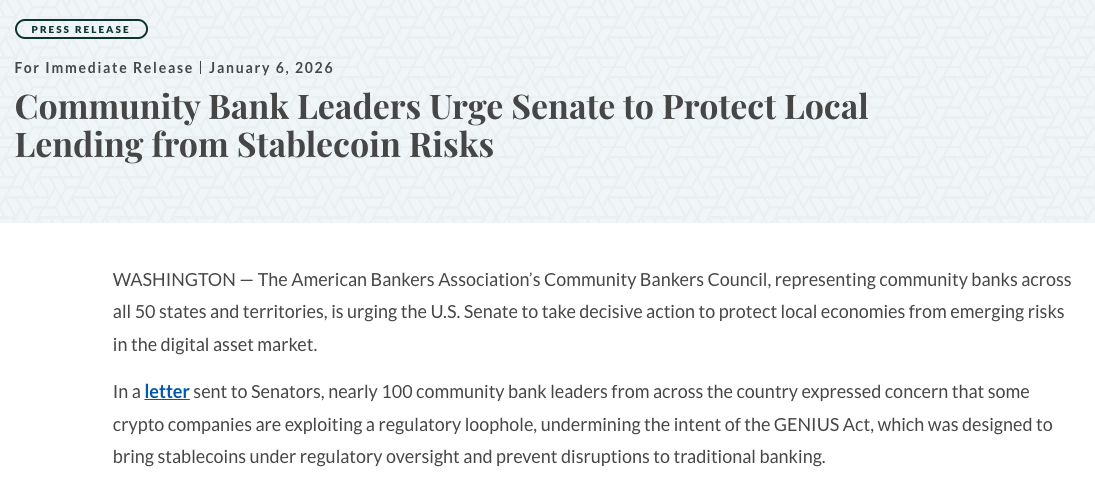
Image source: ABA American Bankers Association warns of stablecoin risks, concerns over deposit outflows
Banking industry warns that if the U.S. government allows stablecoins to offer interest or rewards, depositors will tend to park their funds in crypto assets rather than bank accounts, risking up to $6.6 trillion in bank deposits fleeing across the country. This will directly impact local banks that rely on deposits to operate, further affecting their ability to lend to families and small businesses.
Unlike banks, crypto companies tied to stablecoins do not have the ability to create credit, and their products are not protected by the Federal Deposit Insurance Corporation (FDIC) like bank deposits. In case of risks, consumers will lack protection.
JPMorgan Chase downplays: Stablecoins are a complementary financial tool
While U.S. community banks are on high alert, banking giants and the crypto industry have differing opinions.
According to CoinDesk, a JPMorgan spokesperson responded to concerns that stablecoins could drain bank deposits and pose systemic risks, stating that the financial system already includes multiple forms of currency, including central bank money and commercial bank money, and in the future, deposit tokens and stablecoins will serve as complementary payment tools rather than a zero-sum game.

Image source: Flickr, Can Pac Swire Photography JPMorgan spokesperson responds to stablecoin controversy
Michael Treacy, Business Director at payment company OpenPayd, believes that the core of the debate between U.S. banks and stablecoin companies lies in whether regulation is meant to protect vested interests or to promote competition.
He compares this situation to the emergence of money market funds years ago, noting that ultimately, competition can strengthen market pricing and transparency.
Nima Beni, founder of crypto lending platform Bitlease, criticizes that the banking industry’s letter is spreading fear, arguing that if funds truly flow out, the main reason is that banks have failed to offer competitive, transparent digital products in the digital age, not because of a conspiracy involving cryptocurrencies.
Further reading:
Barclays invests in Ubyx! Collaborates with a U.S. startup to explore compliant stablecoins and tokenized deposits
Stablecoin Bill Battles Intensify, Influencing the Future Positioning of the Financial System
As the Senate begins to consider a more comprehensive regulatory framework for crypto assets, whether stablecoins can generate yields and whether the “GENIUS Act” needs further revision have become key battlegrounds between the banking and crypto industries.
The final outcome of this legislative contest will determine the positioning of stablecoins within the U.S. financial system and will redefine the competitive relationship between emerging fintech and traditional banks. For community banks that rely on deposit and loan interest margins to survive, whether they can defend their regulatory boundaries will be crucial for their future survival.
Disclaimer: The information on this page may come from third parties and does not represent the views or opinions of Gate. The content displayed on this page is for reference only and does not constitute any financial, investment, or legal advice. Gate does not guarantee the accuracy or completeness of the information and shall not be liable for any losses arising from the use of this information. Virtual asset investments carry high risks and are subject to significant price volatility. You may lose all of your invested principal. Please fully understand the relevant risks and make prudent decisions based on your own financial situation and risk tolerance. For details, please refer to
Disclaimer.


