


BitMine 質押以太坊突破 100 萬枚!股價暴跌 80% 為何仍狂買?

BitMine pledged 86,400 ETH through four transactions on Saturday, valued at $268.7 million, pushing total staked ETH beyond 1 million to 1,080,512. As the largest Ethereum treasury company, it holds over 4 million ETH. Based on a 2.81% yield, it generates an annual income of $94.4 million. However, the stock price has plummeted 80% from the high of $161 to $30.06. The chairman’s proposal to authorize a thousandfold share expansion paves the way for a stock split.
The Revenue Logic Behind the $3.3 Billion Staking Empire
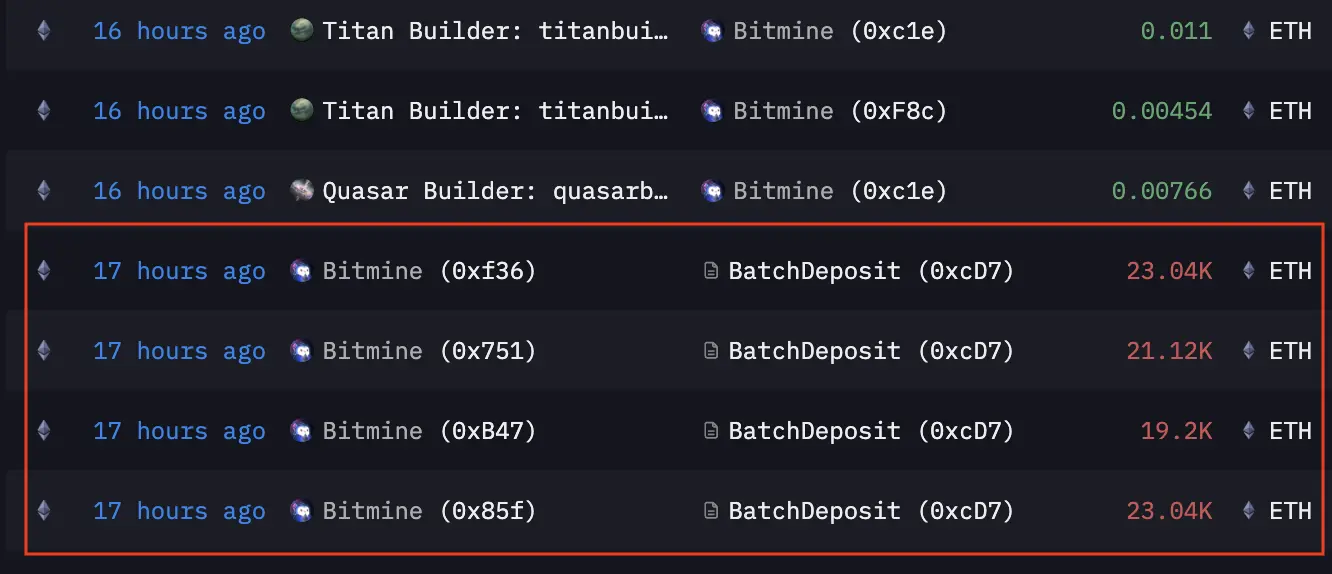 BitMine’s ETH staking surpassing 1 million marks a huge profit engine behind this number. Based on the current Ethereum staking yield of 2.81%, BitMine’s 1,080,512 ETH (worth about $3.3 billion) can generate approximately $94.4 million in ETH income annually. This income is entirely denominated in ETH, meaning if Ethereum’s price rises, the actual USD earnings will be higher.
Market analyst Nick Puckrin pointed out the key difference between this model and Bitcoin treasury companies. “Obviously, Bitcoin does not generate cash flow,” he said. This contrast reveals the core logic of BitMine’s strategy: ETH staking provides continuous cash flow income, while BTC relies solely on price appreciation. During crypto winter, this difference could determine a company’s survival.
Puckrin further questioned: “If another crypto winter occurs, with debts maturing, will holding stakable assets help some companies better weather the storm?” This is a critical question. During the 2022 bear market, many treasury companies were forced to sell assets at low prices to repay debts. Companies like BlockFi and Celsius, once prominent, fell during that harsh winter. By staking ETH, BitMine has established a continuous cash flow, theoretically giving it a stronger survival capacity in the next bear market.
However, this strategy also carries risks. Staked ETH is locked up and cannot be immediately liquidated. If Ethereum’s price crashes, even with staking rewards, losses from asset depreciation may not be covered. Additionally, staking yields are not fixed; as more ETH is staked, yields tend to decline gradually. The current 2.81% yield has already dropped significantly from over 5% in 2022 and may further compress in the future.
The Threefold Advantages of BitMine’s Staking Strategy
Continuous Cash Flow: $94 million ETH income annually, independent of price appreciation
Compound Effect: Staking rewards can be reinvested, creating a snowball growth
Cycle Resilience: During bear markets, income can cover debts, avoiding forced asset sales
BitMine’s holding of 4 million ETH makes it the world’s largest Ethereum treasury company. This scale grants significant market influence; BitMine’s buying and selling decisions may directly impact ETH prices. The recent one-time staking of 86,400 ETH removed liquidity worth $268.7 million from the market, providing short-term price support. Strategically, BitMine is shifting its holdings from “passive reserves” to “active income assets,” setting an industry example in the crypto treasury sector.
The Crypto Winter Behind the 80% Stock Price Collapse
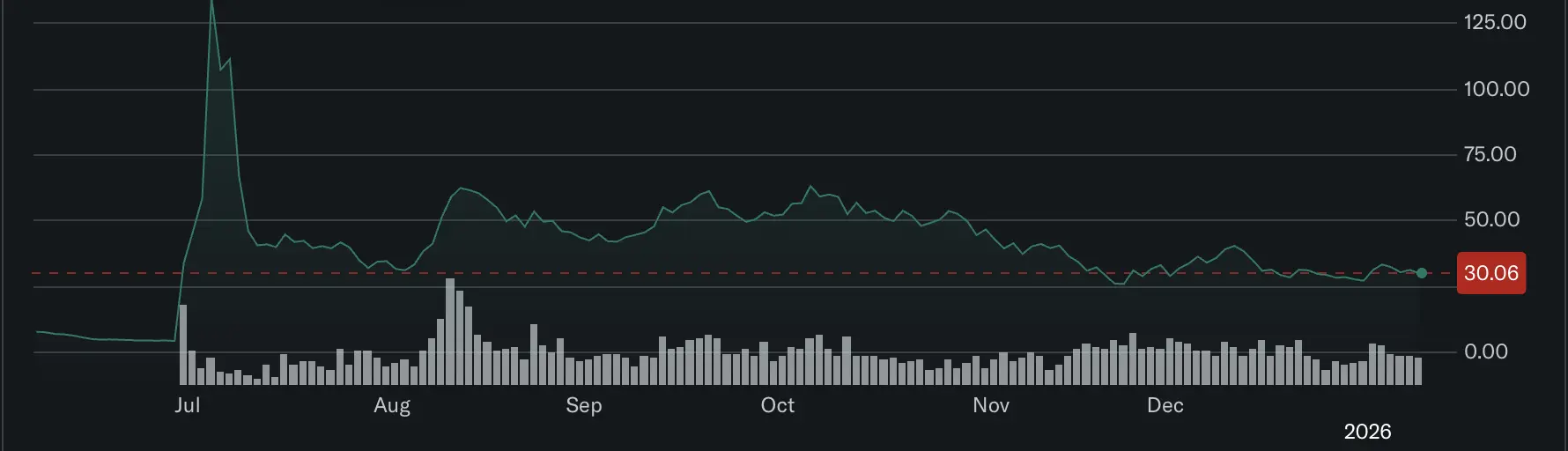
(Source: Yahoo Finance)
BitMine’s staking milestone occurred amid a sharp correction in its stock price. The price has fallen over 80% from the all-time high of $161 per share set in July 2025, to $30.06 at press time. This decline is not unique to BitMine but reflects a broader industry downturn in 2025.
Crypto treasury companies experienced turbulence this year, with some losing over 90% of their market cap from their all-time highs. The collapse stems from multiple factors: Bitcoin and Ethereum prices fluctuating in the second half of 2025, reduced risk appetite among institutional investors, and doubts about the sustainability of treasury business models. Many treasury companies used issuing stocks or bonds to buy crypto assets; this high leverage amplified gains in bull markets but also magnified losses in bear or volatile markets.
BitMine’s stock price plunge reflects a reassessment of its valuation logic. At peak, the market assigned a significant premium to BitMine, valuing it well above its net ETH holdings. But as the crypto market cooled, this premium rapidly disappeared or even turned into a discount. Investors are questioning: why buy treasury company stocks and take on extra risk instead of directly purchasing ETH or ETH ETFs?
However, BitMine has a key advantage over other treasury companies: staking income. While competitors only hold BTC or unstaked ETH, BitMine’s $94.4 million annual income from staking provides fundamental support for its stock. This cash flow can be valued using DCF (discounted cash flow) models, making BitMine not just a “crypto asset holding company” but also a “income-generating asset management company.”
The Ambition for a Thousandfold Stock Split via Share Authorization
(Source: Tom Lee)
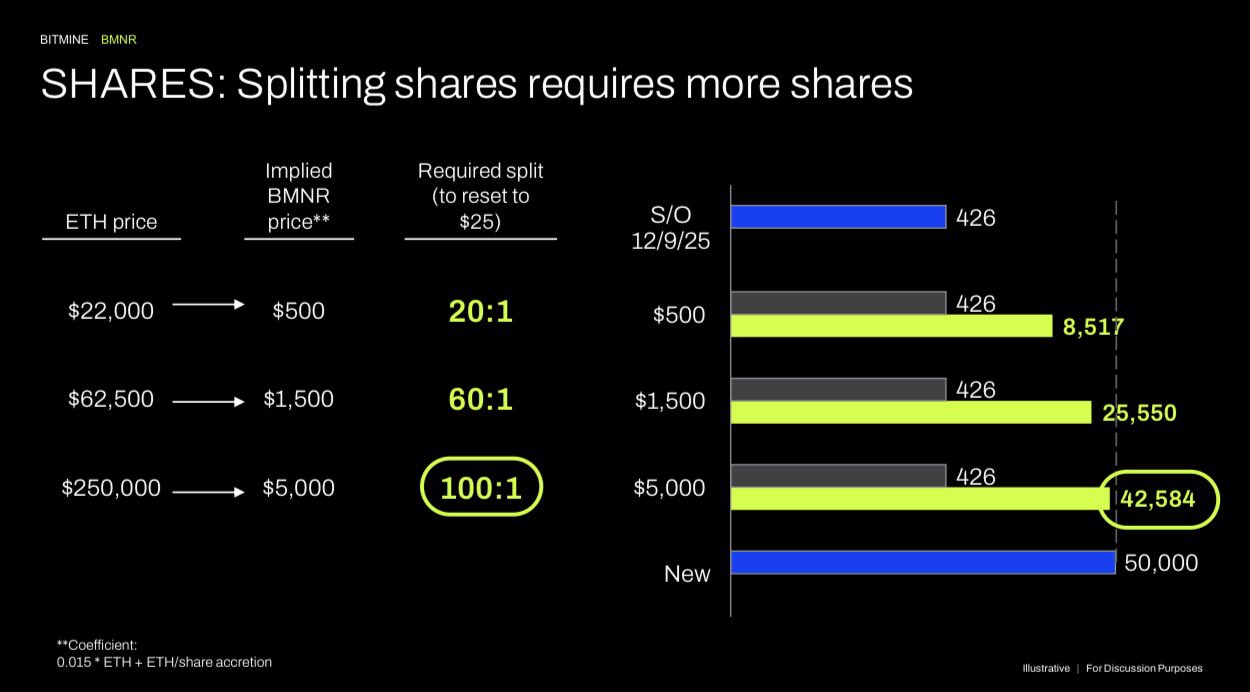
In early January 2026, BitMine Chairman Tom Lee urged shareholders to vote in favor of a proposal to increase the authorized share limit to 50 billion shares. This would allow BitMine to issue up to 50 billion shares, a 1,000-fold increase from the current 50 million. This staggering number has sparked market discussion, but Lee clarified that increasing the statutory share limit does not necessarily mean the company will immediately issue all these shares.
Lee stated that raising the authorized share limit would enable future stock splits, helping keep BitMine’s share price around a reasonable level of about $25. Stock splits involve dividing one share into multiple shares, lowering the per-share price but keeping total market value unchanged. For example, a current $30 stock split 1:10 would become $3 per share, with the total value unchanged.
The logic behind this strategy is to improve stock liquidity and retail accessibility. When the stock was at $161, many small investors were deterred by the high per-share price. Splitting the stock to around $25 or lower would attract more retail participation, increasing trading volume and market attention. Tech giants like Tesla, Apple, and Nvidia have used similar strategies.
However, the authorization to increase shares a thousandfold also raises dilution concerns. Although Lee emphasizes that no immediate issuance of all authorized shares is planned, this opens the door for large-scale issuance in the future. If BitMine faces financial difficulties in a bear market, it might be forced to issue more shares to raise funds, significantly diluting existing shareholders’ equity. This potential risk makes some shareholders cautious about the proposal.
Related Articles
Continuing to rise! Bitcoin briefly breaks above $74,000, Ethereum surpasses $2,200, and the entire network experiences $570 million in liquidations.
Data: If ETH drops below $2,050, the total long liquidation strength on major CEXs will reach $786 million.
Who Is Tom Lee? The Ethereum Saylor Behind Bitmine
"Maji" ETH long position increased to 6,050 tokens, now with an unrealized profit of $670,000.
Matrixport's whale-associated ETH and BTC long positions have a floating profit of over $22 million
ETH 15-minute increase of 1.09%: Whales' on-chain buying and ETF capital inflows drive price rebound