


Here’s Why Polygon (POL) Price Pumped 51%

Polygon (POL) has been one of the strongest performers in the market over the past week. The POL price surged more than 50%, and at writing, it is trading around $0.1725, up another 3% on the day.
Trading volume is also up roughly 30%, confirming that the move is backed by real participation, not thin liquidity. The rally stands out even more because it happened while much of the broader market remained muted.
- What’s driving the POL price rally
- What the Polygon chart is showing
- What market indicators are saying
- What comes next for Polygon Price
What’s driving the POL price rally
A major catalyst came on January 5, when Polygon burned 3.2M POL tokens in a single day. This marked the largest burn event in the network’s PoS history.
Daily burns now average close to 1M POL, supported by more than $1.7M in fees generated year-to-date. With nearly all MATIC-to-POL migration completed, these burns directly reduce circulating supply and ease sell pressure.
Another key driver was the launch of Polygon’s Open Money Stack on January 9. It is intended to be supportive of global payments with stablecoins, and it already integrates with users such as Stripe and Revolut.
They are processing over $50M of stablecoin transactions on Polygon, and this underlines the idea that this announcement has more to do with actual usage as opposed to hype.
As pointed out by Hamza, Polygon was first in network revenue in the last seven days, and this further reinforces the positive sentiment.
What the Polygon chart is showing
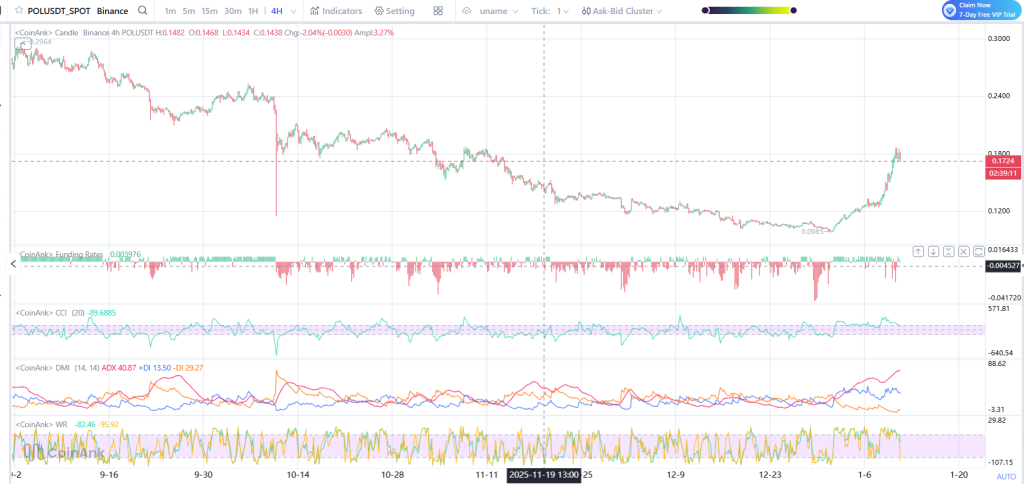
On the 4H chart, the POL price clearly broke out of a long downtrend that had been in place for months. Price formed a base near the $0.10 area before accelerating sharply higher.
The move through the $0.15 zone was decisive, with strong momentum and little resistance until the $0.17–$0.18 range.
It has now started consolidation, given the initial surge, a little beneath current highs. It is a sign of health because buyers are defending gains rather than rushing to exit. As long as the POL price holds above the $0.15 level, the breakout structure remains intact.
Source: Coinank
What market indicators are saying
Funding rates have flipped positive, but remain controlled. It implies that there is increasing bullish market sentiment without any indication of overcrowding.
CCI made deep inroads into overbought regions during this rally and has cooled off a little, which marks a corresponding phase of consolidation.
ADX has spiked, which indicates that the strength of the current trend forming in the market is genuine. Directional indicators also favor buyers, though momentum has slowed compared to the initial breakout.
Williams %R remains elevated, showing strong demand but also signaling that short-term pullbacks are possible. Overall, indicators support continuation as long as volume stays elevated.
Bittensor (TAO) Price Tests a Key Level That Could Change the Trend_**
What comes next for Polygon Price
In the short term, the $0.15 mark is critical support. Above it, the bullish pattern will remain intact.Resistance-wise, a clear breakout above $0.18 may open up the way towards $0.20, followed by $0.22.
A more substantial break below $0.15 may pull the price towards the $0.13-$0.14 regime for some consolidation.
Despite the recent rally, the POL price is still approximately 88% below the all-time high Price Level Value. That gap helps explain why buyers are stepping in now, especially with fundamentals shifting toward payments, burns, and real on-chain activity.
For now, Polygon’s move looks driven by utility and adoption, not speculation. Whether the rally continues will depend on sustained fees, burn rates, and follow-through from the Open Money Stack rollout.
Related Articles
Warning Signs Flash for $XRP as $1.34 Support Gets Tested
Crypto Prices Surge While Volatility Runs Across Other Markets Amid Middle East Conflict
Shiba Inu Price Analysis: Is Massive Profit Still Possible for SHIB?
Is Bitcoin nearing the cycle bottom? Jan van Eck says the four-year cycle is coming to an end, and BTC is expected to gradually rebound.
Analysis: Bitcoin futures demand drops to the lowest level since 2024
Bitcoin's decline has clearly slowed down! The key support holds, but analysts warn: the bear market structure remains unchanged