


MicroStrategy purchased 1,229 Bitcoins in the last week of 2025, with a total holding of 672,000 Bitcoins.

MicroStrategy (MSTR) purchased 1,229 Bitcoins between December 22 and 28, 2025, at a total cost of $108.8 million, with an average price of $74,997 per Bitcoin. This transaction brings the company’s total Bitcoin holdings to 672,497, solidifying its position as the world’s largest corporate Bitcoin holder. Currently, MicroStrategy’s Bitcoin return rate has reached 23.2%.
MicroStrategy’s 2025 Purchase Frequency Surges 128%

(Source: MicroStrategy)
MicroStrategy’s Bitcoin purchasing activity in 2025 has reached unprecedented levels. According to SaylorTracker data, the company disclosed Bitcoin purchase records for 41 weeks in 2025, a 128% increase compared to 18 weeks in 2024, and more than five times the 8 weeks in 2023. This explosive growth in purchase frequency indicates that under Executive Chairman Michael Saylor’s leadership, MicroStrategy has shifted Bitcoin accumulation from a strategic choice to a core operational rhythm.
In absolute terms, MicroStrategy held 447,470 Bitcoins at the end of 2024, and by the end of December 2025, this had increased to 672,497, a net increase of 225,027 Bitcoins within the year. This means that the company’s Bitcoin purchases in 2025 alone exceeded half of its total accumulated holdings from initiating its Bitcoin strategy in 2020 through the end of 2024. This accelerated accumulation pattern reflects MicroStrategy’s strong belief in Bitcoin’s long-term value and ongoing optimism about current price levels.
The increase in purchase frequency is also closely related to MicroStrategy’s financing strategy. The company has been raising funds by issuing stock to buy Bitcoin, utilizing common and preferred stock offerings. Between December 22 and 28, MicroStrategy sold 663,450 shares of Class A common stock, netting $108.8 million, all used to purchase Bitcoin. This “issuing stock to acquire Bitcoin” approach has become standard practice for MicroStrategy, supported by sustained market demand for its shares, ensuring the strategy’s sustainability.
Notably, while purchase frequency has increased significantly, the size of individual purchases is not evenly distributed. Data shows that MicroStrategy’s largest Bitcoin transaction in 2025 occurred on March 31, when the company spent about $1.92 billion to buy approximately 22,049 Bitcoins, at an average cost of about $87,000 per Bitcoin. The second-largest was on July 29, when it bought 20,356 Bitcoins for about $1.74 billion. These two transactions account for a substantial portion of MicroStrategy’s total Bitcoin purchases in 2025, indicating that the company conducts large-scale concentrated buys at specific times.
In contrast, the purchase of 1,229 Bitcoins at the end of December is one of the smaller acquisitions this year. This size variation suggests that MicroStrategy employs a flexible buying strategy, making large purchases when prices seem favorable, while continuing to accumulate smaller amounts at other times to ensure steady growth of Bitcoin holdings.
Bitcoin Return Rate 23.2% Measures Shareholder Value Creation
This latest purchase brings MicroStrategy’s Bitcoin return rate for 2025 to 23.2%, a self-created metric used to gauge the growth of its Bitcoin holdings relative to circulating shares. The calculation compares the growth rate of Bitcoin holdings with that of circulating shares; if the former significantly exceeds the latter, it indicates the company is creating net value for shareholders.
A 23.2% Bitcoin return rate is significant. It implies that despite MicroStrategy raising funds through new stock issuance to buy Bitcoin, the growth rate of Bitcoin holdings still substantially outpaces the dilution of equity. For existing shareholders, this means the amount of Bitcoin per share is actually increasing, not being diluted by new stock issuance. This value creation logic is a core reason why MicroStrategy’s stock remains popular in the market.
From a financial engineering perspective, MicroStrategy is effectively leveraging the premium the stock market assigns to its “Bitcoin proxy” status. When the market is willing to pay above Bitcoin’s net asset value for MicroStrategy shares, the company can acquire more Bitcoin with less equity dilution, boosting its Bitcoin return rate. This positive feedback loop is especially prominent during Bitcoin bull markets, as investor demand for Bitcoin exposure drives up MicroStrategy’s stock price.
However, this strategy also carries risks. If Bitcoin prices fall sharply or the market’s premium on MicroStrategy stock disappears, the company could face declining stock prices and financing difficulties. Additionally, continuous issuance of new shares, while currently yielding a positive return, will dilute ownership in the long term, and if Bitcoin’s appreciation does not meet expectations, shareholders could face actual losses.
Michael Saylor appears unconcerned about these risks. He has repeatedly stated publicly that the fundamental outlook for Bitcoin is “better than ever,” and firmly believes Bitcoin will become a mainstream asset class within the next decade. This conviction supports MicroStrategy’s aggressive accumulation strategy and attracts many institutional investors who are bullish on Bitcoin but prefer not to hold it directly.
Corporate Bitcoin Hoarding Wave Sweeps Globally, 192 Public Companies Enter
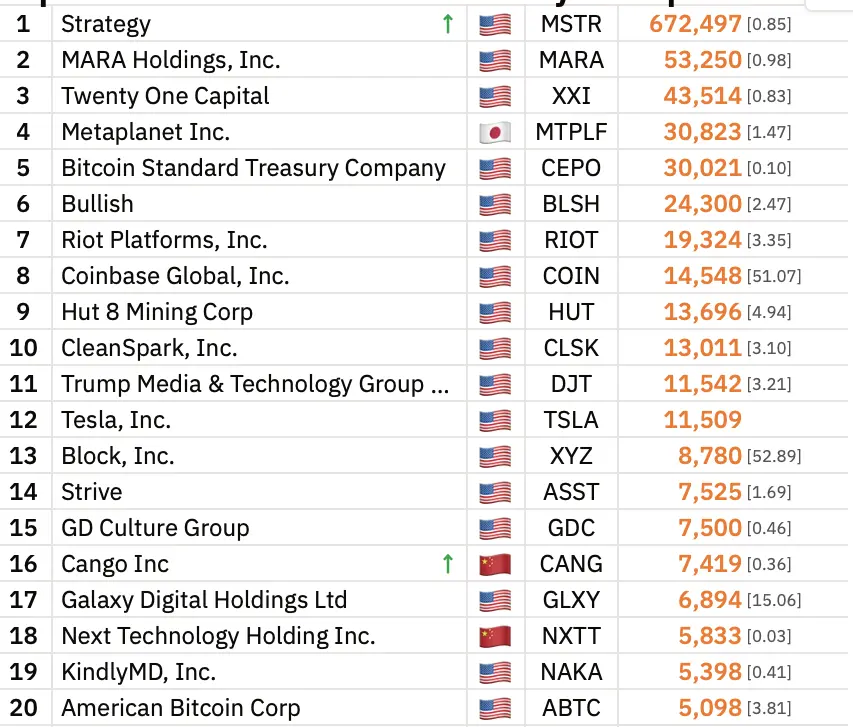
(Source: Bitcoin Treasuries)
MicroStrategy’s success is triggering a wave of corporate Bitcoin accumulation. Currently, 192 publicly listed companies hold over 1.08 million Bitcoins, most of which are headquartered in the United States, followed by Canada, the UK, and Japan. In terms of quantity, corporate holders constitute the largest share of Bitcoin holdings, surpassing governments, private companies, and DeFi protocols.
Bitcoin treasury companies are defined as firms that hold Bitcoin as a core asset on their balance sheets, raising funds through equity or debt to acquire and hold Bitcoin. This business model has experienced explosive growth in 2025. Following MicroStrategy’s lead, Twenty One Capital launched a Bitcoin asset treasury strategy in April, now holding over 43,500 Bitcoins. The company has received support from Cantor Fitzgerald, Tether, SoftBank, and others, and in July increased its holdings by about 5,800 Bitcoins from Tether.
Ranked second, MARA Holdings holds 53,250 Bitcoins, far below MicroStrategy’s 672,497, demonstrating MicroStrategy’s absolute lead in corporate Bitcoin holdings. This lead is not only reflected in quantity but also in strategic consistency and transparency, with MicroStrategy’s weekly purchase announcements becoming an industry standard.
In 2025, several other companies have gone public or announced Bitcoin treasury strategies. Bullish, listed in August, holds about 24,300 BTC; Bitcoin Standard Treasury Company holds about 30,021 BTC; Trump Media & Technology Group holds about 11,542 BTC; CTC holds about 7,500 BTC. The addition of these companies indicates that Bitcoin treasury strategies are shifting from niche experiments to mainstream corporate options.
Geographically, U.S. companies dominate in Bitcoin holdings, which correlates with a relatively clear regulatory environment, ample capital market liquidity, and higher investor acceptance of Bitcoin. Canadian and UK companies are also active but on a smaller scale, while Japanese companies’ participation reflects growing acceptance of Bitcoin in Asia.
This wave of corporate hoarding has profound long-term implications for the Bitcoin market. Corporate holders tend to hold longer-term than retail investors, reducing circulating supply and supporting Bitcoin prices from a supply-demand perspective. Moreover, public disclosures by corporate holders enhance Bitcoin’s transparency and compliance, attracting more institutional investors. As a pioneer and leader in this wave, MicroStrategy’s moves are closely watched by the market and have become a benchmark for corporate Bitcoin strategies.
Related Articles
Bitcoin Is Holding $65K Support and Eyeing $75K–$80K Before March Ends
Three newly created wallets received 1,298.46 bitcoins from BitGo, approximately worth 86.4 million US dollars.
BTC drops 0.99% in 15 minutes: Short-term selling driven by a sudden decline in macro risk appetite and on-chain fund withdrawals
A revenge attack funded by cryptocurrency has emerged in South Korea, with the suspect receiving a reward of $300-$600.