


Ethereum in 2026: Glamsterdam and Heze-Bogota Forks to Drive L1 Scaling and Interoperability
As Ethereum enters 2026, the network is poised for significant upgrades aimed at dramatically improving Layer 1 (L1) scalability, interoperability, and user experience.
The two major hard forks—Glamsterdam (mid-2026) and Heze-Bogota (end-2026)—will introduce perfect parallel transaction processing, substantial gas limit increases, higher data blob capacity, and a gradual shift toward zero-knowledge (ZK) validation. These changes set the stage for Ethereum L1 to approach 10,000 transactions per second (TPS) in the future, while Layer 2s (L2s) could handle hundreds of thousands TPS. Additional focus on cross-chain seamless operation, privacy enhancements, and censorship resistance will make 2026 a pivotal year for Ethereum’s evolution. For developers and users searching Ethereum roadmap 2026, Glamsterdam fork, or Ethereum scaling updates, these upgrades promise a more efficient, inclusive, and resilient network.

(Sources: X)
Glamsterdam Fork: Parallel Processing and Gas Limit Boost
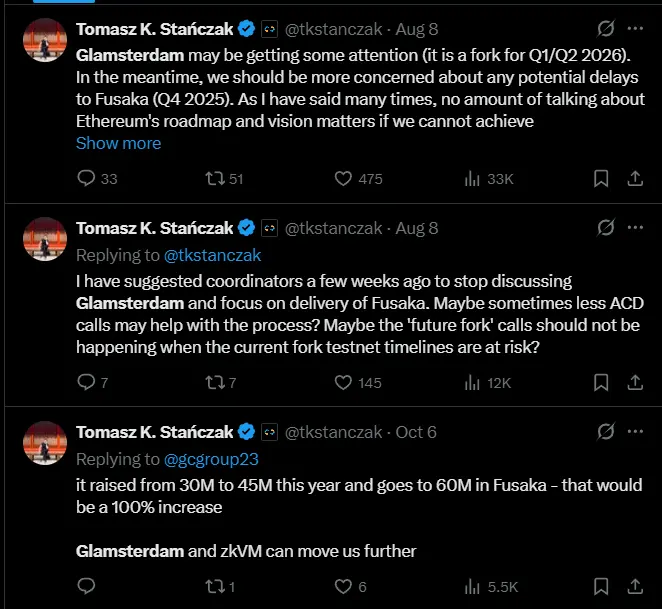
The Glamsterdam hard fork, targeted for mid-2026, is finalizing its Ethereum Improvement Proposals (EIPs) with two headline features:
- Block Access Lists (EIP-7928): Enables “perfect parallel processing” by allowing transactions to specify data access in advance, reducing conflicts and enabling simultaneous execution.
- Enshrined Proposer-Builder Separation (ePBS): Formalizes the separation of block proposal and building, improving MEV management and network efficiency.
Combined, these changes will:
- Raise Gas Limit: From ~60 million today to 200 million, unlocking higher throughput.
- Prepare for ZK Transition: ~10% of validators expected to switch from re-execution to ZK proof verification.
- Path to 10,000 TPS: L1 scaling foundation, though full target likely post-2026.
While technical names dominate for now, community nicknames like “Firedancer” may emerge for client diversity efforts.
(Sources: X)
Increased Data Blobs: Supercharging Layer 2 Scaling
Data blobs—introduced with EIP-4844 (Dencun)—will see major expansion:
- Blob Count: Potentially 72+ per block (from current levels).
- L2 Impact: Enables rollups to process hundreds of thousands TPS collectively.
- User Experience: Innovations like ZKsync’s Atlas upgrade allow mainnet balances with L2-fast execution.
This blob boost makes Ethereum the settlement layer for massive parallel L2 activity.
Heze-Bogota Fork: Interoperability, Privacy, and Censorship Resistance
The year-end Heze-Bogota fork targets:
- Ethereum Interoperability Layer: Seamless cross-L2 communication and asset movement.
- Privacy Focus: Enhanced tools for private transactions and data.
- Censorship Resistance: Stronger protections against block-level exclusion.
These features address long-standing user pain points in multi-rollup environments.
Why 2026 Is Crucial for Ethereum Scaling
- L1 Throughput: Parallel execution + gas hikes lay groundwork for higher native TPS.
- L2 Explosion: Blob increases supercharge rollup capacity.
- ZK Shift: Gradual validator transition to proof verification reduces resource needs.
- User-Friendly: Abstraction and interoperability lower barriers.
While 10,000 TPS on L1 remains a multi-year goal, 2026 upgrades position Ethereum for exponential effective scaling via L2s.
In summary, Ethereum’s 2026 roadmap—headlined by Glamsterdam (parallel processing, 200M gas limit) and Heze-Bogota (interoperability, privacy)—will drive L1 efficiency, L2 explosion via more blobs, and a 10% ZK validator shift. These changes set the network on a path to higher TPS, better user experience, and stronger resilience. Monitor core dev calls and EIP discussions for finalized details on this transformative year for Ethereum scaling.
Related Articles
Vitalik Buterin of Ethereum: Build "shelter technology," don't try to become Apple or Google
Analysis: The Ethereum validator queue has surged to approximately 34 million ETH, possibly driven by large investors
CME February cryptocurrency contract daily average trading volume increased by 45%, with a notional value of $9.3 billion
Corporates and Exchanges Rush to Stake Ethereum Instead of Selling
Ethereum staking demand surges: 3.4 million ETH queued for 60 days, institutional funds accelerate locking