


Quantum computers won’t break Bitcoin’s code, they’ll break its politics
James Check, founder and lead analyst at Bitcoin onchain analysis service Checkonchain, said Monday that the quantum threat is more of a consensus problem than a technology issue.
In a Monday X post, Check claimed that “there is no chance we come to consensus to freeze” Bitcoin (BTC) that is not moved to quantum-resistant addresses, with development politics limiting the community’s ability to react. This means that a large amount of lost Bitcoin would flood the market as old addresses are compromised when quantum computer attacks become feasible.
BitBo data shows that 32.4% of all Bitcoin has not been moved in the last five years, 16.8% in over 10 years, 8.2% in seven to 10 years, and 5.4% in five to seven years. How much of those assets are actually lost or inaccessible, and how many are kept in storage for so long, is subject to debate.
Check’s post was responding to comments by Ceteris Paribus, head of research at crypto market research firm Delphi Digital. He said Bitcoin’s quantum threat problem is not technological in nature and “what makes the problem specifically unique to BTC is that the tech problem is secondary.” “Quantum resistant Bitcoin will be feasible but it doesn’t solve what you do with the old coins,“ he said.
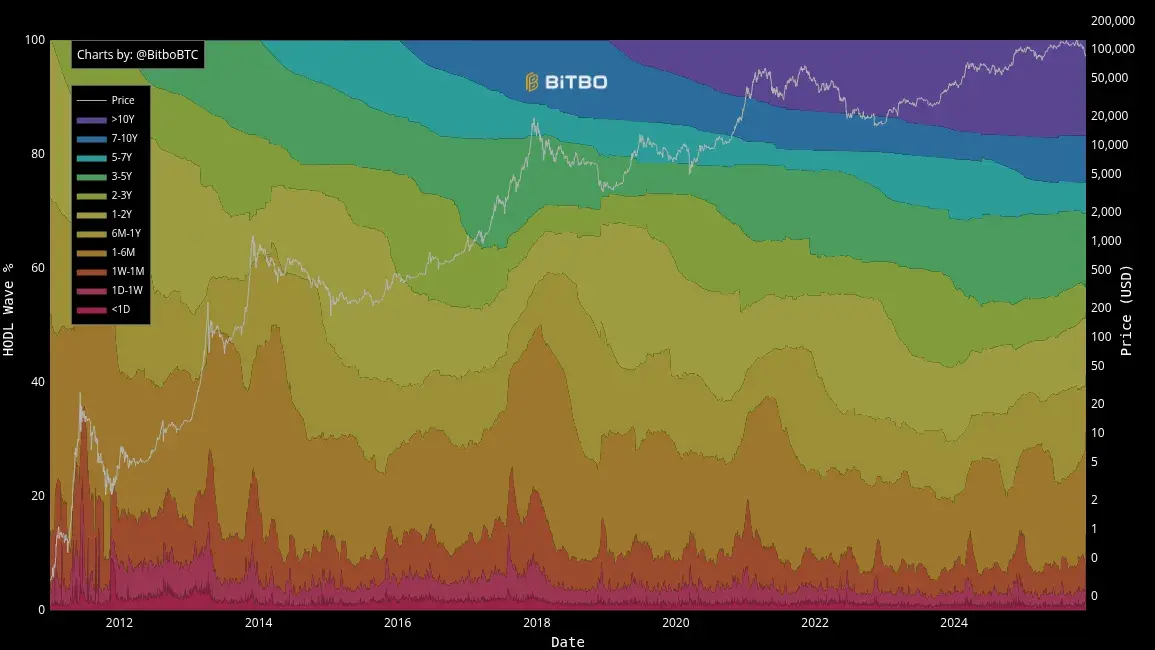 Bitcoin hodl waves chart. Source: BitBoTalking to Cointelegraph in late April, early cypherpunk Adam Back, cited by Satoshi Nakamoto in the Bitcoin white paper, said that the community will have to choose between deprecating old, vulnerable addresses or letting those funds be stolen. Check thinks that the community should “allow the old coins to come back to market.”
Related: VanEck boss questions Bitcoin’s privacy, encryption against quantum tech
A fix for new addresses only
The technological fundamentals for making Bitcoin quantum-resistant are in place, with the US National Institute of Standards and Technology (NIST) having already endorsed multiple post-quantum public-key cryptography schemes last year. If the Bitcoin community decides to implement them, quantum-resistant Bitcoin addresses are already within reach thanks to those encryption standards — and the Bitcoin Improvement Proposal 360 addresses this need.
Still, Bitcoin uses the Elliptic Curve Digital Signature Algorithm (ECDSA) signatures for legacy addresses and Schnorr signatures for Taproot, both of which are vulnerable to quantum computers. For this reason, it is almost certain that a solution would require the introduction of a new post-quantum signature standard. Still, this raises the question of what will happen to the large amount of lost Bitcoin left in non-quantum-resistant addresses.
During the interview with Cointelegraph, Back went as far as to suggest that the quantum threat may reveal whether Bitcoin’s pseudonymous creator is alive. He said that quantum computing may force Nakamoto to move their Bitcoin to avoid it being stolen by quantum computers. Still, last week he recently said Bitcoin is unlikely to face a meaningful threat from quantum computing for at least two to four decades.
Related: What happens to Satoshi’s 1M Bitcoin if quantum computers go live?
Some blockchains got their fix
Experts tend to agree that a backwards-compatible fix that also protects older addresses is unlikely ever to be developed for Bitcoin. Still, the same cannot be said for some other blockchains.
In late July, researchers unveiled a backwards-compatible quantum-resistant fix that would not require signature switching. Unfortunately, the new approach would apply to Sui, Solana, Near, Cosmos and other networks, but not to Ethereum and Bitcoin.
That implementation leveraged peculiarities of the Edwards-curve Digital Signature Algorithm used by those networks. This scheme derives private keys deterministically from a seed, so researchers created a zero-knowledge proof system that allowed one to prove they hold the seed. If such a proof were required, a quantum-computer-falsified signature would not be enough to hack an address.
Magazine: Bitcoin vs. the quantum computer threat: Timeline and solutions (2025–2035)
- #Bitcoin
- #Satoshi Nakamoto
- #Adam Back
- #Cryptography
- #Consensus
- #Quantum Computing
Add reaction
Related Articles
Arthur Hayes says that if the U.S. intervenes in the Iran conflict for the long term, it could drive up Bitcoin prices
Willy Woo Warns Liquidity Breakdown Could Cap Bitcoin’s Rally Despite Short-Term Relief
Data: If BTC breaks through $69,195, the total liquidation strength of long positions on mainstream CEXs will reach $1.521 billion.
Bitcoin treasury company EmperyDigital's third-largest shareholder requests to sell 3,723 BTC and return cash