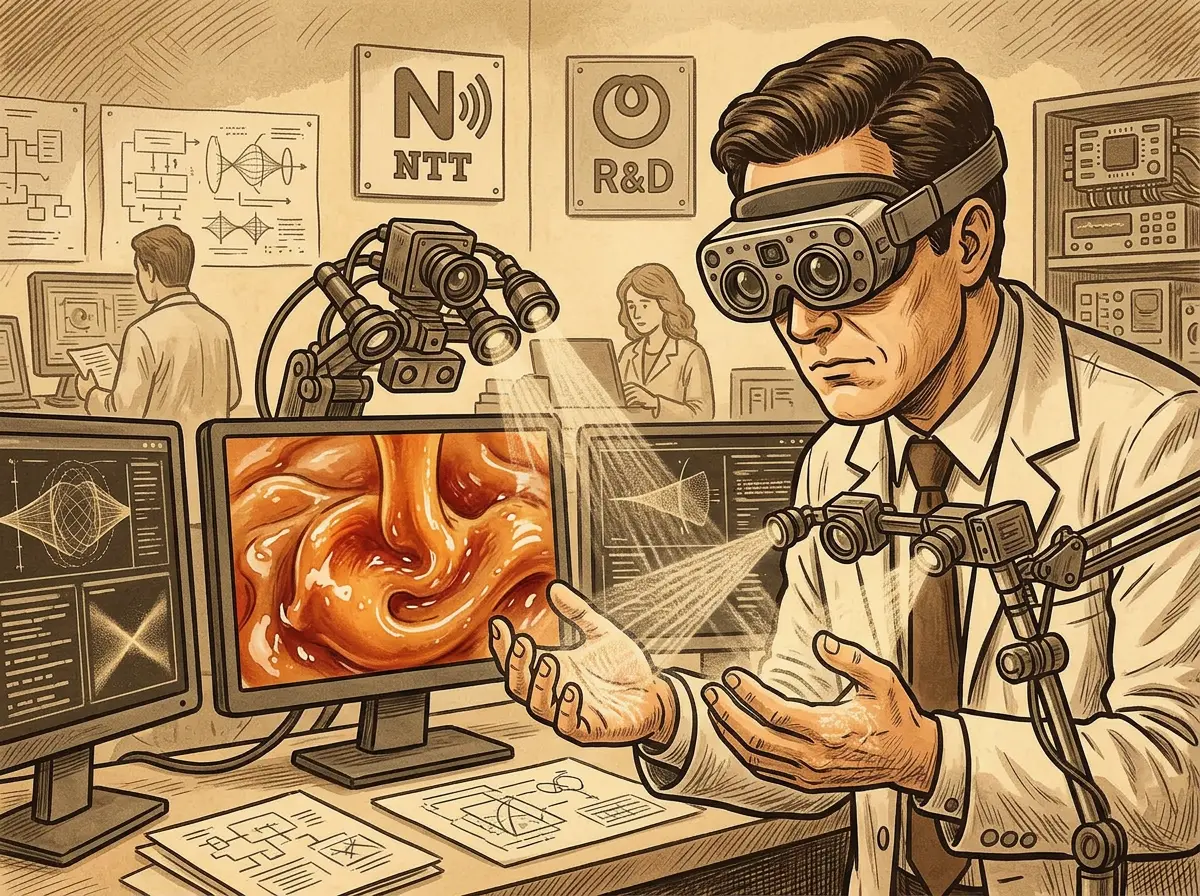
On May 12, Japanese telecom company NTT announced that it has successfully developed the world’s first “illusion technique,” which allows users to perceive the softness and viscosity of a remote object using only visual information, without wearing any specialized haptic devices. The technical mechanism is: the system captures hand movements through a smartphone or computer camera, and simultaneously displays corresponding deformation visuals of a virtual object on the screen, causing the brain to generate a haptic illusion.
Three Key Technical Core Points Confirmed by NTT
NTT explained three core mechanisms in an official article. First is softness control: the research team operates softness perception by controlling the spatial deformation range of a virtual object when it is pressed. Experiments confirmed that when the spatial deformation range is around 16 to 32 pixels, the softest visual illusion effect can be achieved.
Second is viscosity control: it operates viscosity perception by controlling the distance to which a virtual object is stretched until it breaks as the user’s finger moves. Both lab tests and online tests confirmed that the longer the virtual object is stretched, the stronger the viscosity users feel.
Third is real-time hand motion tracking: based on the hand trajectory captured by the camera, the system calculates deformation parameters instantly and displays them in sync. Users do not need to wear any additional devices; while manipulating a virtual object, they can receive realistic texture feedback.
Confirmed Community Reactions from Japanese Netizens
After NTT’s technology was reported by Japanese TV, it triggered a large amount of discussion on social media, with the general trend being to link the technology’s “softness” and “viscosity” characteristics to adult entertainment applications. Comments from netizens included “Humans have once again moved in the direction of something lewd”; someone proposed the formula review “FANZA (Japan’s adult video platform) + VR + NTT = world peace”; and others joked that the official could have simply used the word “touch,” yet instead chose “softness” and “viscosity.” Some netizens also said they recognize the technology’s scientific research value, but the direction of the comment section still made people smile.
Frequently Asked Questions
What scientific questions has NTT’s technology solved that were still unanswered?
In the past, it was already known that humans can judge an object’s softness through visual cues, but scientifically, there has been no complete answer to which specific visual parameters can systematically determine texture perception. NTT identified specific visual parameters that non-contactly convey softness (16–32 pixels spatial deformation range) and viscosity (the distance stretched to the point of breaking).
What application scenarios does NTT officially expect?
NTT’s official application prospects focus on three areas: e-commerce (helping consumers judge the touch feel of products), remote communication (conveying texture-related information), and education and training (simulating hands-on touch experience).
What equipment does a user need to use this technology?
According to NTT, no additional specialized haptic devices are required to be purchased or worn. It only needs a standard camera on a regular smartphone or computer.


