Pi coin’s largest whale continued to accumulate this week, with holdings breaking through 391.5 million tokens worth $82 million, approaching the 400 million milestone. Technical analysis shows a double bottom pattern and Wyckoff accumulation phase, with key support at $0.1942 holding, targeting $0.25. Protocol 23 upgrade and DEX, AMM mainnet launch expectations provide catalysts.
Pi Coin’s Mysterious Whale Approaches 400 Million Token Milestone

(Source: PiScan)
Pi Network’s price has remained consolidating this year, unaffected by recent cryptocurrency market gains. As of January 7, it trades at $0.21, far below its all-time high of over $3.6. However, Pi coin’s biggest supporter continues accumulating this year.
According to on-chain data, this mysterious whale began accumulating this week. On Monday, he transferred 313,565 PI tokens to a CEX, then transferred 391,174 PI tokens from the CEX to his self-custody wallet. This accumulation pushed his total tokens over 391.5 million, worth over $82 million, making him the largest token holder in the Pi ecosystem. This also suggests the investor may hold 400 million tokens within months.
The whale behind this transaction likely believes the token will rebound. From the transaction pattern, transferring tokens to a CEX then out to a self-custody wallet shows this whale isn’t doing short-term exchange trading, but accumulating then moving to cold storage for long-term holding. This behavior pattern is typical of “smart money” accumulation strategy, contrasting sharply with retail panic selling.
However, on-chain data also shows contradictory signals. PiScan data shows 21 whales currently, down from 23 last week. This means while the largest whale accumulates, two whales have exited or reduced below whale thresholds. This divergence shows disagreements within the whale group about Pi’s prospects, with not all major holders bullish on the future.
Data shows PI’s 24-hour trading volume is $11 million, making it one of the smallest trading volume tokens among the top 50. Given its market cap exceeding $1.76 billion, the trading volume appears insignificant. This low volume reflects Pi coin’s liquidity issues; large buy or sell orders could cause severe price swings.
Protocol 23 Upgrade and DEX Launch: Dual Catalysts
One possible reason for Pi’s rebound is one or more top exchanges listing it. Currently Pi only trades on exchanges like Gate, with no second-round listing campaign launched. If a new CEX announces Pi launch, it would bring massive liquidity and exposure, potentially doubling prices short-term.
Another potential catalyst is the upcoming Protocol 23 upgrade and this year’s DEX and AMM mainnet launch. While launch itself matters, the most important events will be their activity and trading volume. If Pi’s DEX can attract substantial liquidity and offer low-slippage trading, it significantly improves the Pi ecosystem’s user experience. Currently Pi users mainly rely on centralized exchanges; DEX launch provides decentralized trading options.
Three Major Catalysts for Pi Rebound
Protocol 23 Upgrade: Technical improvements may enhance network performance and user experience, boosting market confidence
DEX and AMM Mainnet Launch: Decentralized exchanges provide more liquidity options, reducing dependence on centralized platforms
Top Exchange Listing: If major U.S. compliant crypto exchanges list Pi, it brings explosive demand and liquidity
However, whether these catalysts truly drive price rebounds depends on execution. Pi Network has repeatedly failed to deliver promised features and timelines, making markets skeptical of future commitments. Only when the DEX truly launches and demonstrates substantial trading volume will markets reassess Pi’s value.
Technical Analysis Shows Double Bottom Pattern and Wyckoff Accumulation
(Source: Trading View)
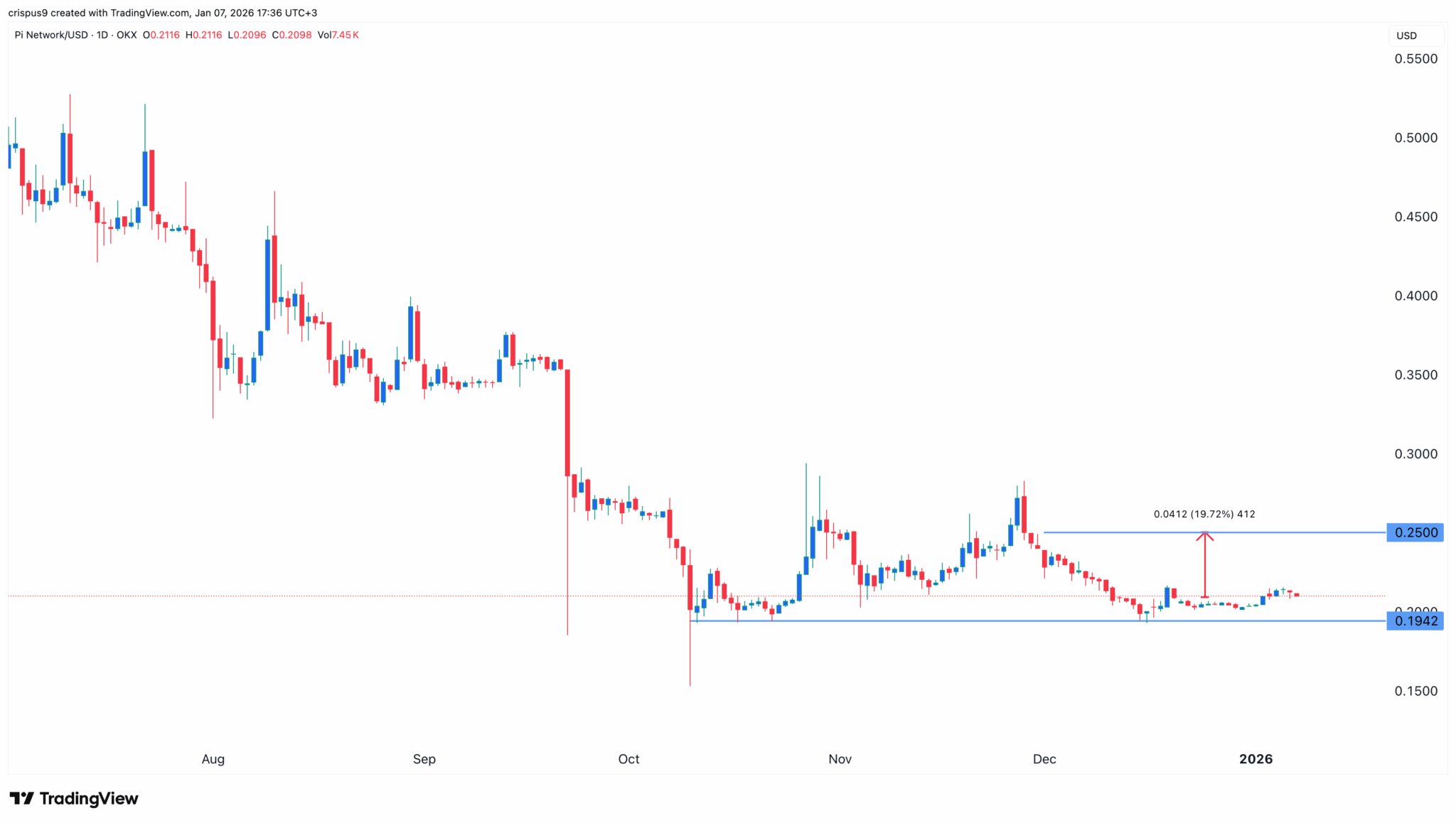
Technical analysis suggests Pi coin may be about to experience significant short-term breakout gains. Current price is slightly above key support at $0.1942, the lowest point on October 11, 17 and December 16 last year. Price has repeatedly held above this support, forming a double bottom pattern. Double bottoms are classic bullish reversal patterns, showing selling pressure at this level is fully absorbed and buying pressure is gaining advantage.
The token currently sits in the Wyckoff theory’s accumulation phase. Usually after this phase comes an uptrend, where asset prices typically show parabolic gains. Zcash’s Q4 price surge is an excellent example, with that token consolidating for years beforehand. Wyckoff theory divides market cycles into four phases: accumulation, markup, distribution, markdown. Pi is currently in late accumulation phase; smooth transition to markup phase could bring substantial gains.
Therefore, as long as Pi maintains above the $0.1942 key support, its most likely technical direction is bullish. If price stays above support, it could rally to $0.25. This represents approximately 19% upside from current levels, attractive for risk-seeking investors.
Breaking below this level signals further downside, indicating bears have gained control. Double bottom failure typically triggers accelerated decline as technical traders relying on pattern breakdowns quickly exit. The next support may be around $0.15, a deeper psychological support level.
For Pi investors, this is a critical observation period. Whale accumulation provides confidence support, while technical double bottom and Wyckoff accumulation point to potential rebounds. However, low volume, reduced whale count, and historical project execution issues are non-negligible risk factors.
Tuyên bố miễn trừ trách nhiệm: Thông tin trên trang này có thể đến từ bên thứ ba và không đại diện cho quan điểm hoặc ý kiến của Gate. Nội dung hiển thị trên trang này chỉ mang tính chất tham khảo và không cấu thành bất kỳ lời khuyên tài chính, đầu tư hoặc pháp lý nào. Gate không đảm bảo tính chính xác hoặc đầy đủ của thông tin và sẽ không chịu trách nhiệm cho bất kỳ tổn thất nào phát sinh từ việc sử dụng thông tin này. Đầu tư vào tài sản ảo tiềm ẩn rủi ro cao và chịu biến động giá đáng kể. Bạn có thể mất toàn bộ vốn đầu tư. Vui lòng hiểu rõ các rủi ro liên quan và đưa ra quyết định thận trọng dựa trên tình hình tài chính và khả năng chấp nhận rủi ro của riêng bạn. Để biết thêm chi tiết, vui lòng tham khảo
Tuyên bố miễn trừ trách nhiệm.
Bài viết liên quan
Dự đoán Giá Pi Coin (PI) cho Tháng 3: Đây là Triển vọng
Giá PI bắt đầu tháng 3 với tâm trạng tích cực sau một tháng 2 vững chắc, khi token tăng khoảng 25.7% trong tháng. Sự phục hồi đó đến sau một khởi đầu năm yếu hơn và đã giúp mang lại một số tâm lý lạc quan trở lại cho dự án.
Ngay cả với sự phục hồi đó, giá PI hiện đang ở trong một tình huống khó khăn p
CaptainAltcoin52phút trước
Hàng triệu người âm thầm chuẩn bị cho bước nhảy lớn của Pi Network
Nhiều người dùng hơn vẫn đang chuẩn bị cho tầm nhìn toàn cầu của Pi Network khi họ tiếp cận nhiều hơn với việc chấp nhận. Các cập nhật mới về tiến trình di cư và mở rộng hệ sinh thái trên toàn mạng đã thúc đẩy mức độ thảo luận của cộng đồng.
Tầm Nhìn Toàn Cầu của Pi Network nhận được Đà Cộng Đồng tích cực
Pi Net
Coinfomania13giờ trước
Pi Network kiểm tra khả năng tính toán của nút thử nghiệm AI, nâng cấp mạng chính lên phiên bản 20.2, khám phá mạng lưới sức mạnh tính toán trí tuệ nhân tạo phi tập trung
Pi Network đang tiến hành nâng cấp mainnet và thử nghiệm khả năng tính toán AI, khám phá sự kết hợp giữa blockchain và AI phân tán. Các nút cần nâng cấp lên phiên bản 20.2 trước ngày 12 tháng 3, thử nghiệm cho thấy các nút có thể tham gia vào các nhiệm vụ AI, trong tương lai có thể nhận được phần thưởng token bằng cách cung cấp sức mạnh tính toán AI. Mặc dù đối mặt với những thách thức như trì hoãn xác minh KYC, Pi Network hy vọng trở thành mạng lưới sức mạnh tính toán AI phi tập trung.
GateNews15giờ trước
Pi Network thử nghiệm tính toán AI trên các nút trong quá trình nâng cấp bắt buộc, Giá PI tăng 20% bất chấp việc mở khóa token
Pi Network đã bắt đầu thử nghiệm các khối lượng công việc tính toán trí tuệ nhân tạo trên hạ tầng nút toàn cầu của mình trong quá trình nâng cấp giao thức bắt buộc, khám phá xem hệ thống nút phân tán của nó có thể hỗ trợ các nhiệm vụ xử lý AI phi tập trung hay không.
CryptopulseElite16giờ trước
Pi Network thử nghiệm tính toán AI trên các nút trong giai đoạn nâng cấp
Tin tức Pi Network hôm nay cho biết đã bắt đầu thử nghiệm một khái niệm mới kết hợp trí tuệ nhân tạo với hạ tầng blockchain của nó. Thử nghiệm này diễn ra trong bối cảnh dự án đang tiến hành nâng cấp giao thức lớn trên các nút Mainnet của mình. Quá trình nâng cấp hiện đang diễn ra qua nhiều
Coinfomania17giờ trước
PI (Pi Coin) tăng 10,40% trong 24 giờ, hiện giá là 0,2 USD
Tính đến ngày 6 tháng 3, giá của PI là 0,20 USD, tăng 10,40% trong 24 giờ, với vốn hóa thị trường đạt 1,93 tỷ USD. Pi Network thông qua khai thác bằng điện thoại di động và nhấn mạnh đổi mới công nghệ, tăng cường niềm tin của người dùng, thúc đẩy sự phục hồi giá. Tâm lý thị trường chuyển sang tích cực, dấu hiệu phục hồi rõ ràng, nhưng vẫn cần chú ý đến rủi ro đầu tư.
GateNews20giờ trước


