
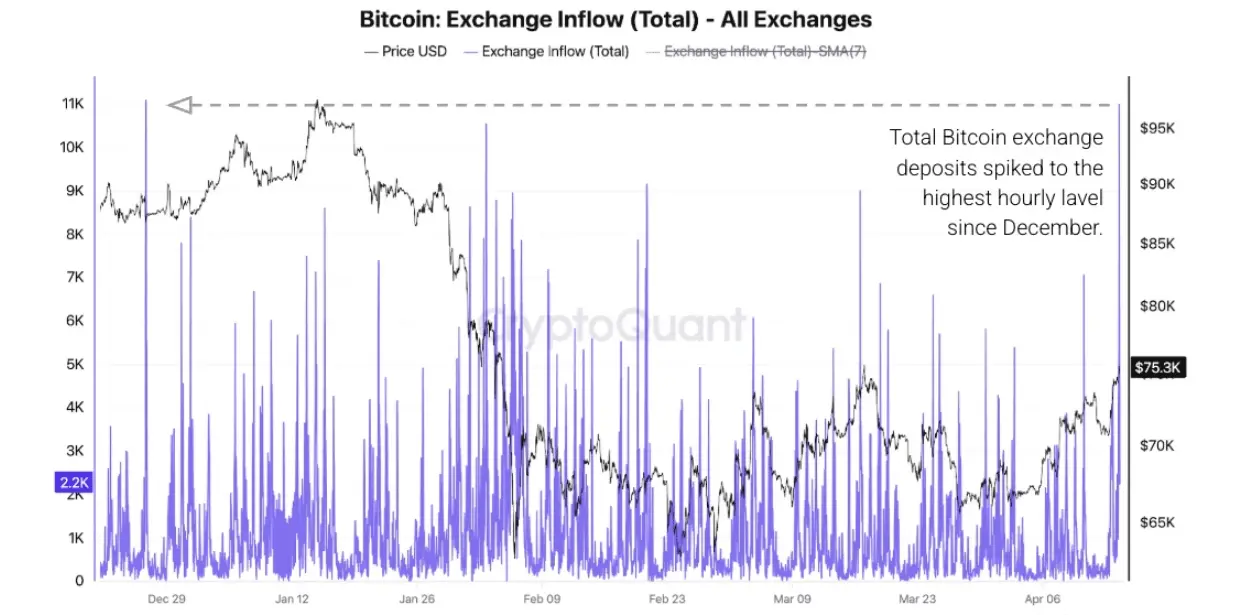
On April 17, Bitcoin returned to near $75,000. On Thursday, U.S. President Trump announced that Israel and Lebanon had reached a 10-day ceasefire agreement, easing the geopolitical situation and lifting sentiment in the crypto market. However, in an on-chain report published by CryptoQuant on Thursday, there was a simultaneous warning: the hourly inflow to Bitcoin exchanges rose to about 11,000 coins, indicating that institutions and large holders are accumulating sell positions.
Geopolitical catalyst: Direct Israel-Lebanon talks for the first time in 34 years
Trump said he spoke with Israeli Prime Minister Netanyahu and Lebanese President Aoun, and both sides agreed to a 10-day ceasefire. The agreement was reached after the two countries held direct talks for the first time in 34 years. The meeting took place in Washington, with U.S. Secretary of State Rubio in attendance. Trump also announced that he would invite the leaders of both countries to the White House for what he called the “first bilateral talks of real substance since 1983.”
On the same day the ceasefire news was released, the U.S. House of Representatives voted 213 to 214, narrowly rejecting a war powers resolution that sought to limit Trump’s ability to use military force against Iran, thereby maintaining the president’s current military authorization.
CryptoQuant on-chain warning: Rapid rise in large-deposit concentration
 (Source: CryptoQuant)
Exchange hourly BTC inflow: About 11,000 coins, the highest new level since late December 2024
Average deposit size: 2.25 BTC, the highest single-day level since July 2024
Large deposits as a share of total exchange inflows: Jumping from under 10% to above 40%
Binance single-transaction top-ups: Large deposits of over 1,000 BTC recorded
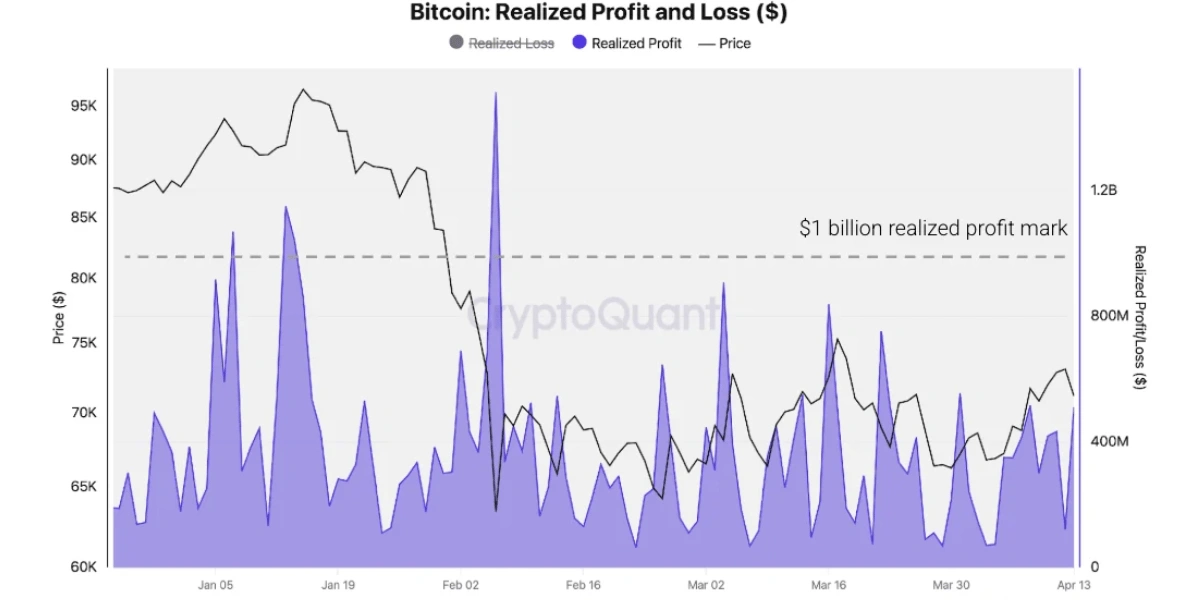
Realized profits for the day: About $500 million (below the $1 billion historical bull-bear dividing line)
CryptoQuant noted that a similar pattern occurred in March—exchange inflows reached 9,000 coins alongside highly concentrated large deposits, after which the market saw a short-term pullback. This time the inflow level has surpassed that threshold, suggesting that sell pressure may be more pronounced during tests of the resistance level.
Key technical levels: TRAP level at $76,800
 (Source: CryptoQuant)
The CryptoQuant report also pointed out that if Bitcoin holds above $76,000, or further rises to around the “trader realized average price” (TRAP) near $76,800, profit-taking could accelerate and create a risk of reversal for the current uptrend. Judging by the scale of profit-taking, the realized profit of $500 million for the day is still below the $1 billion threshold historically marking a broader profit distribution phase, indicating that some investors have started locking in gains, but large-scale profit-taking may still be in its early stage.
Frequently Asked Questions
What is the direct impact of the Israel-Lebanon ceasefire announced by Trump on the Bitcoin market?
The ceasefire news reduces market expectations that the geopolitical conflict will continue to escalate. In the short term, it boosts buying interest in risk assets, pushing Bitcoin back to around $75,000. However, the ceasefire agreement lasts only 10 days. The market remains cautious about whether the broader regional situation—including tensions with Iran—will ease as a result.
How should CryptoQuant’s large-deposit concentration indicator be interpreted?
When the proportion of large deposits in total exchange inflows rises rapidly, it typically reflects that institutional investors or whales are transferring their Bitcoin holdings to exchanges in preparation for potential selling. The quick change from under 10% to above 40% is a signal that CryptoQuant has historically repeatedly linked to increases in short-term sell pressure.
What key technical resistance does Bitcoin face near $75,000?
CryptoQuant’s report states that the $76,000 to $76,800 range is the most critical technical resistance zone right now, with $76,800 being the trader realized average price (TRAP). Large holders with cost bases between $65,000 and $76,000 enter a potential profit-taking range within this zone, forming structural resistance to further upside.
Disclaimer: The information on this page may come from third parties and does not represent the views or opinions of Gate. The content displayed on this page is for reference only and does not constitute any financial, investment, or legal advice. Gate does not guarantee the accuracy or completeness of the information and shall not be liable for any losses arising from the use of this information. Virtual asset investments carry high risks and are subject to significant price volatility. You may lose all of your invested principal. Please fully understand the relevant risks and make prudent decisions based on your own financial situation and risk tolerance. For details, please refer to
Disclaimer.
Related Articles
Solana Price Stalls Near $80 as ETF Outflows Weigh
Solana trades around $80, facing bearish sentiment due to ETF outflows and declining retail participation. Technical indicators show mixed signals, with resistance at $87 and $98, while support at $77 remains critical for stability.
CryptoFrontNews3h ago
Dogecoin Holds $0.094 as X Cashtags Drive Market Attention
Key Insights
Dogecoin holds above $0.094 despite market weakness as Bitcoin and Ethereum stabilize, reflecting resilience and sustained demand across major cryptocurrencies during the consolidation phase.
X launches smart cashtags enabling real-time crypto and stock tracking, improving marke
CryptoNewsLand6h ago
Chainlink Price Compresses Below $10 as Breakout Pressure Builds
Key Insights
Chainlink maintains higher lows within a tightening range, reflecting steady accumulation as buyers absorb selling pressure and prepare for a potential breakout move
Repeated resistance tests near $10 weaken supply levels while rising support strengthens demand, increasing the p
CryptoNewsLand7h ago
XRP Price Clears $1.40 While Broader Downtrend Persists
XRP's recent rise above $1.40 indicates a shift in market behavior after a consolidation phase. While momentum indicators show improvement, the broader bearish trend persists, limiting upside potential. Sustained support is crucial for extending its recovery.
CryptoNewsLand7h ago
XRP Consolidation Signals Reset as Bullish Setup Emerges
XRP has recently rebounded to $1.39 after trading between $1.20 and $1.40 due to improved market sentiment. A significant drop in futures open interest reflects reduced speculation, while technical indicators suggest a potential bullish breakout, targeting $1.50 and possibly $1.80.
CryptoNewsLand8h ago
PEPE Holds Key Range as $0.000005 Breakout Comes Into Focus
Key Insights:
PEPE trades in consolidation with neutral RSI and bearish MACD, signaling a potential buildup before a decisive directional move in coming sessions.
Analysts highlight a $0.000005 breakout level, representing nearly 50% upside if momentum shifts and buying volume strengthens
CryptoNewsLand8h ago


