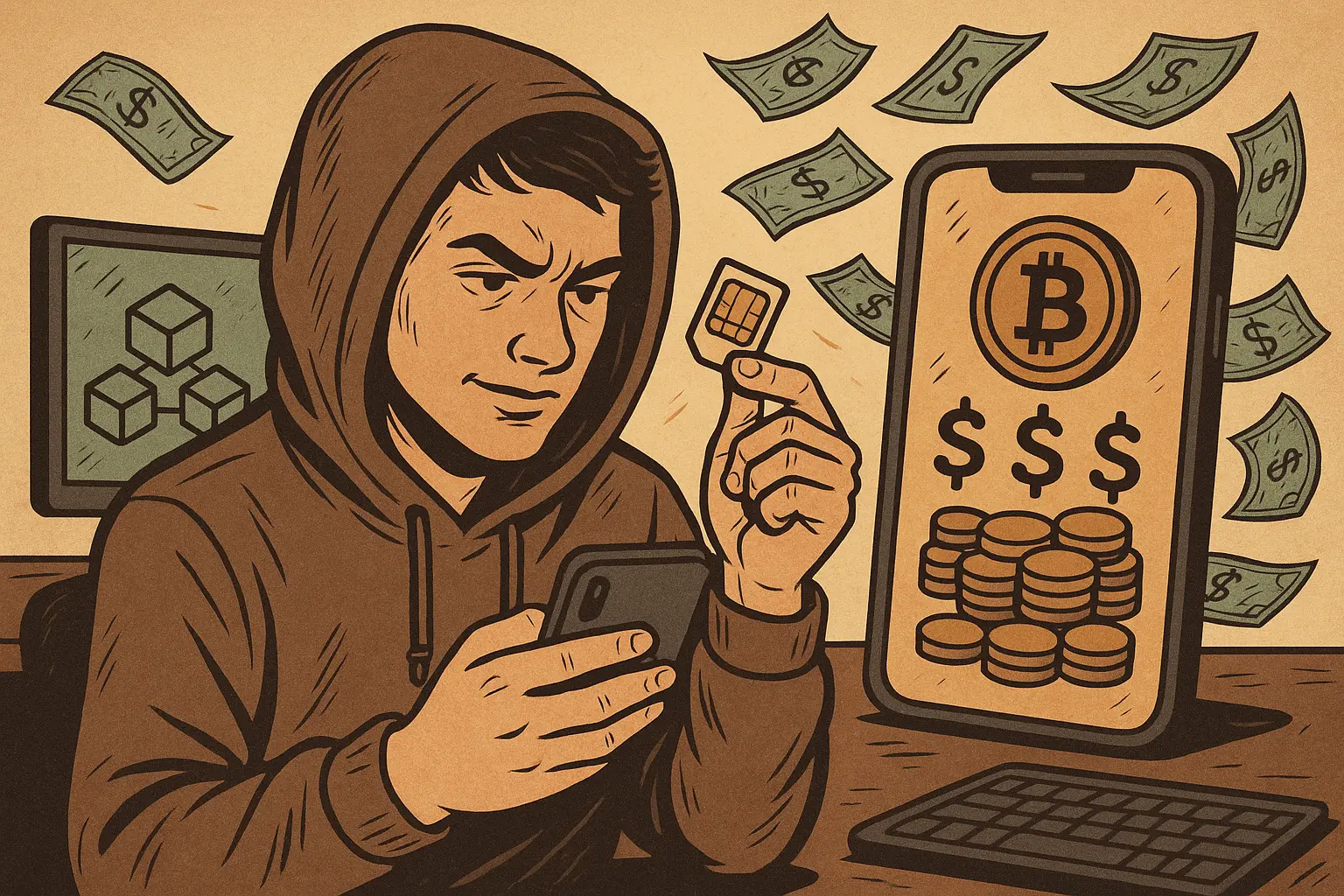
A 21-year-old Manhattan resident, Nicholas Truglia, is accused of carrying out a SIM swap attack—emptying cryptocurrency investor Michael Terpin’s account—through SIM card exchanges, causing more than $23 million in losses, and he is also facing 21 counts of felony charges. The most widely circulated detail of the case is not the massive amount that was stolen, but a tweet the suspect himself posted: “Stole $24 million, yet still can’t seem to make friends.”
How SIM Swap Attacks Empty Crypto Accounts in Just a Few Hours
A SIM swap attack is a highly targeted social engineering technique. The attacker tricks or bribes customer service representatives at telecommunications companies to transfer the victim’s mobile phone number to a SIM card controlled by the attacker. Once the attacker gains control of the phone number, they can use the “forgot password” feature to bypass two-factor authentication (2FA) through SMS verification codes, and then access email accounts, exchange accounts, and crypto wallets.
Michael Terpin said that on January 7, 2018, he was the victim of a SIM swap attack, and more than $23 million in crypto assets in his account were transferred out in a very short period of time. Afterward, he filed a civil lawsuit against Truglia, stating: “I filed this lawsuit as part of my ongoing efforts to pursue the losses from the theft.”
The Suspect’s Self-Inflation: A Complete Profile Revealed by a Sworn Statement
A sworn statement submitted by Truglia’s former partner, Chris David, details the suspect’s lifestyle habits and mental state while he was stealing, providing a wealth of firsthand information for the entire case.
Key Details Recorded in Chris David’s Sworn Statement
A Luxurious Material Life: Rolex watches, a $6,000-per-month apartment, $100k in cash kept in a closet
Calling Himself a Robin Hood: claiming he “takes from the rich, but doesn’t give to the poor”
Publicly Praising SIM Swap Behavior: boasting about having carried out a SIM swap attack on his father through a Twitter account, @erupts
Claiming He Will Never Get Caught: “How can they prove my story is wrong? No one can put me in prison. I’m willing to bet my life on it.”
Other Behavior Recorded: David’s sworn statement also mentions that Truglia has a habit of dodging restaurant bills
Among all the details, the one with the most lasting impact is that tweet—“Stole $24 million, yet still can’t seem to make friends.” This publicly shared statement, filled with self-mockery, ultimately became part of the court filing documents and also became a widely cited warning example throughout the crypto security community.
Case Outcome and Long-Term Lessons for Crypto Security
Truglia was arrested in Manhattan in November 2018, and was then extradited to California, facing 21 felony charges. His case is a representative early example of SIM swap attacks targeting holders of high-net-worth crypto assets, and it also vividly reveals the core weakness of phone-number-based 2FA verification: the attacker doesn’t need to compromise devices—just controlling a single phone number is enough to take over a large number of associated accounts.
The case prompted the crypto community to discuss more broadly the need to upgrade verification methods, encouraging more users and institutions to move away from SMS 2FA toward authenticator apps (Authenticator App) or hardware security keys.
Frequently Asked Questions
What is a SIM swap attack, and why are crypto assets especially vulnerable?
A SIM swap attack is a social engineering method in which the attacker tricks telecommunications providers into transferring the victim’s phone number to their own SIM card. Since the reset process for most crypto exchange accounts relies on SMS verification codes, once the attacker obtains control of the number, they can completely bypass 2FA, making crypto assets a highly fragile target.
What impact did Michael Terpin’s case have on crypto security?
Terpin’s lawsuit against Truglia is one of the most representative SIM swap cases in crypto security history. It drove widespread discussion across the industry about assigning responsibility to telecommunications providers, and it also pushed the crypto community to more actively advocate abandoning SMS 2FA and switching to safer hardware-based verification solutions.
How can you effectively defend against SIM swap attacks?
Key protections include: replacing SMS 2FA with a hardware security key or an authenticator app; requesting SIM lock settings or an account PIN from telecommunications providers; avoiding directly linking important crypto asset accounts to phone numbers; and regularly reviewing the verification methods of all accounts to reduce asset exposure if a phone number is transferred away.
Disclaimer: The information on this page may come from third parties and does not represent the views or opinions of Gate. The content displayed on this page is for reference only and does not constitute any financial, investment, or legal advice. Gate does not guarantee the accuracy or completeness of the information and shall not be liable for any losses arising from the use of this information. Virtual asset investments carry high risks and are subject to significant price volatility. You may lose all of your invested principal. Please fully understand the relevant risks and make prudent decisions based on your own financial situation and risk tolerance. For details, please refer to
Disclaimer.
Related Articles
Chainalysis Details 'Shadow Crypto Economy' Exposure as Grinex Suspends Operations
Grinex’s shutdown is intensifying scrutiny of crypto laundering tactics, as fund movements suggest behavior inconsistent with typical enforcement actions. Chainalysis analysis highlights patterns that raise questions about whether the activity aligns with a conventional external hack or
Coinpedia8h ago
SEC Crypto Shift Clarifies Rules Without Blanket Approval
The SEC has adopted a more lenient stance on crypto regulation, allowing some interfaces to operate without broker-dealer registration, but has not given blanket approval for the industry. Recent guidance clarifies how crypto assets are categorized, emphasizing that federal securities laws apply mainly to digital securities. Enforcement activity has decreased as the agency focuses on fraud and market integrity.
CryptoFrontier9h ago
Polish Parliament Fails to Override President's Veto on Crypto Law; PM Alleges Russian Interference
Polish lawmakers failed to override President Nawrocki's veto on a cryptocurrency regulation bill aimed at aligning with EU standards. Tensions rise as accusations emerge of Russian influence in a major crypto exchange amid liquidity issues and lack of regulation.
GateNews12h ago
Hong Kong SFC Investment Committee Warns Prediction Market Trading May Constitute Illegal Gambling
The Hong Kong SFC warns that prediction markets are speculative and not investment products, lacking regulatory protection. They involve gambling elements, potentially making them illegal. The committee urges the public to differentiate between investment and gambling.
GateNews21h ago
Elizabeth Warren Accuses SEC Chair Paul Atkins of Misleading Congress Over Enforcement Decline
Senator Elizabeth Warren accused SEC Chair Paul Atkins of misleading Congress about enforcement actions' decline. With only 456 new cases in 2025, concerns arise regarding the SEC's effectiveness and the regulatory landscape for cryptocurrency and market oversight.
GateNews04-18 00:47
Sanctioned Exchange Grinex Hit by $13.7M Hack; Blames Foreign Intelligence Services
Grinex, a sanctioned crypto-ruble exchange, has halted operations due to a cyberattack that stole over $13.74 million in USDT. The attack is believed to involve state-level actors aiming to destabilize Russia's financial system. Grinex is cooperating with law enforcement but has no timeline for resuming services.
Coinpedia04-18 00:04


