In a new report, TRM Labs stated that while illicit finance threats remain in Latam, including cartel-linked OTC brokers, Venezuelan sanctioned flows, and Chinese laundering networks, regulations are encircling these threats, with every major Latam market increasing its compliance efforts.
Key Takeaways:
- TRM Labs reports stablecoins drive 95% of illicit Latam inflows, forcing VASPs to upgrade tech next.
- The Sinaloa Cartel laundered $103B in 2025, pushing governments to enforce upcoming AML laws.
- Following these reports, Latam countries are enhancing their compliance standards.
TRM Labs: Regulation is Narrowing Threat Windows In Latam
Crypto regulations are advancing internationally, and Latam is not an exception, even with numerous documented threats. According to TRM Labs, a blockchain intelligence firm, regulations are coming to make cryptocurrency transactions and flows more secure in the region.
In a recent report, TRM Labs disclosed that stablecoins have become the dominant payment rails across Latam, accounting for 95% of inflows to sanctioned entities globally in a region that, due to its economic traits, is open to the adoption of these new technologies.
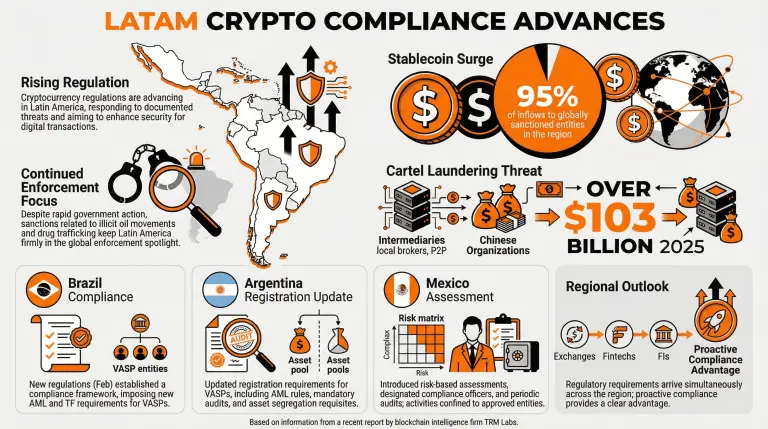
TRM Labs states that the threats are well-documented in the region, including flows linked to the Sinaloa Cartel, leveraging local brokers and P2P exchanges to launder funds using Chinese organizations as intermediaries to process over $103 billion in 2025 alone.
In addition, the institution highlighted that sanctions that remain in place related to illicit oil movements and drug trafficking keep Latam in the enforcement spotlight. Nonetheless, governments are moving quickly to plug these holes and strengthen compliance across the sector.
In Brazil, new regulations passed in February establish a compliance framework that includes new anti-money laundering (AML) and terrorism financing (TF) requirements for virtual asset service providers (VASPs) to receive authorization to operate.
Argentina also tightened oversight over the crypto market, with updated registration requirements for VASPs that include AML rules, audit, and asset segregation requisites.
Mexico also introduced risk-based assessments, designated compliance officers, and periodic compliance audits for entities, as virtual asset activities are still confined to organizations approved by the Central Bank of Mexico (Banxico).
TRM Labs concluded that “for exchanges, fintechs, and financial institutions operating in Latin America, regulatory requirements are arriving across the region simultaneously. Institutions building compliance infrastructure ahead of enforcement deadlines carry a clear operating advantage.”
Disclaimer: The information on this page may come from third parties and does not represent the views or opinions of Gate. The content displayed on this page is for reference only and does not constitute any financial, investment, or legal advice. Gate does not guarantee the accuracy or completeness of the information and shall not be liable for any losses arising from the use of this information. Virtual asset investments carry high risks and are subject to significant price volatility. You may lose all of your invested principal. Please fully understand the relevant risks and make prudent decisions based on your own financial situation and risk tolerance. For details, please refer to
Disclaimer.
Related Articles
SEC Crypto Shift Clarifies Rules Without Blanket Approval
The SEC has adopted a more lenient stance on crypto regulation, allowing some interfaces to operate without broker-dealer registration, but has not given blanket approval for the industry. Recent guidance clarifies how crypto assets are categorized, emphasizing that federal securities laws apply mainly to digital securities. Enforcement activity has decreased as the agency focuses on fraud and market integrity.
CryptoFrontier9h ago
Polish lawmakers want to overturn the president’s veto of the cryptocurrency bill but failed again in their latest attempt to push it through.
Poland’s parliament failed to override the president’s veto of the cryptocurrency regulatory bill, stalling the process of digital-asset legislation and making it one of the few countries in the EU that has not yet implemented the MiCA framework. Differences between the president and the government over the bill’s content led to a political stalemate, affecting market confidence and legal transparency.
ChainNewsAbmedia10h ago
Polish Parliament Fails to Override President's Veto on Crypto Law; PM Alleges Russian Interference
Polish lawmakers failed to override President Nawrocki's veto on a cryptocurrency regulation bill aimed at aligning with EU standards. Tensions rise as accusations emerge of Russian influence in a major crypto exchange amid liquidity issues and lack of regulation.
GateNews12h ago
White House Mediates Clarity Act Stablecoin Dispute, Witt Reveals Legislative Timeline
Patrick Witt announced at the Solana Policy Institute summit that the White House mediated a stablecoin dispute to advance the Clarity Act. The compromise allows banks and crypto firms to together address regulatory concerns, with future focus on crypto taxation and blockchain integration strategies among financial institutions.
GateNews19h ago
Hong Kong SFC Investment Committee Warns Prediction Market Trading May Constitute Illegal Gambling
The Hong Kong SFC warns that prediction markets are speculative and not investment products, lacking regulatory protection. They involve gambling elements, potentially making them illegal. The committee urges the public to differentiate between investment and gambling.
GateNews21h ago
Economist Proposes National USD Stablecoin to Eliminate Currency Controls in Venezuela
Alejandro Grisanti, head of Ecoanalitica, proposed issuing a national USD stablecoin as part of a series of measures to lift currency controls in Venezuela. This system would complement the current auction system, allowing the excluded sector to receive dollars via blockchain rails.
Key
Coinpedia23h ago


