


Deposit annual interest rate of 6%! X Money launches external testing, directly challenging traditional bank savings

Elon Musk’s social platform X’s payment feature, X Money, officially launched limited external testing this week. Early screenshots show users can earn deposit returns with an annual percentage yield (APY) of 6%, and can also earn credit card rewards through specific spending. Deposits are held by Cross River Bank, a member of the Federal Deposit Insurance Corporation (FDIC), with each person protected up to $250,000.
Feature Details Revealed: High Yields, Metal Card, and Rewards Mechanism
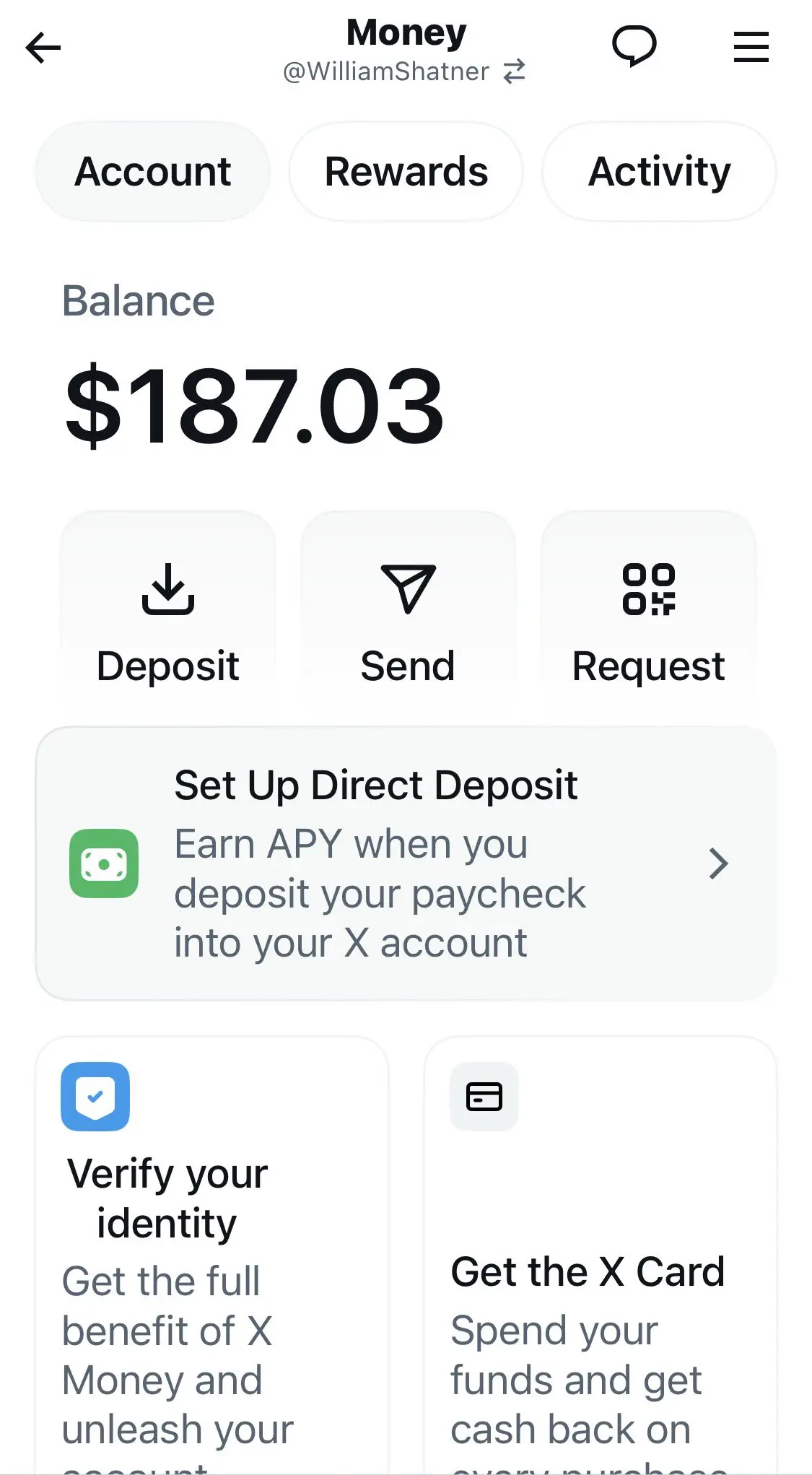 (Source: Elon Musk X)
Screenshots from X Money’s testing reveal core financial functions, showing the platform is entering the personal finance market with a clear interest rate advantage. The 6% annual deposit yield far exceeds the market average of major U.S. savings accounts, and the underlying deposit structure is backed by FDIC insurance, aligning with traditional bank account security.
Based on current disclosed testing features:
High-Yield Savings Account: 6% APY, deposits held by FDIC member Cross River Bank, with a maximum protection of $250,000 per person
Visa Metal Debit Card: Issued in partnership with Visa, featuring the user’s name on a metal X Money card
Spending Rewards Mechanism: Certain credit card transactions earn reward bonuses
Peer-to-Peer Payments: X holds remittance licenses in over 40 U.S. states and is registered with FinCEN, supporting direct transfers within the platform
Star Trek Captain William Shatner Sparks Testing Buzz: Charity Auction Experiment
William Shatner, Hollywood actor who played Captain Kirk in the original Star Trek series, became the most talked-about early participant in X Money’s external testing. His shared screenshots immediately sparked community discussion. Shatner then used the $42 sent by Musk for charity fundraising, and with official permission from X, auctioned off 42 X Money test invitations at $1,000 each. Winners not only received testing access but also got a $25 welcome gift card from X. After the first auction round, Shatner and X launched a second round, auctioning an additional 166 invitations at the same $1,000 price.
Participation in the external testing currently has clear restrictions: only U.S. residents aged 18 and above with an active, “good standing” X account are eligible.
X Money’s Greater Ambitions: Universal App Ecosystem and Crypto Payment Speculation
X Money is a core component of Musk’s “super app” strategy, expected to integrate payments, messaging, Grok AI chat, creator content, and identity verification. Musk stated in February this year: “This will become the hub for all funds, the central source for all currency transactions,” calling it a “game changer.”
It is noteworthy that there are currently no signs of crypto payment integration in X Money. Despite Musk’s long-standing public support for Dogecoin (DOGE), the crypto community has long anticipated crypto payment features within X Money. However, the current test version remains focused solely on fiat currency frameworks. X Money also marks Musk’s return to the payments space—he founded X.com in the late 1990s, which later merged with PayPal.
Frequently Asked Questions
How does the 6% APY in X Money work, and is there deposit protection?
According to current disclosures, deposits are held by FDIC member Cross River Bank, offering a 6% APY with federal deposit insurance up to $250,000 per person. The underlying yield mechanism has not been fully disclosed; details on withdrawal conditions and interest calculation will be announced in the official release.
Does X Money plan to integrate crypto or Dogecoin payments?
There is no official information confirming crypto payment integration. The test features currently only involve fiat savings, rewards, and P2P transfers. Crypto payment integration remains speculative. While Musk has publicly supported Dogecoin for a long time, no specific plans for crypto payment features have been announced.
When will X Money be fully available to general users?
Musk stated in February that the external testing version of X Money would launch within 1 to 2 months, with a phased rollout before global availability. Currently, the testing remains limited, and no specific timeline for full release has been announced.
Related Articles
Bitwise Sends $233,000 From $2.7B Bitcoin ETF to BTC Developers: Here’s Why
Visa, ANZ Bank, China Asset Management, and Fidelity International have completed a cross-border settlement solution based on Chainlink
Bitwise donates $230,000 to support Bitcoin open-source developers, funded by BITB profits.
SOL Strategies Validator surpasses 33,000 wallets, and the stock price rises more than 20% in response.
RedStone deploys price oracles on Stellar to strengthen DeFi security and RWA pricing infrastructure