


Bitcoin surges past $74,000! Korean stocks plunge 20% over two days, retail investors returning to crypto becoming a rebound driver?

Bitcoin Breaks $74,000, ETF Inflows Reach $680 Million in Two Days. Amidst a 20% Crash in Korean Stocks, Retail Funds Likely Shifted to Crypto. But Experts Are Divided and Warn of Bull Trap Risks.
Bitcoin Rebounds Strongly, $680 Million Inflow into Spot ETFs in Two Days
Bitcoin ($BTC) briefly surged past $74,000 early this morning. According to CoinGlass data, in the past 24 hours, a total of 129,049 traders were liquidated in the global perpetual futures market, with total liquidations reaching $594 million.
Meanwhile, institutional investors are re-entering the market. SoSoValue data shows that from March 2 to March 3, U.S. Bitcoin spot ETF inflows totaled over $680 million in just two days.
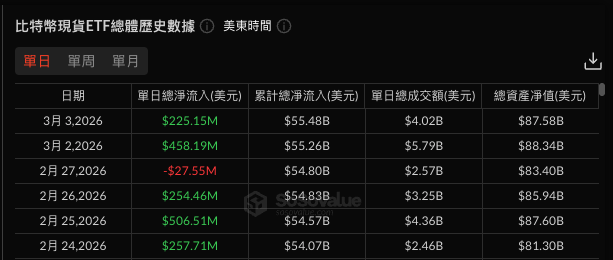
Image source: SoSoValue
Nic Puckrin, co-founder of Coin Bureau, mentioned that Bitcoin has performed better than the Nasdaq, S&P 500, and even gold during recent US-Iran tensions, which is a positive signal.
Research firm K33 also pointed out that after six consecutive weeks of decline and five months of stagnation, Bitcoin has entered its most severe weekly oversold condition in history; Clear Street analyst Owen Lau stated that the approximately 44% drop in the crypto market from October 10 last year to February 28 might signal the end of a new downturn. If this period represents a crypto winter, then let it be.
Korean Stocks Plummet 20 in Two Days, Retail Funds Shift to Bitcoin?
Bitcoin’s strong rebound coincides with intense volatility in the Korean stock market. According to CoinDesk, the Korea Composite Stock Price Index (Kospi), which is tech-heavy, plunged about 20% over two trading days this week, marking one of the fastest declines in history.
Geopolitical tensions temporarily burst the speculative bubble in AI-related hot stocks. Previously, months of active retail buying in Korean stocks pushed the Kospi index, dominated by Samsung and SK Hynix, up nearly 180% over about 10 months.
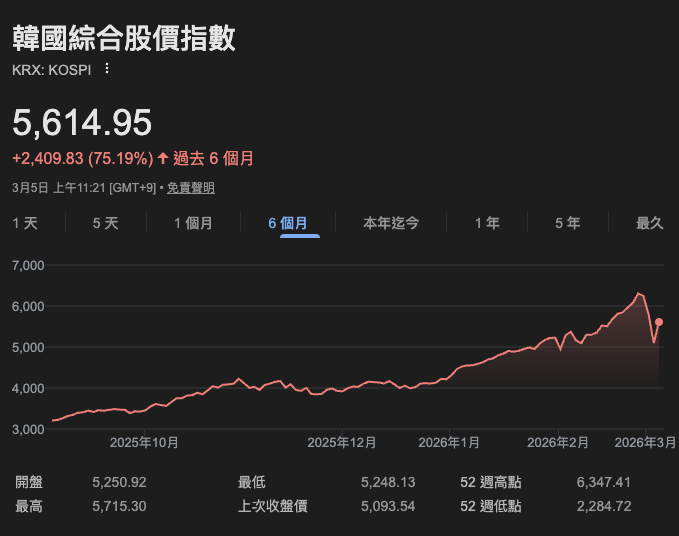
Image source: Google, Korea Composite Stock Price Index (Kospi) six-month gains
South Korea is one of the few countries where retail investors play a significant role in both stock and crypto markets. Long-term analysis shows that local traders often rotate funds between different speculative markets and do not fully exit risk assets.
In November last year, a CoinDesk analysis described a major shift in Korea, noting that retail investors moved into AI-related tech stocks, leading to a decline in trading volume on domestic crypto exchanges. Now, as the stock market cools, funds seem to be once again seeking crypto as a new outlet.
Korean Premium Remains Low, Retail Investors Not Yet in Frenzy
Although trading volume in Korea’s crypto market is beginning to recover, it has not yet reached the levels of early cycle speculative surges typical of Korean markets.
Currently, the “Kimchi Premium,” which measures the price difference between Korean exchanges and global markets, remains moderate. CryptoQuant data shows the Korean premium index is near 1%, well below the levels seen during previous retail-driven rebounds.
However, compared to mid-January when the Kimchi Premium briefly turned negative, recent retail sentiment has shown some moderate recovery.
Bull Trap or Reversal Signal? Market Divided
There is no consensus in the market regarding Bitcoin’s recent rally. Some traders warn that the current price action could be a classic bull trap—where a brief breakout attracts buyers before reversing downward.
Analysts point out that the derivatives market’s position distribution and heavy supply overhead are potential risks. Bitcoin’s rebound to the $72,000–$76,000 range could trigger sell-offs, making it uncertain whether this is a sustainable upward trend.
However, analyst Owen Lau holds a different view, believing that recent developments may signal broader industry shifts and that this rally has momentum to continue.
Further Reading:
Milestone Approaching? Bitcoin Circulating Supply Nears 20 Million, 114 Years Left to Mine Last 1 Million
This article is a compilation of information from various sources by Crypto Agent, reviewed and edited by Crypto City. It is still in training and may contain logical biases or inaccuracies. Content is for reference only and should not be considered investment advice.
Related Articles
Chinese electric vehicle company Jiuzi New Energy "exchanges shares for coins," planning to use $1 billion worth of equity to acquire 10,000 Bitcoins
Arthur Hayes warns: Bitcoin SaaS decoupling incomplete, dead cat bounce risk still exists
PIPPIN drops 37% as $43 million is withdrawn from the market – What's going on?
Arthur Hayes: BTC has not yet decoupled from American SaaS technology companies and may only be a short-term rebound
Pi Network price hits two-week high, protocol upgrade drives 8.5% increase
Gate Institute: Under wartime conditions, BTC's trend remains stable with a slight upward bias, and volatility stays high