


Trading Moment: Geopolitical conflicts trigger risk aversion sentiment, over 60% of analysts are bullish on Bitcoin

Daily Market Highlights and Trend Analysis, produced by PANews.
Macroeconomic Market
Following the joint military strike by the US and Israel against Iran that resulted in the death of Khamenei, the Middle East tinderbox has been fully ignited. Trump’s tough stance has heightened market anxiety, openly stating that military operations could last four weeks or more, with no ceasefire until objectives are met; Iran, in turn, responded firmly, declaring that the decision to cease fire rests with Iran.
Panic quickly swept through traditional financial markets. US stock index futures opened sharply lower on Monday, with S&P 500, Nasdaq, and Dow futures down over 1%. Short-term government bond yields briefly dropped to their lowest levels since 2022, as capital frantically fled overvalued risk assets.
Amid the risk aversion frenzy, precious metals unsurprisingly became the “ultimate safe haven” for global funds. Spot gold surged 2% to $5,390 per ounce, spot silver jumped 2.6% to $96 per ounce. Analysts from Saxo Bank and KCM Trade stated that this worrying escalation would push gold back to its safe-haven status; City Index even predicted strong safe-haven buying could push gold prices to hit $5,500 or even break new records.
The energy market’s choke point—the Strait of Hormuz—has effectively “shut down,” prompting panic buying that drove international oil prices up by $8 at the open. Brent crude soared 9% to $82.37 per barrel, WTI climbed to $75.33 per barrel. Despite OPEC’s emergency announcement of a daily increase of 206,000 barrels from April, supply fears remain unalleviated.
Wall Street investment banks are highly alert to the future trajectory of oil prices, with tail risks fully priced in. JPM warns that if the strait is completely closed, Middle Eastern oil producers can only sustain about 25 days of production due to storage limits; Citigroup and Rystad Energy project that if infrastructure attacks or shipping disruptions persist for weeks, oil prices could break through $100, with a potential spike to $120.
Goldman Sachs’ strategists note that the “duration” of the conflict has become the key variable, surpassing the initial outbreak itself. If oil supply disruptions turn into a prolonged conflict, soaring inflation expectations could lock in the Fed’s rate cuts, with volatility spiking, risking a repeat of the 2022 energy shock scenario.
AI Sector Developments
On February 28, US Department of Defense negotiations with AI firm Anthropic for a $200 million deal fell apart over disagreements, with the Pentagon designating Anthropic as a “supply chain risk” and cutting off cooperation. On the same day, Anthropic’s competitor OpenAI quickly reached an agreement with the Pentagon, allowing it to use AI for “all legal purposes” while retaining technical safeguards.
Despite the controversy over Pentagon cooperation, Claude’s market appeal was not diminished—in fact, downloads and willingness to pay surged, with the app topping the US App Store free charts, surpassing OpenAI’s ChatGPT.
Bitcoin Market
Under extreme pressure from Middle East tensions, Bitcoin spot prices did not replicate the 2020 “312” crash but instead declined gradually. Over the weekend, prices briefly dipped to $63,000, but following the death of Khamenei, a rapid V-shaped reversal occurred. February closed down nearly 15%, marking the third-worst February performance in history. Since reaching its all-time high, Bitcoin has fallen for five consecutive months, with March still opening on a downward note.
Options markets show implied volatility (IV) for March 27 delivery spiking to 51.3%. The maximum pain point remains at $76,000. Total open interest in puts and calls exceeds 167,000 BTC (over $11.2 billion). The put/call ratio (PCR) is only 0.75, but 24-hour trading volume PCR surged to 1.37. Market sentiment is highly polarized: long-term institutions hold onto bullish positions, refusing to give up their chips, while short-term hot money is aggressively buying puts in the $67,000–$70,000 “meat grinder” zone for tactical hedging. According to unbias data, 61% of analysts are short-term bullish.
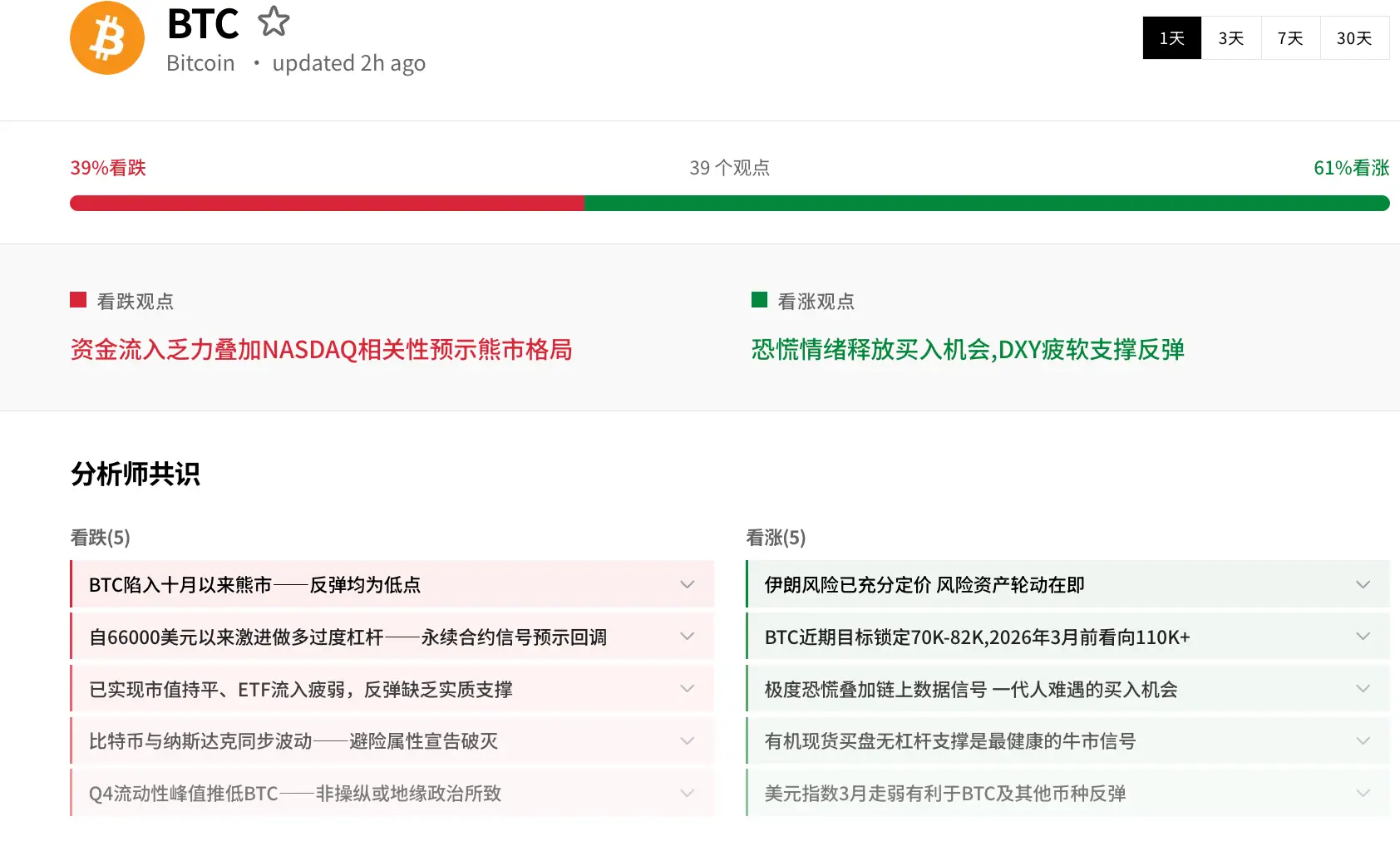
Bearish Viewpoints
Core logic: Macro risk-off flows and options market maker suppression will limit short-term rebounds, risking liquidity-driven downside.
- GodotSancho: Major funds have shifted from buying puts for defense to selling calls to cap upside; deep negative premiums remain in the forward curve, clearly betting on further downside this week. Caution advised around the $66,000 support level.
- Skew: Spot market near $68,000 faces passive selling; leverage chasing prices makes a short-term correction unsurprising.
Bullish Viewpoints
Core logic: War-driven inflation expectations and fiat trust crises will reshape Bitcoin’s safe-haven value as a borderless hard asset, forcing the Fed to loosen liquidity.
- Arthur Hayes: The longer the US intervenes in Iran, the more likely the Fed will cut rates and print money to support war expenses; best strategy is to accumulate Bitcoin after rate cuts.
- Samson Mow (Jan3 CEO): Compared to gold and global money supply, Bitcoin is severely undervalued; current Z-score below -2 signals a major reversal.
- Henrik Zeberg (macro economist): Driven by rising risk appetite and ETF inflows, Bitcoin’s target price could reach $110,000–$120,000.
- Alex Krüger: End of Q1 target at $78,000–$82,000; breaking above $71,000 will trigger FOMO.
- Mercado Bitcoin research: When priced in gold, Bitcoin’s bear cycle may bottom in February–March, with whales opportunistically accumulating during panic.
- BitBull / Michaël van de Poppe: Market is poised for a corrective rebound, with short-term targets around $73,000–$74,000.
Ethereum Market
Compared to Bitcoin’s volatility, Ethereum’s start in 2026 has been sluggish, with a 36% decline this year, retreating to around $1,900. Data shows Ethereum’s DEX trading volume has plummeted 55% over the past six months, recording only $56.5 billion in February, far below August’s peak of $128.5 billion. This sharp decline in on-chain activity has dragged down network fees and DApp revenue, making the $3,000 psychological barrier increasingly distant.
However, behind the disappointing price action, Ethereum’s fundamentals and institutional consensus remain solid. It still controls $52.4 billion in TVL, and including Layer 2s like Base and Arbitrum, its market share reaches 65%, crushing Solana’s $6.4 billion and BNB Chain’s $5.5 billion. Moreover, Ethereum dominates 68% of the RWA market, becoming the preferred platform for tokenized funds issued by Wall Street giants like JPM, Citi, and BlackRock. Market sentiment is mixed: retail investors are pessimistic due to weak prices and liquidity, but traditional financial giants are accelerating their accumulation.
Bearish Viewpoints
Core logic: On-chain activity decline and prolonged price weakness severely weaken holder conviction and short-term explosive potential.
- Crypto Seth: Since December 2024, Ethereum has closed in the red for 12 of the past 15 months, with persistent weakness.
Bullish Viewpoints
Core logic: Leading locked-in value, high institutional adoption, and ongoing protocol evolution create a strong long-term moat.
- Vitalik Buterin: Focusing on layer-1 scaling and ZK-EVM development, with parallel block validation and quantum-resistant cryptography, to ensure long-term efficiency and security.
- Investor Jordan: Continues to add in the oversold $1,800 zone; Ethereum’s role in stablecoins and DeFi remains unshaken, with a five-year target of $20,000.
- Major financial institutions (JPM, Citi, BlackRock): Despite short-term volatility, they still see Ethereum as the top platform for tokenized funds and bank-issued stablecoins.
Key Data (as of 13:00 HKT March 2)
(Source: CoinAnk, Upbit, SoSoValue, CryptoBubbles)
- Bitcoin ETF: Net inflow $787 million this week
- Ethereum ETF: Net inflow $80.46 million this week
- SOL ETF: Net inflow $44.44 million this week
- XRP ETF: Net inflow $9.55 million this week
- Fear & Greed Index: 10 (Extreme Fear)
- Upbit 24-hour trading volume top: XRP, BTC, SAHARA, ETH, CFG
- Sector performance: Entire crypto market down, NFT and GameFi sectors down over 3%
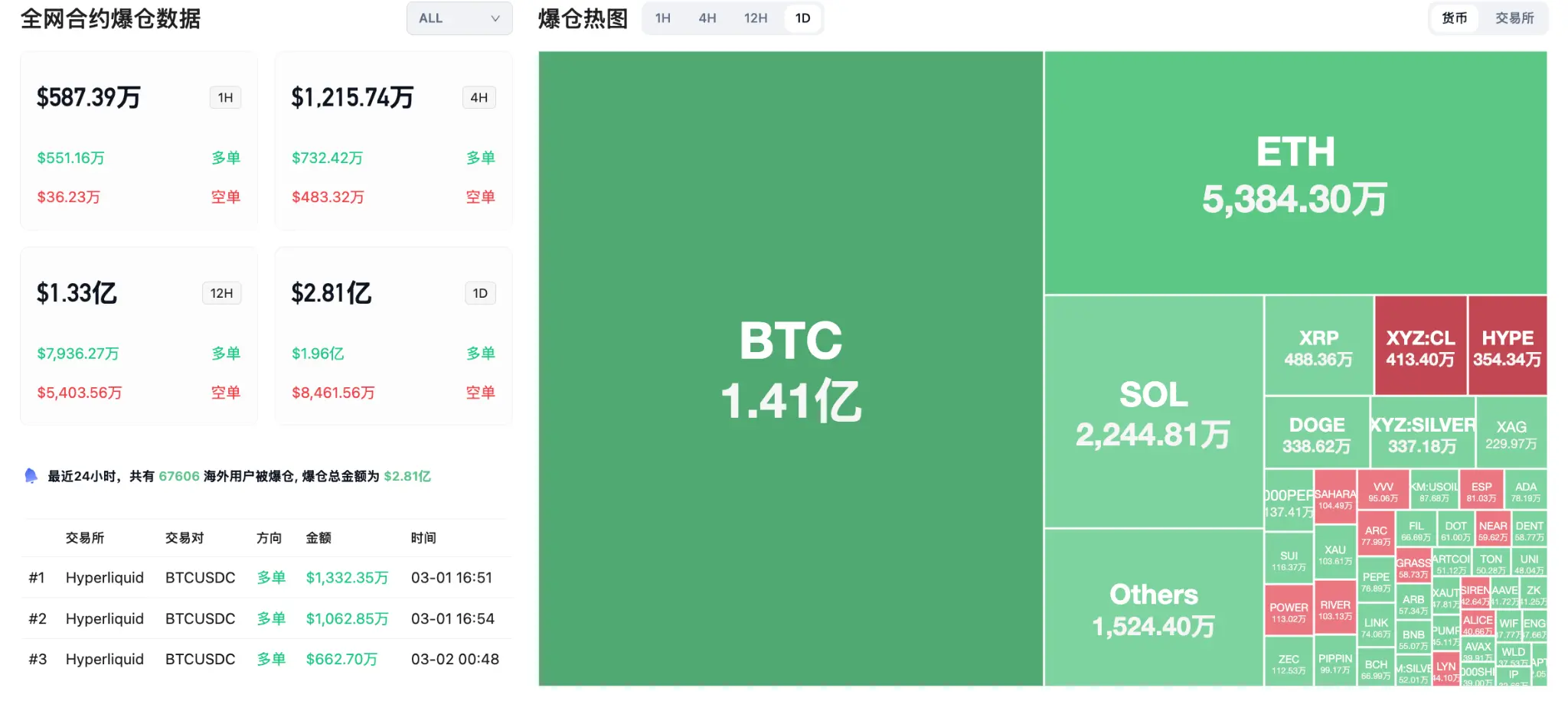
Globally, 67,606 traders were liquidated, totaling $281 million, including $141 million in BTC, $53.84 million in ETH, and $22.44 million in SOL.
Today’s Outlook
- Binance: Bitway (BTW) token to start trading at 16:00 on March 2
- MANTRA token upgrade scheduled for March 3, including rebranding and 1:4 split
- Upbit to delist GoChain (GO) on March 3
- ENA to unlock approximately 40.63 million tokens (~$4.3 million) on March 2
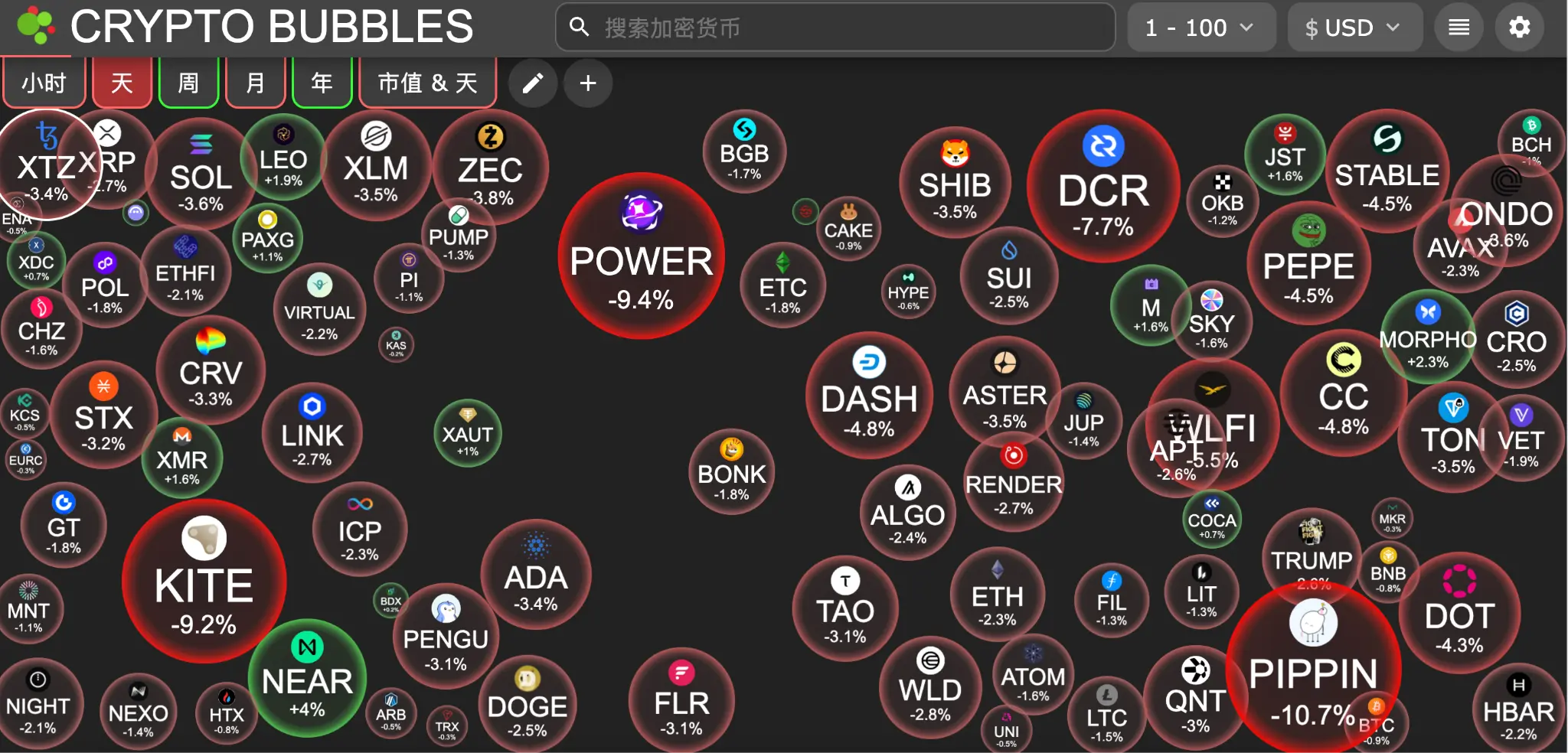
Top 100 coins by market cap today see the biggest declines in Power Protocol (-9.4%), Decred (-7.7%), Stable (-10.7%), Internet Computer (-9.2%), MemeCore (-5.5%).
Hot News
- Data: RED, HYPE, ENA tokens to undergo large unlocks, with RED unlocking worth about $6.2 million
- Weekly preview | Gemini to cease operations in the UK; Fed releases Beige Book
- Warning: OpenClaw Gateway vulnerability detected—immediate upgrade to version 2026.2.25 or higher recommended
- Trump reveals internal contacts in Iran
- A user opened a 40x short on BTC when the market dropped on Feb 28, now holding 750 BTC
- Mysterious account precisely bets on airstrikes against Iran, Trump camp faces “insider trading” accusations
- SpaceX holds about 8,285 BTC in Coinbase Prime custody, now worth approximately $545 million
- Arthur Hayes issues bullish signals on HYPE, targeting $150
- Aave governance controversy ongoing for three months, TVL down from $36 billion to $26.5 billion
- Strait of Hormuz oil tanker transport halted
Related Articles
KAIKO Research: The Rise of Gold and Silver and an Analysis of the Competitive Landscape with Bitcoin
Futures Bitcoin trading volume drops to its lowest level in 2024: Are institutions pulling out of the market?
Bloomberg Analyst: Bitcoin ETF records $1.5 billion in capital inflows over the past 5 days
Neo 2025 Financial Report: The treasury holds approximately 41.17 million NEO and 40.08 million GAS, as well as 1,112 BTC