MrBeast Editor Involved in "Insider Trading": Kalshi's Fine Exposes the Dark Side of the Prediction Market
Author: Frank, PANews
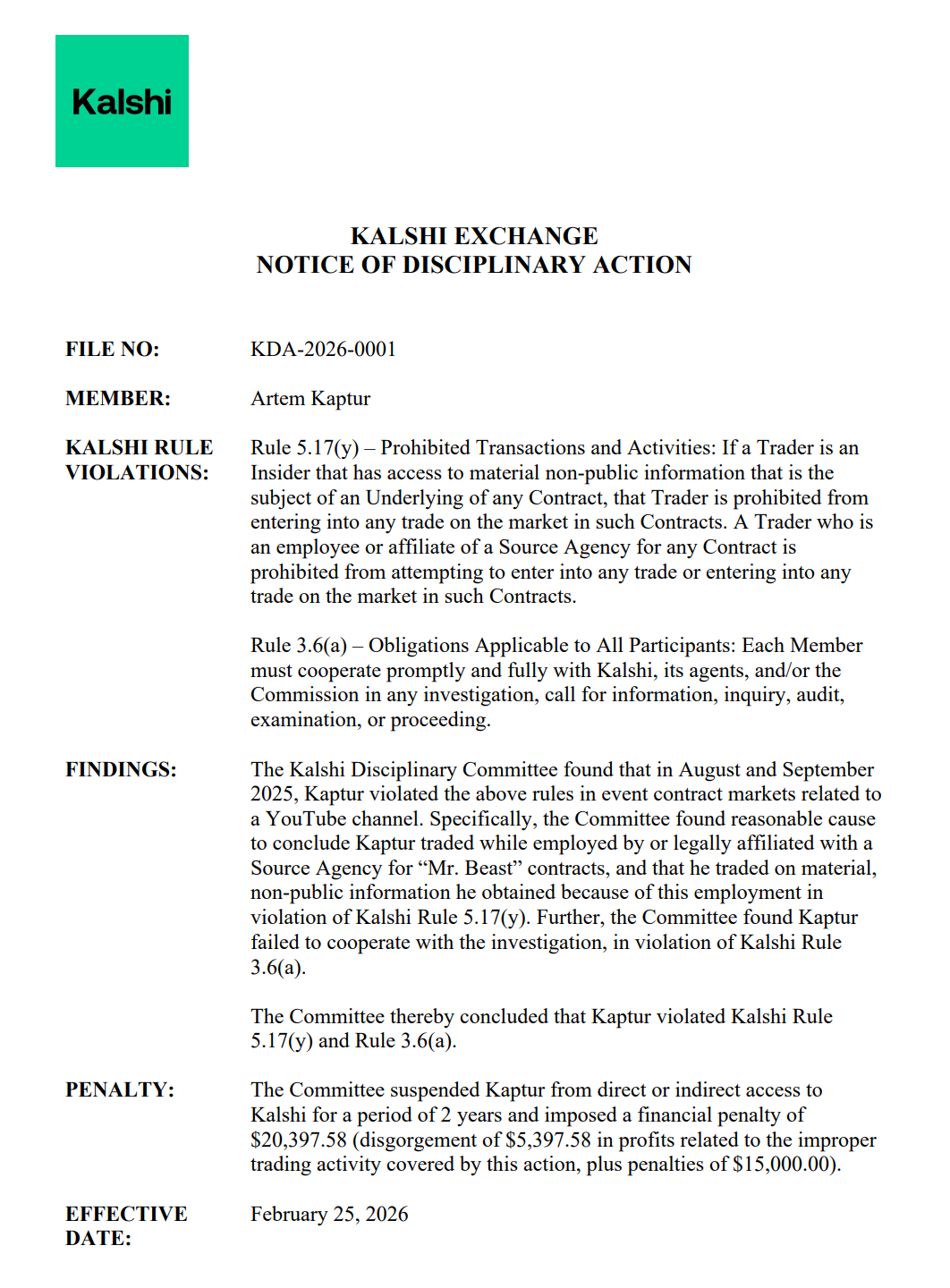
On February 25, 2026, the prediction market platform Kalshi issued a fine of $20,397.58 to a YouTube editor. This precise figure, down to the cent, marks the first publicly disclosed insider trading penalty in the history of the prediction market industry.
The person fined is Artem Kaptur, the visual effects editor for the world’s largest influencer MrBeast. He invested about $4,000 in trading MrBeast-related YouTube event contracts on Kalshi and earned $5,397.58. However, this seemingly small profit triggered a major regulatory signal across the industry, prompting the CFTC (U.S. Commodity Futures Trading Commission) to release an official enforcement consultation notice targeting prediction markets.
Nevertheless, Kalshi is a verified KYC platform, making it relatively easy to catch a trader using real identities. The real question is: what happens if those with the same information turn to Polymarket, which requires no identity verification?
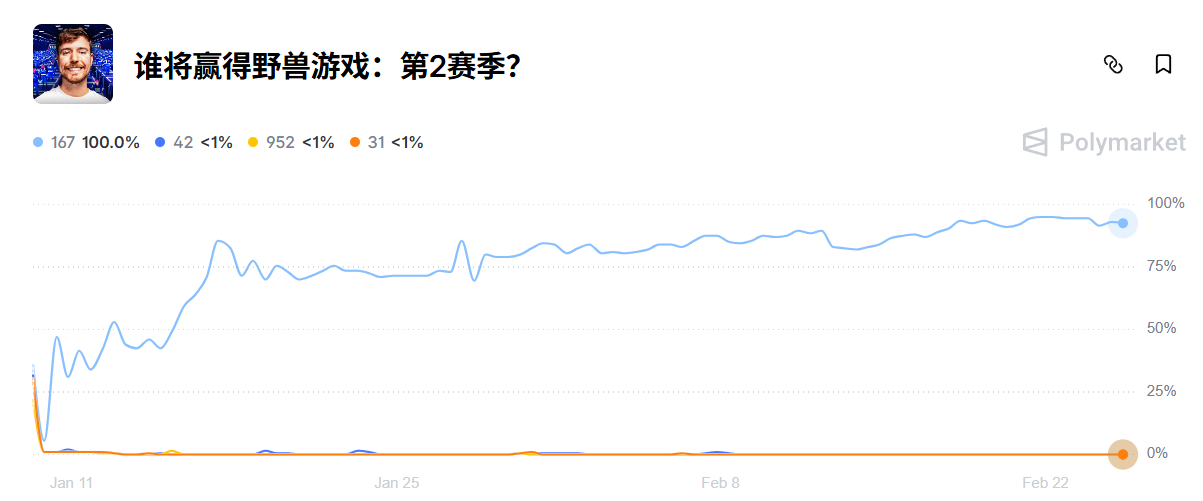
PANews analyzed the on-chain data and found that in the Polymarket contract for Season 2 of MrBeast’s reality show Beast Games, the final winner’s probability was pushed to 94% three weeks before the season ended, exhibiting textbook insider trading characteristics.
Starting from Kalshi’s penalty, combined with on-chain data anomalies on Polymarket, PANews delves into how insider trading has transformed from a Wall Street-exclusive term into a gray area accessible even to assistant editors in editing rooms in the era of “anything can be bet on.”
The First Insider Trading Penalty in Prediction Markets
According to Kalshi’s disciplinary notice, Kaptur traded event contracts related to MrBeast’s channel during August to September 2025, leveraging his position at Beast Industries.
Kalshi’s monitoring system detected extremely abnormal statistical features: Kaptur achieved an “almost perfect trading success rate” in low-odds markets. Since Kalshi’s trading data is fully public, multiple platform users also identified this anomaly and reported it proactively. Under this double trigger, Kalshi froze Kaptur’s account and launched an investigation.
The final penalty was the confiscation of all illegal gains of $5,397.58, plus a $15,000 punitive fine, totaling $20,397.58, and a two-year platform ban.
On the same day, another more absurd case was disclosed. California Republican gubernatorial candidate Kyle Langford bet about $200 on Kalshi that he would win, then publicly flaunted a screenshot of the trade on X (Twitter). Kalshi froze his account that day, ultimately imposing a five-year ban and a $2,246.36 fine.
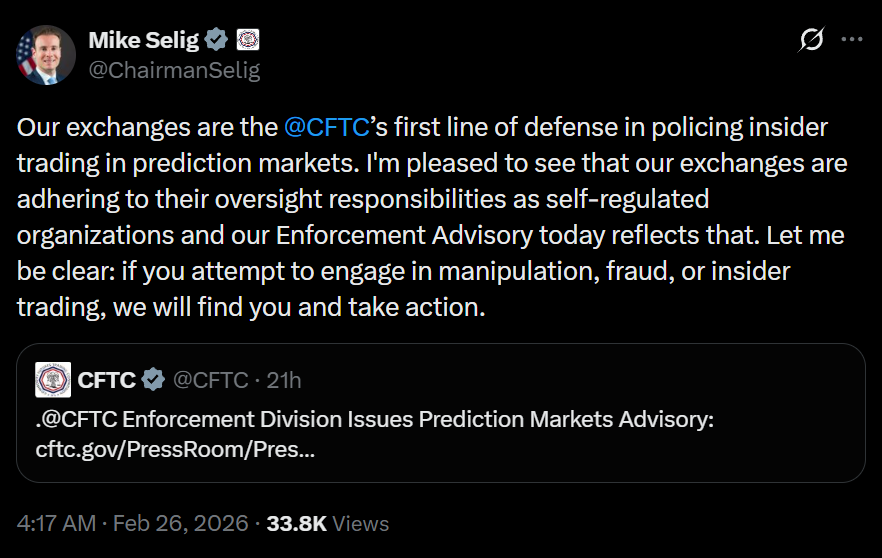
While these fines are not large, their signals far exceed the monetary amounts. On the same day, the CFTC issued an official enforcement consultation, explicitly citing Section 6©(1) of the Commodity Exchange Act, indicating that both cases could constitute federal violations. CFTC Chairman Mike Selig stated on X:
“Our exchange is the first line of defense against insider trading in prediction markets. If you attempt manipulation, fraud, or insider trading, we will find you and take action.”
This marks the first direct warning from a U.S. federal regulator regarding insider trading in prediction markets.
Beast Industries issued a statement emphasizing a “zero tolerance” approach to insider trading among employees and has initiated an independent internal investigation. However, the company also suggested that Kalshi should “be more open” in communicating investigation results in the future.
But all these efforts are based on a premise: Kalshi is a centralized KYC platform where user identities, bank transactions, and IP addresses are fully transparent. Catching a trader using real identities doesn’t reveal much. The real question is: what if those with the same information choose a platform like Polymarket, which requires no identity verification and settles with anonymous wallets and USDC?
94% on Polymarket: The Beast Games Champion Leaked on Chain
At the same time Kaptur was earning over $5,000 on Kalshi and getting penalized, MrBeast was pushing another much larger project. The second season of the reality show Beast Games, in partnership with Amazon Prime Video, premiered on January 7, 2026, featuring 200 contestants competing for a record-breaking $5.1 million prize. The finale aired on February 25, revealing the champion: Player 167, Tyler Lucas, a former U.S. Air Force pilot and former college football wide receiver at the University of Pennsylvania.
However, on Polymarket, this result seemed to have been “publicized” three weeks earlier.
Through analyzing the odds changes on the “Who will win Beast Games Season 2?” contract on Polymarket, PANews discovered an extremely abnormal flow of funds. During the early stages of the show, when many contestants were still in the game and the finals were far off, the share of Yes bets for Player 167 was continuously bought in a way that defies normal market logic.
The timeline shows a clear and significant anomaly. From late January to early February 2026, before the show entered the second half of elimination rounds, the probability of Player 167 winning began to sharply diverge from fundamentals. By February 4, three weeks before the finale, Tyler Lucas’s winning probability had surged to 84%. By February 18, just one week before the finale, the implied probability was pinned above 94%.
In stark contrast, other top performers in the show were almost “priced at zero.” In a reality show with 200 contestants relying on physical and mental tests, it’s highly unlikely that rational funds would price a single contestant’s winning probability above 90% midway through the competition without insider information.
Reddit communities and Polymarket comment sections exploded with discussions. Multiple posts bluntly pointed out, “The champion was basically leaked on Polymarket,” drawing parallels to the early leak of season 1 champion Jeff Allen, but this pattern was even more blatant.
Odds are just surface-level indicators. PANews conducted a comprehensive on-chain transaction analysis of the odds market and found more direct evidence than odds fluctuations.
The entire Beast Games Season 2 market recorded 111,000 transactions involving 2,640 unique addresses. Among these, one data point was particularly striking: 795 addresses only traded the contract for Player 167 during the entire market lifespan. Out of 25 contestants, only the eventual champion was “coincidentally” targeted, a concentration far beyond normal betting logic.
Further cross-referencing all suspicious addresses’ transaction histories across the platform, including their share of Beast Games trades, overall platform win rates, and address relationships, PANews identified 147 highly suspicious addresses. Among them, 16 exhibited textbook insider trading features—they only participated in Beast Games markets and had no trading records in any other markets.
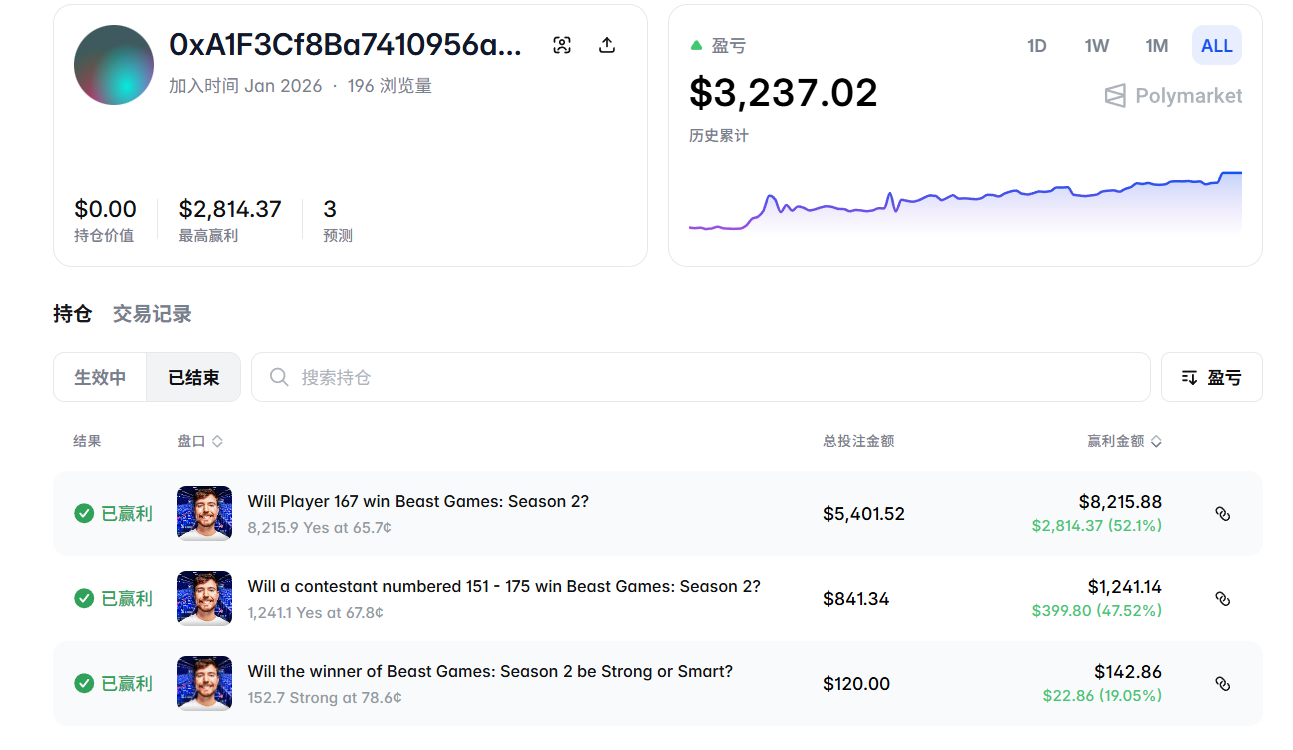
Of these 16 addresses, the most suspicious one is “0xA1F3Cf8Ba7410956a2955D5300A9be7Ff1dBc07E-1767992471439,” which only traded in three Beast Games sub-markets, all profitable, with a 100% win rate, and a total profit of $3,237. Multiple similar addresses exist, with small individual profits but highly similar operational patterns. This suggests insider traders may deliberately spread their bets to reduce attention.
More concerning are those who profited heavily on Beast Games but did not only trade MrBeast-related markets. Their trading behaviors further deepen suspicion. PANews identified multiple “address clusters” that were highly synchronized in time and behavior. On January 27, the biggest trading day for the entire market (with a daily volume of $44,547), the top suspicious address completed all 12 trades within 17 minutes, earning $11,830. Two anonymous addresses executed sell trades within the same minute on January 30 at 09:41, each profiting $3,542—mirroring each other in amount, timing, and behavior.
So, who has the ability to place such confident bets mid-season? The sources point to a very limited group: the massive post-production team of Beast Industries, the 200 contestants and their close social circles, and staff involved in scheduling and announcing (investigations found multiple addresses focused on film and TV contracts with extremely high win rates). Kaptur’s trades on Kalshi involved only $4,000, earning over $5,000, but on Polymarket, the suspected insider addresses tracked by PANews have already accumulated profits exceeding $100,000—likely just the tip of the iceberg.
A Feature and an Unfair Game
Kalshi’s ability to precisely confiscate $5,397.58 in illegal gains stems from its status as a regulated centralized exchange, where all traders’ identities, bank transactions, and IP traces are fully visible for audits. In contrast, on Polymarket, users only need to connect decentralized wallets like MetaMask to trade, with on-chain transactions transparent but identities anonymous behind addresses.
The deeper divide lies in philosophy. Kalshi’s enforcement head, Robert DeNault, explicitly defines information asymmetry as a violation that must be strictly cracked down on. Meanwhile, Polymarket CEO Shayne Coplan has publicly expressed a completely different stance: insider trading is a “feature rather than a flaw” of prediction markets.
The early “leak” of the season 2 champion on Polymarket at 94% probability three weeks in advance may be a direct result of such systemic arbitrage. For ordinary players with no inside information advantage, participating in such predictions essentially makes them mere fuel for the game—“chives” in the gambling metaphor.
From a broader perspective, prediction markets aim to turn collective intelligence into price signals. But when they become large “whale” positions, the game may no longer reflect collective wisdom but rather the shadow of informational privilege.