


Hyperliquid hides 28.9 million shorts liquidated, bulls and bears battle at the $35 level

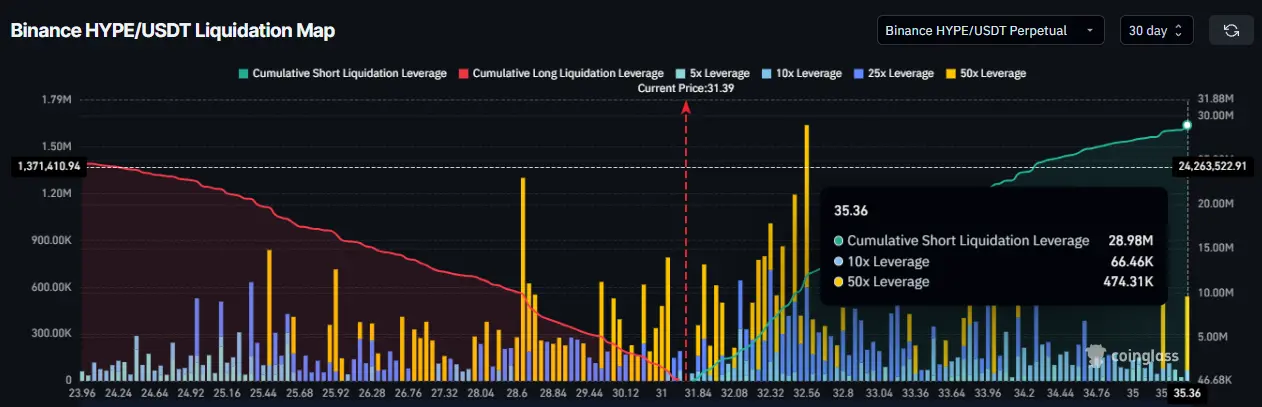
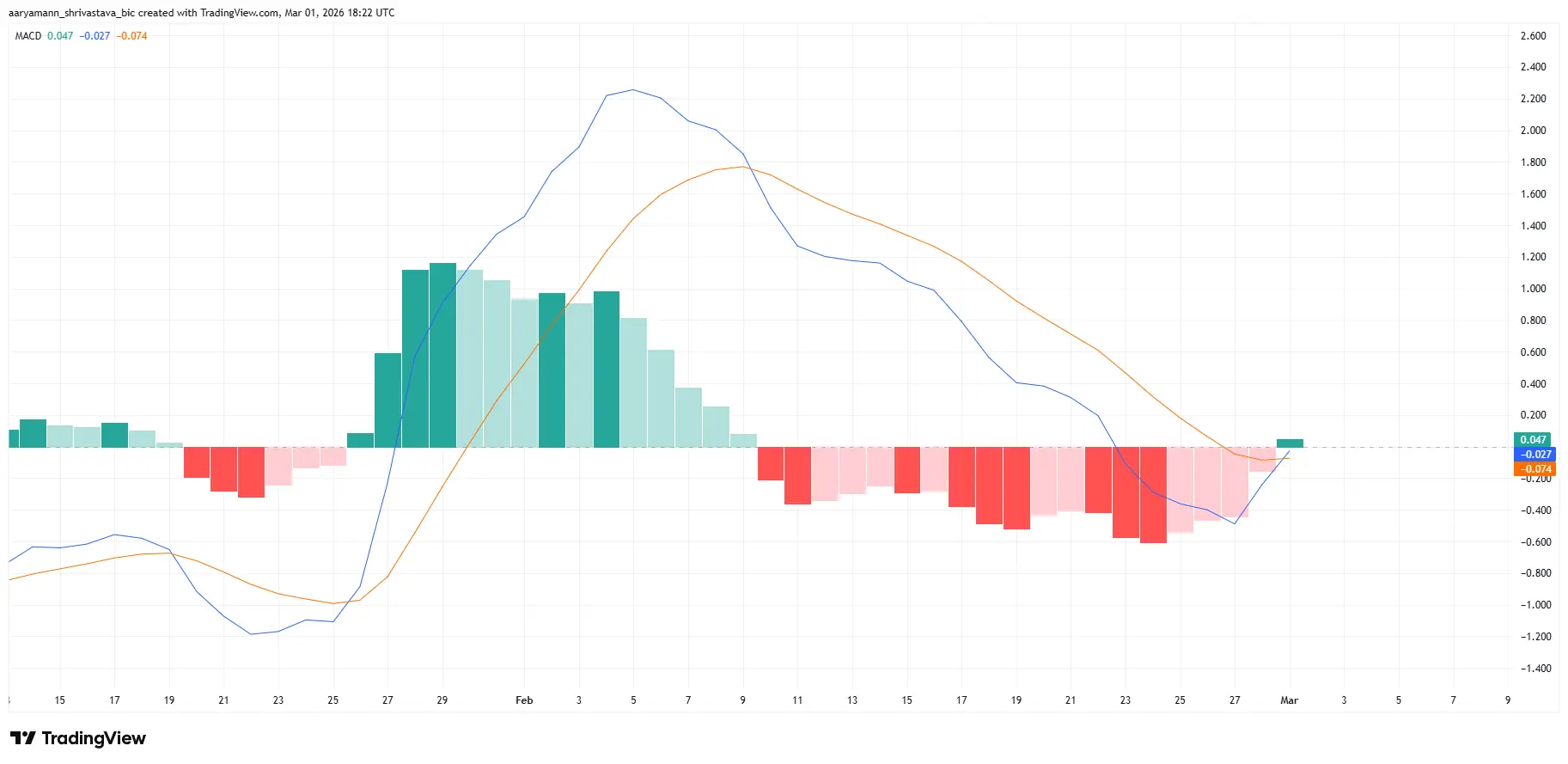
Hyperliquid’s native token $HYPE recently attempted a rebound from lows, but Coinglass’s liquidation map shows approximately $28.9 million in short positions concentrated above the $35 level. Meanwhile, the MACD indicator experienced a bullish crossover on Sunday, signaling a potential technical trend reversal.
Liquidation Map Analysis: The $35 Key Breakout Point
(Source: Coinglass)
Hyperliquid’s liquidation structure exhibits a clear directional asymmetry: currently, high-liquidity contracts are dominated by short positions, with over $28.9 million in shorts heavily concentrated around the $35 price level.
This concentration of shorts can be interpreted from two perspectives:
On one hand, the large number of short positions reflects market expectations that $HYPE will continue its downtrend, creating technical selling pressure. On the other hand, the dense cluster of shorts also sets the stage for a potential upward catalyst—if buying momentum drives $HYPE to decisively break through $35, forced short covering will trigger a chain reaction, amplifying the upward move. This “short squeeze” could push the price rapidly toward the $38 region, as technical analysis suggests.
At around $38, the distance between the 50-day and 200-day moving averages may narrow further. If, after short liquidation, these moving averages form a golden cross, it would serve as a stronger confirmation of a medium-term bullish structure.
Technical Signals and Key Price Levels
(Source: TradingView)
Beyond the liquidation structure, technical indicators provide initial positive signals for short-term momentum.
The MACD (Moving Average Convergence Divergence) experienced a bullish crossover on Sunday, with the DIF line crossing above the DEA line, a common short-term buy signal in technical analysis. The narrowing and turning positive of the histogram suggest that selling momentum may be weakening. If spot buying demand aligns with these technical signals, $HYPE could gradually establish a stable upward trend in the near term.
Key technical levels to watch are:
- First Resistance: $34 — immediate overhead pressure for spot price
- Core Liquidation Trigger: $35 — short position concentration zone; breaking through could trigger a chain reaction
- Short Squeeze Target: $38 — price target after $28.9 million short liquidation
- First Support: $30 — critical bottom line protecting the bullish structure
- Secondary Support: $26 — next major support if $30 fails
Frequently Asked Questions
Q: Why does the $HYPE short liquidation at $35 amplify the price movement?
In futures markets, traders holding short positions typically set stop-loss orders just above key resistance levels. When the price breaks above $35, many stop-loss orders are triggered automatically, forcing traders to buy back (cover) their shorts. This forced buying adds to the upward momentum, accelerating the price increase—creating a short squeeze. The $28.9 million concentrated liquidation can generate significant volatility in a short period.
Q: Is the MACD bullish crossover enough to confirm a trend reversal for $HYPE?
A MACD crossover is a short-term bullish signal indicating increasing buying momentum, but it alone is insufficient to confirm a trend reversal. Analysts usually recommend combining it with volume analysis, spot market strength, and other momentum indicators like RSI. Given the current macro environment—geopolitical tensions and overall market risk appetite—this initial technical signal needs macro confirmation to be reliable.
Q: If $HYPE falls below $30 support, what signals should investors watch?
$30 is the current structural support that has maintained the upward trend for over a month and a half. A breakdown below this level would shift the focus to the next support at $26, and the bullish structure would be invalidated. Investors should monitor whether volume increases during the decline (confirming genuine selling pressure) and whether spot funds are flowing out (net outflows), which would indicate the breakdown’s sustainability.
Related Articles
Altcoin Dominance Hits Bullish MACD — Trade These 4 Coins Now for Potential 80% Profits
Will XRP Hold $1.33 or Extend Toward $1.30 Before Rebound?
Continuing to rise! Bitcoin briefly breaks above $74,000, Ethereum surpasses $2,200, and the entire network experiences $570 million in liquidations.
$15M Revenue in Two Months, 60% Market Share – Why Is ONDO Price Still Down 50%?
Dogecoin Drops 9.6% to $0.08885 as Adam and Eve Pattern Tests Key Neckline