


Willy Woo Issues Stark Warning: BTC Bear Trend Deepens Across 3 Phases
Bitcoin remains locked in a strengthening bear market as volatility spikes and liquidity weakens, signaling deeper downside risk ahead, according to on-chain analyst Willy Woo.
Willy Woo Warns Bitcoin Bear Market Is Strengthening
Market analysts are signaling caution in the digital asset sector as volatility accelerates. On Feb. 17, on-chain analyst Willy Woo shared on social media platform X that bitcoin remains in a strengthening bear market, citing volatility and liquidity trends as key indicators.
He said:
“ BTC is still strengthening its bear trend.”
Woo described volatility as a key metric used by quantitative analysts to detect structural shifts in market direction.
The accompanying chart he posted, which tracks bitcoin’s weekly price against volatility spikes since 2013, shows that major bear markets were preceded by sharp upward volatility surges in 2014–2015, 2018–2019, and 2022. In each instance, volatility climbed rapidly at the onset of the downturn, peaked during the mid-to-late phase, and then tapered off as price formed a macro bottom. The current reading shows volatility rising again from relatively subdued levels, a pattern Woo interprets as characteristic of an early bear phase rather than a completed correction.
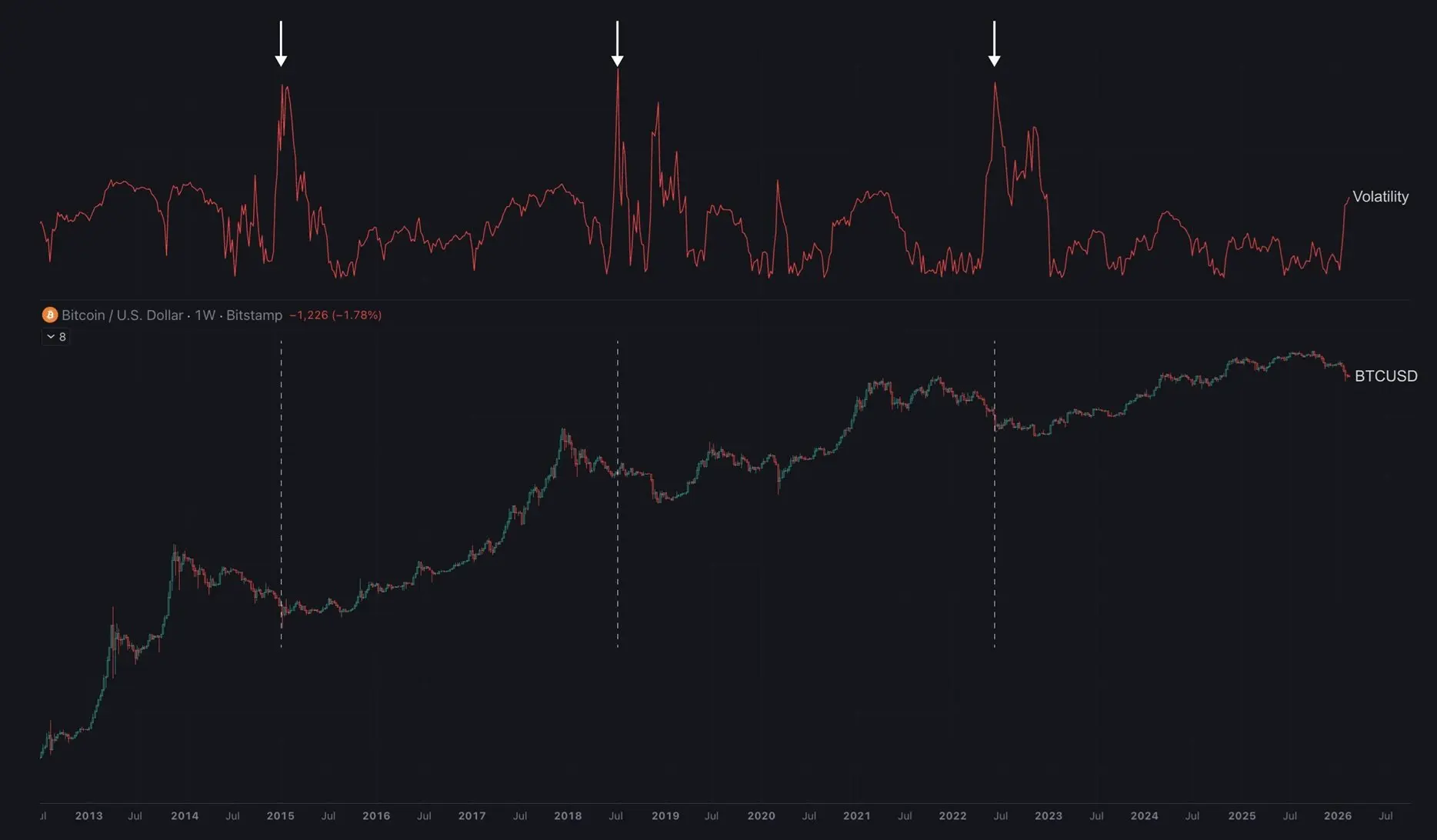 Bitcoin Weekly Price vs. Volatility Spikes chart shared by Willy Woo.
“I find it useful to frame BTC bear markets in 3 phases,” Woo further stated, outlining a liquidity-driven structure for assessing market cycles. In describing early-cycle reactions, he remarked: “In this phase, perma bulls will blindly say it’s a correction inside a broader bull market but will not give you any hard evidence of capital flowing in, they will only give narrative.”
The analyst divided the downturn into three stages tied to liquidity conditions and broader macro performance. Addressing the second stage, he wrote: “This is the mid phase BTC bear market where all risk assets are falling and there’s no doubt we are in a bear market.” Woo characterized the final stage as a period when liquidity stabilizes, investor participation gradually returns, and markets approach exhaustion. He concluded:
“A final price capitulation is usually found in this phase, either before or slightly after the peak outflows.”
Under this model, Woo indicated that BTC remains in Phase 1 and is approaching Phase 2, suggesting that broader market weakness could add further downside pressure if liquidity fails to recover. He opined: “Under this bear market framework, BTC is presently in Phase 1 and close to Phase 2.”
Some market participants disputed his view. One critic argued that volatility spikes typically follow sharp drawdowns rather than predict them. “This is bad analysis,” he wrote, adding that such moves are a symptom of 40–80% crashes, not an independent trend signal. He described volatility as “noisy” and “mean-reverting,” calling it a “rear-view mirror” instead of a forward-looking indicator, underscoring debate over its reliability in identifying bitcoin bear cycles.
FAQ ⏰
- Why does Willy Woo say bitcoin is in a bear market?
He cites rising volatility and weakening liquidity trends as confirmation of a strengthening bear trend.
- What are the three phases of a bitcoin bear market according to Woo?
They include an early volatility spike phase, a mid-phase with broad risk asset declines, and a final capitulation stage.
- What signals the mid phase of a BTC bear market?
Woo says it is marked by falling risk assets and clear confirmation that markets are in a downturn.
- Where does Woo believe bitcoin is currently positioned?
He assesses that bitcoin is in Phase 1 and approaching Phase 2 of the bear cycle.
Related Articles
Data: If BTC drops below $65,668, the total long liquidation strength on mainstream CEXs will reach $1.679 billion.
BTC short-term decline of 0.81%: Futures long liquidation wave triggers passive selling and liquidity resonance, intensifying volatility