Author: Hubble AI
For traders predicting markets, the biggest pain point is often not “not knowing,” but “being late.”
When we see breaking news, our instinctive reaction is usually to verify: “Is this information genuine?” “Is it just a rumor?” This caution is a virtue in traditional investing, but in markets like Polymarket’s binary options, it can be an extremely costly hidden expense.
We call this cost the “confirmation tax.”
The PolyHub team analyzed 2,023 on-chain individual trades on Polymarket, attempting to answer a quantitative question: how much alpha (excess returns) do you sacrifice to achieve 100% informational certainty?
The data’s conclusion is more brutal than we expected: in the most liquid breaking events, 96% of the information advantage is absorbed within the first 10 minutes. This means that when you spend one minute verifying news authenticity, you’ve already handed over the vast majority of potential profits to opponents willing to take risks or with faster information sources.
This article does not induce anxiety. Instead, by reviewing on-chain data from three typical markets, it restores the “golden entry window” for different types of news events.
The harsh but simple conclusion: in prediction markets, time is an exponential function of money. The later you enter, the smaller the remaining profit space you can capture, and this decay often far exceeds most people’s expectations.
1. Defining the Metric: What is “Remaining Profit Space”?
To quantify the cost of “late entry,” we use a simple metric:
Remaining profit space (Alpha) = 1 - current buy-in price
For a contract that ultimately settles at $1 (YES):
- Enter at $0.20, your remaining space is $0.80.
- Enter at $0.90, your remaining space is only $0.10.
This is the amount of money still on the table. Our research shows that, over time, this money doesn’t decrease linearly but evaporates exponentially.
2. On-Chain Review: Three Different “Decay Curves”
- Deterministic Breakout: Can only “blindly rush,” no “confirmation”
- Case: Maduro out by Jan 31, 2026?
- Features: Physical event + instant official confirmation.
- On-chain data reconstruction:
0-1 minutes (golden window): Within 60 seconds after the information shock, the average transaction price was only $0.56, meaning the remaining profit space is as high as $0.44 (44%).
1-5 minutes: Just a few minutes later, large funds flooded in, and the remaining space rapidly dropped to $0.12.
After 10 minutes: Price stabilized at $0.97, alpha exhausted.
Trading insight: In such markets, the half-life of alpha is less than 2 minutes. If you try to wait for mainstream media’s “in-depth report” to confirm the news, you’re actually providing liquidity for those who entered in the first minute. The only strategy here is to sacrifice certainty under controlled risk to secure an entry position.
- Game-theoretic correction: Better to signal than to race
- Case: Silicon Valley Bank acquisition (Will SVB be acquired?)
- Features: No single breaking news, but market expectations and weekend negotiations and rumors.
On-chain data reconstruction:
- Observation period: 6 hours before (despite it being Monday morning), prices remained at 0.61-0.64, market hesitated.
- 6-12 hours: Price jumped in steps from 0.64 to 0.94.
Trading insight: The decay in such markets is “stepwise.” The golden window lasts 0-6 hours. No need to race; instead, look for “confirmation signals” that can change market consensus (such as rumors of negotiation breakdown or big buy orders from smart money).
- Priced-in type: Buying is just taking over
- Case: TikTok ban in the US
- Features: The event has been highly anticipated for a long time, with huge market liquidity.
On-chain data reconstruction: In the 60 minutes before and after the ban takes effect (T0), prices remain around 0.84, with almost no alpha generated.
Trading insight: For highly anticipated institutional events, T0 is not the starting line but the finish line. Entering at this point offers no informational advantage and only the risk of “selling the fact.”
3. Practical Advice: Build Your “Entry Decision Tree”
Based on the above data, we recommend traders not to rush into placing orders upon seeing news. Instead, spend five seconds assessing the event type and then match the corresponding strategy:
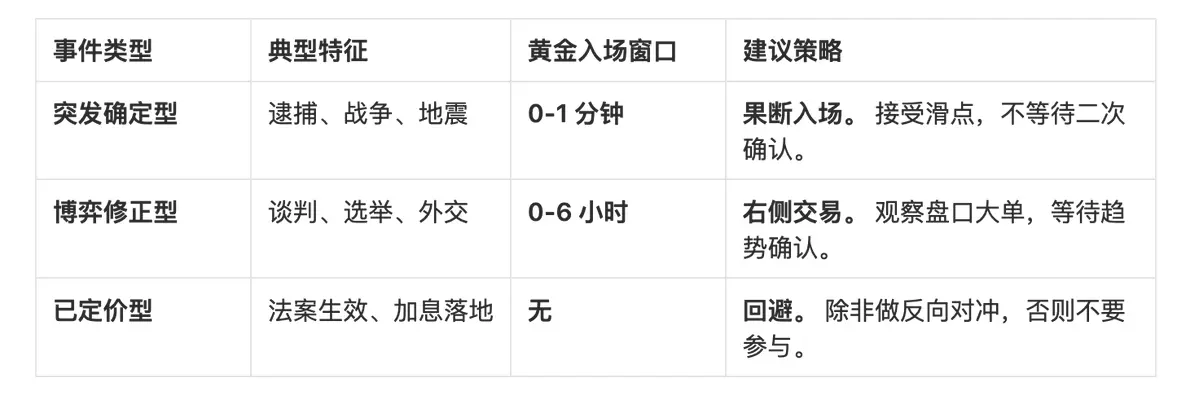
Conclusion
In prediction markets, a one-minute hesitation is not just a matter of time passing but a sharp collapse in the risk-reward ratio.
Next time you face major news, ask yourself:
“Am I entering now as a hunter seeking alpha, or as prey providing liquidity?”
Disclaimer: The information on this page may come from third parties and does not represent the views or opinions of Gate. The content displayed on this page is for reference only and does not constitute any financial, investment, or legal advice. Gate does not guarantee the accuracy or completeness of the information and shall not be liable for any losses arising from the use of this information. Virtual asset investments carry high risks and are subject to significant price volatility. You may lose all of your invested principal. Please fully understand the relevant risks and make prudent decisions based on your own financial situation and risk tolerance. For details, please refer to
Disclaimer.
Related Articles
Polymarket pre-market prediction: WBC Australia will win. Taiwanese baseball fans learned a lesson in prediction markets.
The Chinese Taipei team lost 0:3 to Australia in their first game of the 2026 World Baseball Classic, disappointing fans. The prediction market Polymarket shows Australia's win probability at 64%. However, traditional Taiwanese betting odds suggest that the Chinese Taipei team has a 70% chance of winning, indicating the influence of supporter bias. Analysis points out that Polymarket's predictions are more accurate, reflecting the benefits of diverse participants and data analysis, and highlighting the future potential of prediction markets.
動區BlockTempo2h ago
Bloomberg: Prediction market track rapidly emerging, Polymarket, Kalshi, and Opinion form a three-way competition
PANews March 5 News, according to Bloomberg, prediction markets have experienced rapid growth over the past year, attracting widespread attention including from traditional financial institutions. The main platforms in the industry currently include Polymarket, Kalshi, and Opinion, which are seen as the primary competitors in the market landscape.
The report points out that as the regulatory environment gradually becomes clearer and trading demand around macro events and hot topics continues to grow, prediction markets are becoming an important new frontier at the intersection of the crypto industry and traditional finance.
GateNews3h ago
Senator Chris Murphy questions insider trading related to Iran airstrike predictions in the prediction market, with million-dollar bets sparking controversy over "White House corruption"
U.S. Senator Chris Murphy expressed concern over prediction market trading ahead of military actions against Iran, accusing large bets of potentially involving insider information and leading to corruption that profits from war. He mentioned that certain accounts placed precise bets before the airstrikes and reaped huge profits, calling for legislation to restrict such transactions to protect national security. This has sparked widespread discussion in U.S. politics about war powers and transparency.
GateNews8h ago
Polymarket nuclear explosion contract attracts $650,000 in trading! Sparks ethical and insider controversy, official removal in emergency.
Polymarket has sparked public controversy for listing nuclear explosion prediction contracts, being accused of exploiting human survival crises for speculation. The platform removed the contracts on March 4 and is facing regulatory pressure. Analysts point out that the platform may become a channel for insider trading, threatening the reputation of prediction markets. U.S. regulatory agencies plan to further regulate prediction markets, emphasizing the need to strike a balance between ethics and legality.
CryptoCity9h ago
Kalshi refuses $54 million payout, insider trading controversy heats up in prediction markets
The prediction market platform Kalshi refused to pay users' expected $54 million payout, citing that its contract "exit" definition does not include assassination scenarios. The incident has sparked insider trading allegations against competitor Polymarket. U.S. senators plan to introduce legislation to ban prediction contracts related to government actions, arguing that such markets distort public judgment.
MarketWhisper11h ago
Forecasting market regulation framework launched! SEC and CFTC submit plans to the White House
The U.S. Securities and Exchange Commission (SEC) and the Commodity Futures Trading Commission (CFTC) have submitted regulatory proposals to the White House, focusing on the classification of crypto assets and rules for prediction markets. The SEC plans to establish token classification standards to clarify regulatory responsibilities for different types of tokens, while the CFTC proposes to develop formal regulations for prediction markets. This submission reflects significant changes in the financial regulatory process, highlighting the White House's increased influence on the regulatory agenda.
MarketWhisper12h ago


