


Does Vitalik support algorithmic stablecoins, and is DeFi truly on the path to revival?
Author: Jae, PANews
What should “true DeFi” look like? When Ethereum co-founder Vitalik Buterin cast his vote for algorithmic stablecoins, a reflection on risk, governance, and monetary sovereignty was reignited.
A single tweet is enough to shake a narrative worth hundreds of billions of dollars.
On February 9, Vitalik Buterin posted a tweet asserting a firm stance: algorithmic stablecoins are the “true DeFi.”
This is not a technical tweak to the current stablecoin landscape, but an authoritative redefinition of DeFi’s underlying logic. In a market dominated by centralized stablecoins like USDT and USDC, Vitalik’s statement is like a deep-water bomb, bringing the long-dormant algorithmic stablecoin track back into the spotlight.
Decoupling Stablecoin Risks and De-dollarization as the Standard for “Real DeFi”
Vitalik’s definition of “genuine DeFi” is based on risk structure decoupling. He categorizes algorithmic stablecoins into two models.
First, pure native asset collateralization. Protocols use ETH and its derivatives as collateral. Even if 99% of liquidity comes from CDPs (Collateralized Debt Positions), the essence is to transfer counterparty risk on the dollar side to market participants and market makers.
This means no frozen bank accounts, and no suddenly collapsing centralized institutions.
Second, highly diversified RWA (Real World Asset) collateralization. Even if a protocol introduces RWAs, as long as risk is hedged through diversification and over-collateralization, it can be considered a significant risk structure improvement.
If an algorithmic stablecoin can ensure that any single RWA’s proportion never exceeds the system’s over-collateralization ratio, then even if one asset defaults, the principal of stablecoin holders remains safe.
A more forward-looking view is that Vitalik advocates for stablecoins to gradually detach from the dollar peg. Given the long-term potential devaluation risk of sovereign currencies, stablecoins should evolve toward more universal, diversified index-based units of account, reducing reliance on any single fiat currency, especially the US dollar.
This also means the connotation of stablecoins is evolving—from “price stability” to “purchasing power stability.”
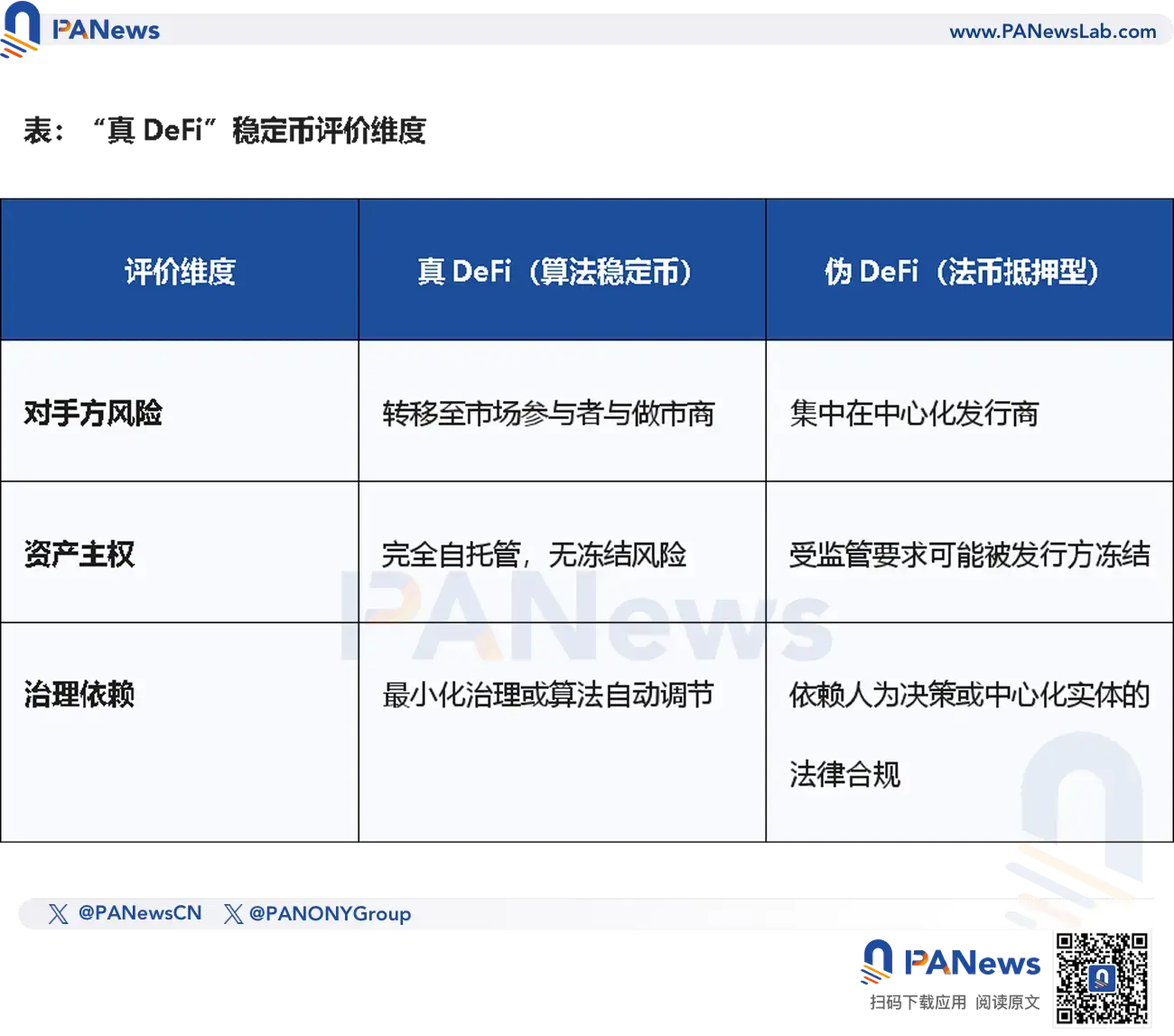
Regarding Vitalik’s definition of algorithmic stablecoins, PANews has compiled projects in the market that best meet these standards, but they generally face user acquisition challenges. This may also be why Vitalik is once again rallying for such projects.
USDS: “The Dragon Slayer Becomes the Dragon,” Mainstream Expansion Sparks Controversy
After Vitalik’s tweet, the price of MKR, the protocol token of the pioneer algorithmic stablecoin MakerDAO, surged by as much as 18%.
Interestingly, the transformed SKY token’s price remained relatively flat, and this divergence itself reflects a market attitude.
As one of the most representative protocols in DeFi history, MakerDAO officially rebranded to Sky Protocol in August 2024 and launched a new stablecoin, USDS, completing a “final game” transformation called “Endgame.”
USDS is positioned as an upgraded version of DAI and is Sky’s flagship product. As of February 12, USDS rapidly grew to become the third-largest stablecoin in the entire crypto market, with a market cap exceeding one billion dollars.
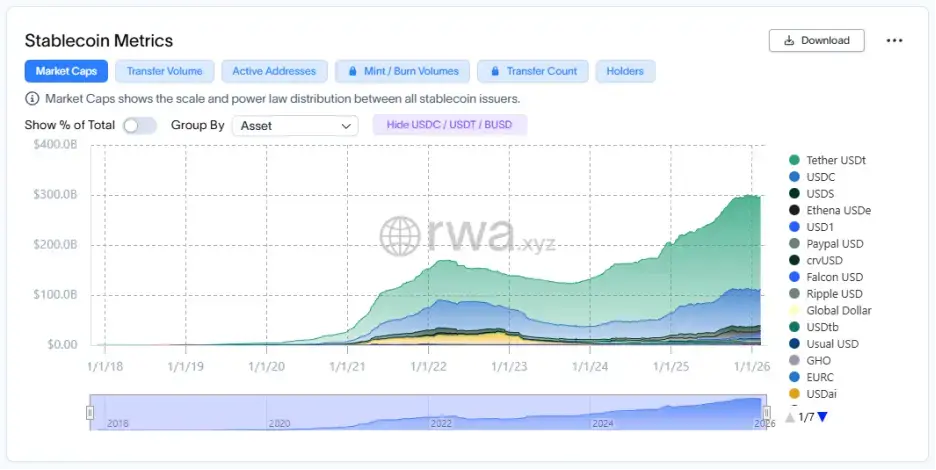
On the surface, this appears to be a successful evolution for a DeFi giant. But at a deeper level, it’s a costly “coming of age.”
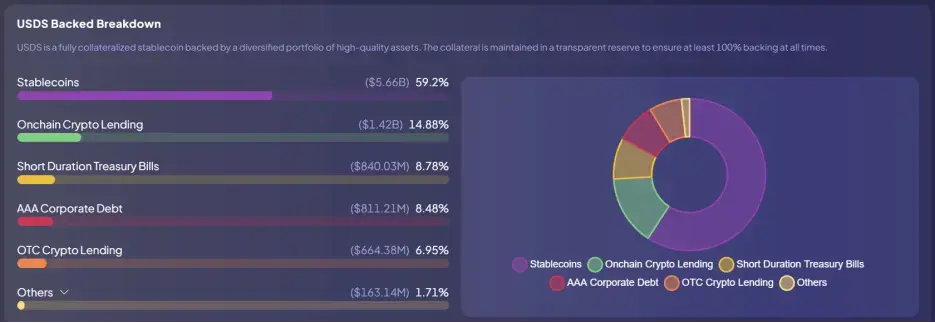
The returns of USDS mainly come from diversified underlying assets. Sky’s Star modular ecosystem, where sub-DAOs allocate collateral into RWAs including short-term government bonds and AAA corporate bonds.
From a risk diversification perspective, this aligns with Vitalik’s second category of algorithmic stablecoins. However, the issue lies in the shift of asset structure focus.
While USDS has taken steps toward asset diversification, nearly 60% of its reserves are USDC, far exceeding the portion backed by over-collateralization (20%).
This means that the underlying value support of USDS is fundamentally highly dependent on another centralized stablecoin. Therefore, the protocol’s transformation has always been controversial.
What’s even more unacceptable to DeFi purists is that the protocol introduces a “freeze function.” This design allows Sky to remotely freeze USDS in user wallets upon receiving legal instructions or in the event of security incidents.
For Sky, this is a pragmatic compromise to address global regulation: without compliance, mainstream adoption is impossible. Technically, the freeze function aims to counteract hacking, money laundering, and other illegal activities, making USDS a compliant financial tool in the eyes of regulators.
But for DeFi believers, this is an unforgivable “territory ceding.” Some community members argue that Sky has betrayed DeFi’s original anti-censorship promise. Once the protocol is granted the power to freeze assets, USDS essentially becomes indistinguishable from USDC.
Clearly, the protocol is moving further away from what Vitalik envisions. Compared to today’s Sky and USDS, the market may be more nostalgic for the days of MakerDAO and DAI.
LUSD/BOLD: Upholding ETH-Centricity and Pursuing Minimal Governance
If Sky chose outward expansion, Liquity chose inward deepening.
Vitalik has repeatedly praised Liquity, which exemplifies a “minimal governance” approach, designed to almost eliminate reliance on human governance.
Liquity’s stablecoins LUSD and BOLD are fully backed by ETH and its staked tokens (LST), representing the most typical example in Vitalik’s first category of algorithmic stablecoins.
Liquity V1, with its pioneering 110% minimum collateral ratio and rigid redemption mechanism, established its authority among ETH-collateralized stablecoins. But V1 also faced trade-offs in capital efficiency and liquidity costs:
- Zero interest rate: Users pay a one-time borrowing fee (usually 0.5%) at the time of borrowing, with no interest accruing over time. While attractive to borrowers, the protocol must continuously pay rewards (like minting LQTY tokens) to maintain liquidity, which raises questions about long-term sustainability.
- 110% minimum collateral ratio: Through its instant liquidation system (stability pool), Liquity achieves higher capital efficiency than competitors. If ETH price drops, the system first uses LUSD from the stability pool to offset bad debt and distribute collateral.
- Hard redemption: Any LUSD holder can redeem ETH at a fixed $1 value, creating a price floor for LUSD and maintaining its peg even in extreme market conditions.
However, the single-asset collateral model is a double-edged sword. Since LUSD only supports ETH collateral, users face significant opportunity costs as ETH staking yields rise, leading to a shrinking supply of LUSD over the past two years.
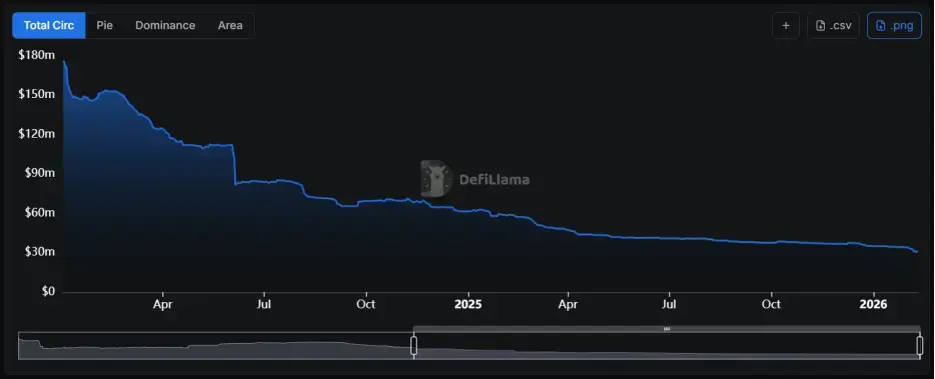
To address V1’s limitations, Liquity launched V2 and the new stablecoin BOLD, with core innovation in “user-set interest rates.”
In Liquity V2, borrowers can set their own risk appetite by choosing their interest rate. The protocol sorts debt positions by rate, with lower-rate positions more likely to be “redeemed” (liquidated).
- Low-interest strategy: suitable for users sensitive to capital costs but willing to accept early redemption risk.
- High-interest strategy: for those aiming to hold positions long-term and resist redemption.
This dynamic mechanism allows the system to automatically find market equilibrium without manual intervention: Borrowers, to avoid losing collateral passively during ETH downturns, tend to set higher interest rates, which directly flow to BOLD depositors, creating real yield without token issuance.
Additionally, V2 breaks the single-asset restriction, supporting wstETH and rETH. This enables users to earn staking rewards while maintaining BOLD liquidity.
Most importantly, V2 introduces a “one-click multiplier” feature, allowing users to leverage their ETH exposure up to 11x through recursive leverage, greatly improving capital efficiency.
Liquity’s evolution marks a solid step from idealistic to pragmatic algorithmic stablecoins.
RAI: An Industrial-Driven Monetary Experiment with High Opportunity Cost
If Liquity is pragmatic, Reflexer is an uncompromising idealist.
The protocol’s stablecoin RAI is not pegged to any fiat currency. Its price is regulated by a PID algorithm borrowed from industrial control theory.
RAI does not aim for a fixed $1 peg but seeks extremely low volatility.
When RAI’s market price deviates from its internal “redemption price,” the PID algorithm automatically adjusts the redemption rate, i.e., the effective interest rate within the system.
- Positive deviation: market price > redemption price → redemption rate becomes negative → redemption price drops → debt decreases, incentivizing minting and selling RAI for profit.
- Negative deviation: market price < redemption price → redemption rate becomes positive → redemption price rises → debt increases, incentivizing buyback and liquidation.
Despite receiving praise from Vitalik multiple times, RAI’s development path is fraught with difficulties.
- User perception barrier: RAI is nicknamed “blood token” because its persistent negative interest rates cause holdings to shrink over time.
- Liquidity scarcity: Without a fiat peg, RAI struggles to be widely adopted in payments and trading; its use as collateral remains limited to niche crypto circles.
- Complex calculations: Compared to Liquity’s constant $1 peg, RAI’s PID model is difficult for investors to predict or model.
RAI demonstrates the elegance of algorithmic stablecoins in theory but exposes the harsh reality of user adoption.
Nuon: A Parity Coin Pegged to Purchasing Power Index, Highly Dependent on Oracles
As global inflation intensifies, a more radical stablecoin paradigm—Flatcoins—may emerge. These stablecoins aim not to peg to a fiat currency but to real living costs or purchasing power.
Traditional stablecoins (USDT/USDC) see their purchasing power erode in inflationary environments. If the dollar’s value declines by 5% annually, holders of traditional stablecoins suffer implicit capital loss. In contrast, Flatcoins track independent cost-of-living indices (CPI), dynamically adjusting their face value.
Take Nuon, the first protocol based on cost-of-living (COL) index, as an example. It connects to on-chain verified real-time inflation data to adjust its peg dynamically.
- Target asset: a basket including food, housing, energy, and transportation indices.
- Purchasing power parity: if inflation data shows a 5% increase in living costs, Nuon’s target price also rises by 5%, ensuring that one Nuon in the future can buy the same amount of goods and services.
- Mechanism: Nuon employs over-collateralization; when inflation changes, the algorithm automatically adjusts minting/burning logic to preserve real value.
For residents in high-inflation countries like Turkey or Argentina, traditional USD stablecoins can mitigate local currency devaluation but cannot escape the “hidden tax” of dollar inflation. Flatcoins offer a non-dollar, decentralized alternative to fight inflation and maintain purchasing power.
Despite the innovative concept, Flatcoins face significant technical risks. The composition of the cost-of-living index is complex, and the data’s authenticity heavily depends on oracle robustness.
Moreover, on-chain inflation data becomes a target for manipulation; even minor tampering can instantly erode Flatcoin holders’ purchasing power.
Additionally, Flatcoins require sufficient liquidity to maintain dynamic balance. In extreme market conditions, whether arbitrageurs will sustain a constantly rising peg remains uncertain.
Flatcoins represent a bold leap in the narrative of algorithmic stablecoins, but from concept to adoption, there are deep technical and financial challenges.
From Liquity’s steadfastness, Reflexer’s monetary experiment, to Flatcoins’ radical attempt, the landscape of algorithmic stablecoins is unfolding with unprecedented diversity and depth of thought.
Currently, algorithmic stablecoins still face constraints in capital efficiency, liquidity, and user experience, but their core principles—risk decoupling, minimal governance, and monetary sovereignty—remain the holy grail of DeFi.
The revival of algorithmic stablecoins has only just begun.