


ChatGPT now shows ads for free! OpenAI: User trust remains the company's top priority
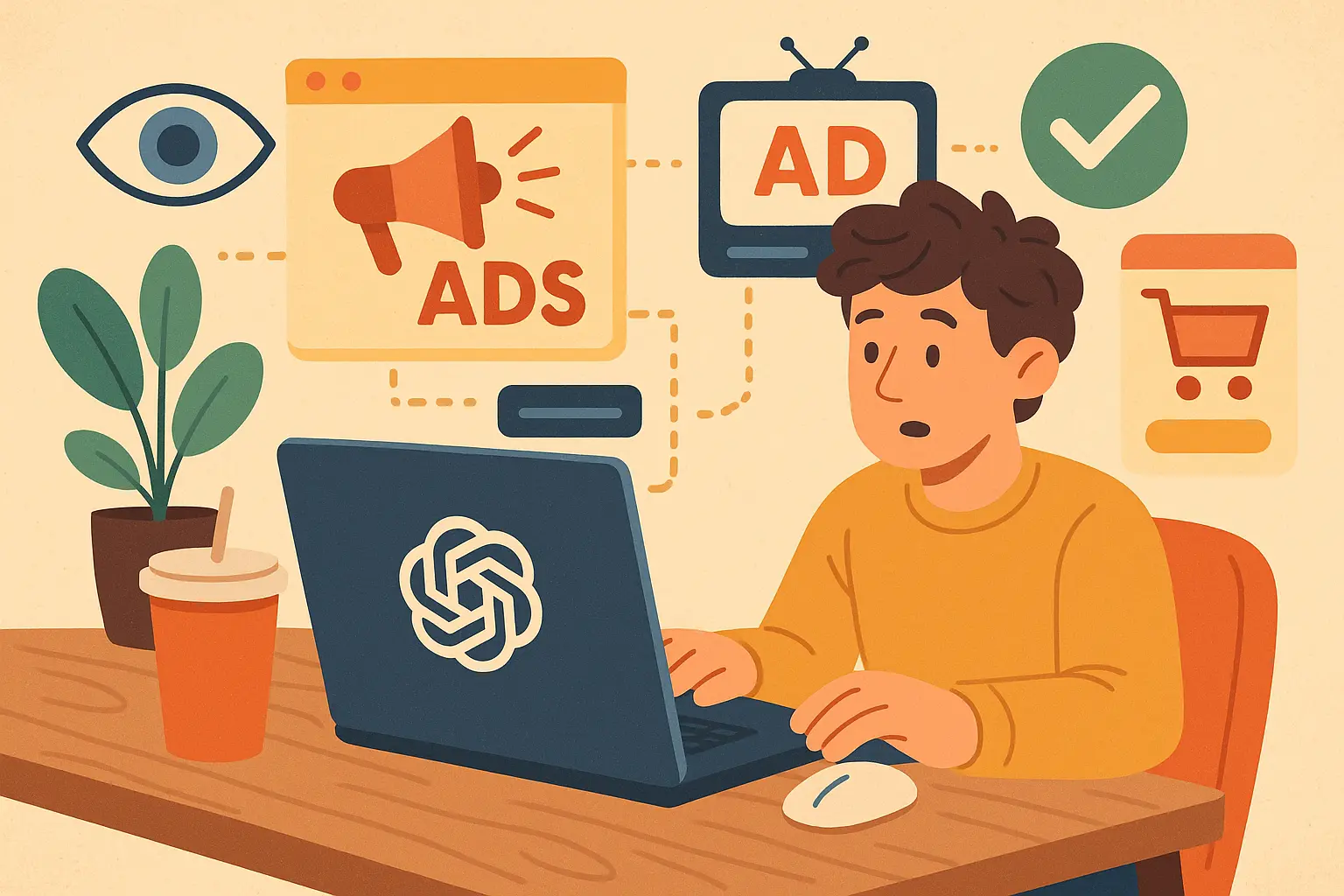
OpenAI Advertising and Business Operations Director Asad Awan first explained the introduction of advertising mechanisms in ChatGPT, which are only displayed to free users and the Go plan, while Plus, Pro, and enterprise versions remain unaffected. He emphasized that “user trust takes precedence over user value, user value over advertiser value, and revenue last,” meaning that even if short-term revenue is higher, damaging trust is not acceptable, and model training and responses will not be altered by advertising.
Free and Go Users See Ads; Plus and Above Are Immune
Awan stated that ads in ChatGPT will only appear to free users and those on the Go plan (whose specific positioning is unclear). The company manages three product lines: enterprise clients, subscription services, and large-scale consumer products, each supported by its own business model. For most general users, the purpose of introducing ads is seen as a feasible way to support “high usage, free access,” rather than quickly limiting usage.
This tiered system is very common in digital services. Platforms like YouTube, Spotify, and LinkedIn adopt a “free with ads, paid ad-free” model. OpenAI applying this to ChatGPT is, to some extent, an inevitable step in monetizing AI services. Providing such powerful AI services for free incurs extremely high costs (GPU computation, electricity, personnel), which must be recovered somehow. Ads are the main business model besides subscriptions.
Awan pointed out that OpenAI’s mission is to make “the best AI” accessible to more people. Without ads, free plans would likely have to limit usage or offer weaker models; with ads, they can provide free users with more complete, higher-spec services. This “ad-for-service” logic may be an acceptable trade-off for free users. The key issue is whether the intrusiveness of ads and privacy protections can be adequately managed.
ChatGPT Plus costs $20/month, Pro is $200/month. If ads become too annoying or infringe on privacy, free users might be forced to upgrade, which is also a strategy for OpenAI to increase subscription revenue. But if the ad experience remains tolerable, most users may choose to continue using it for free, which is crucial for OpenAI’s ad revenue. Balancing ad income with user experience is a core challenge for OpenAI.
ChatGPT Advertising Tiered System
Free Users: Show ads but no service restrictions
Go Plan: Show ads (specific positioning unclear)
Plus ($20/month): No ads, full service
Pro ($200/month): No ads, highest specifications
Enterprise: No ads, customized services
Technical Isolation of Model and Ads
Awan emphasized that model training and responses will not be affected by ads, and the model itself will not know whether ads are displayed on the screen; visually, answer areas and ad areas are clearly separated. If a user wants to inquire about ad content, they need to provide the ad information themselves, otherwise the model is unaware of the ad’s existence. This technical separation is crucial to ensure that ChatGPT’s core value—providing objective, unbiased answers—is not compromised by commercial interests.
The most concerning scenario for users is: when they ask “Which phone is best,” ChatGPT might favor a brand because that manufacturer has placed ads. OpenAI’s design avoids this. The model answers without knowledge of ads, based solely on training data and user questions, with zero interaction with the ad system. Ads are inserted after the response is generated by an independent ad system based on the conversation topic, without modifying or influencing the model’s answer.
Additionally, conversations involving sensitive topics like health, politics, or violence will not display ads or be used for ad matching. Definitions and judgments are based on internal policy teams and high-standard classification mechanisms within the model, which will be continuously adjusted and tested. This “sensitive conversation ad-free” design is both an ethical consideration and a risk management measure. For example, inserting drug ads into health consultations or political party ads into political discussions could cause significant controversy or legal issues.
User Privacy: Triple Safeguards and Control
In response to concerns that personalized ads might make users feel monitored, Awan stated plainly that even if effective, any feeling of “being eavesdropped on or monitored” would be unacceptable. Therefore, OpenAI’s internal priority is: “User trust takes precedence over user value, user value over advertiser value, and revenue last.”
He explained that advertisers cannot see user conversations; ad matching is handled by OpenAI’s internal system, aiming to deliver ads that are “helpful” rather than just maximizing exposure. If no suitable ads are found, they prefer not to display any. This “quality over quantity” principle contrasts with most ad platforms that aim to maximize ad impressions.
Regarding user control, OpenAI provides options to view what data is used for ad personalization, choose whether to use past conversations, clear history, or disable personalization. If users do not want to see ads at all, they can upgrade to Plus or Pro. Awan admitted that such highly controllable and clear data management is uncommon in current advertising industries but is considered essential for building trust.
This user control design surpasses giants like Google or Facebook. While these platforms offer some privacy settings, their defaults maximize data collection and ad personalization. OpenAI explicitly gives control to users, allowing them to decide whether to participate in personalized advertising. If implemented effectively, this “user-centric” philosophy could set a new standard for AI-era advertising.
Future Vision of Agent-Based Advertising
Regarding long-term prospects, Awan described a future where ads become more like “agents,” helping users compare prices, find deals, and identify suitable products. For small and medium businesses, this could involve directly setting advertising goals through conversations, lowering operational barriers without relying on complex ad management. This vision is highly disruptive, transforming advertising from “interruptive and intrusive” to “helpful and service-oriented.”
Imagine this scenario: a user asks, “I want to buy a laptop for video editing, budget 30,000 yuan,” and ChatGPT offers professional advice, then displays relevant product ads from several e-commerce sites, labeled “Based on your needs, these products may be suitable.” The user can compare prices, check reviews, or even let ChatGPT negotiate or find discount codes. This kind of advertising is no longer irrelevant spam but a decision-making aid.
In response to opposition against “no ads,” OpenAI believes that distrust of online advertising has a historical background. The company aims to address this with clear principles, transparent mechanisms, and user control, while still offering a “pay for an ad-free experience” option. This “giving users a choice rather than forcing” approach may be the biggest difference between OpenAI and other ad platforms.