When the SaaS moat is eroded by AI, software companies are left with only three viable paths forward: 1. **Pivot to AI-driven solutions**: Develop and integrate AI technologies to stay competitive and meet new market demands. 2. **Specialize in niche markets**: Focus on specialized, less commoditized segments where AI integration is less disruptive. 3. **Exit or consolidate**: Consider mergers, acquisitions, or exiting the market to preserve value and reduce risks.
AI tools enable non-technical teams to build software themselves. The core logic of the SaaS subscription model: “You can’t code, so you rent” is breaking down. Companies that survive rely not on code, but on data, compliance, and platformization.
(Background: Bridgewater’s Dalio: It’s still too early to sell AI stocks! Because the “bubble-popping needle” hasn’t even appeared yet)
(Additional context: NVIDIA has cemented its dominance in AI! Jensen Huang is heavily investing in AI, building a trillion-dollar GPU empire)
Table of Contents
- The Winter of SaaS
- A $30,000 Bill
- The Gap Between Usable and User-Friendly
- Three Ways Out
- After Software Devours the World
In the global software industry, what did “moats” once mean? The answer is simple: complexity. Good software is hard to write, and even harder to maintain. Companies are willing to pay tens of thousands of dollars annually for subscriptions not because they love a particular SaaS product, but because they lack the capability to build one themselves.
This logic has supported two decades of prosperity in the SaaS industry. From Salesforce to HubSpot, from Slack to Notion, countless software companies have built billion-dollar ARR empires based on “You can’t code, so you rent.”
But starting in 2025, this logic is beginning to break down. What’s dismantling it isn’t another better SaaS company, but a technological revolution that allows everyone to code.
The Winter of SaaS
Numbers don’t lie. Since the beginning of 2026, a basket of SaaS stocks tracked by Morgan Stanley has fallen a total of 15%, further declining after an 11% drop in 2025, marking the worst start to a year since 2022.
Former star companies like HubSpot and Klaviyo have seen their stock prices plummet. Wall Street analysts have used a euphemism: “Renewal rate pressure.” In plain language, customers no longer want to pay.
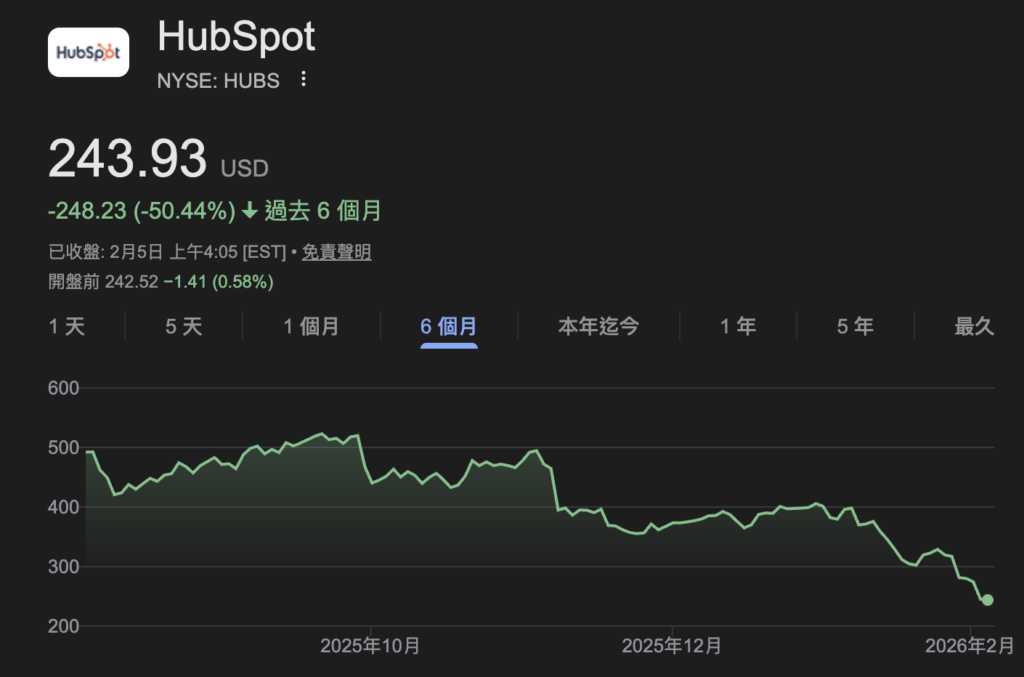
It’s not because the products have become worse, but because customers suddenly realize they can do it themselves.
The catalyst for all this is the so-called “Vibe Coding”: the explosive maturity of AI-assisted development tools. GitHub Copilot, Cursor, Replit Agent—these tools enable teams without technical backgrounds to build fully functional applications in days. Imperfect, but sufficient.
And “sufficient” is deadly for SaaS subscriptions costing three thousand dollars a month.
A $30,000 Bill
A tech company that has already raised Series E recently conducted an experiment.
Their engineering team spent less than a week using AI tools to connect GitHub API and Notion API, rebuilding an internal project management system. It covered about 80% of the core needs of their previous enterprise software.
As a result, they canceled a subscription costing over $30,000 annually.
This isn’t an isolated case. A customer success manager at a SaaS company privately revealed that their churn rate in Q1 2025 was nearly double what was expected. And one of the reasons for churn was a new category: “Customers building their own alternatives.”
This was almost nonexistent a decade ago. Ten years ago, if a company wanted to build a CRM system, it would require dozens of engineers, millions of dollars, and at least a year of development. Today, a product manager plus an AI assistant can prototype one in three days.
But there’s also a trap—one most people haven’t yet realized.
The Gap Between Usable and User-Friendly
There’s an old rule in software development: making something accounts for only 20% of the project; making it stable accounts for the remaining 80%.
AI can help you complete that 20%: write correct code, connect APIs, generate interfaces. But the remaining 80%—error handling, edge cases, security, scalability, maintainability—requires deep understanding of real-world business logic and engineering judgment.
In plain terms, AI can help you build a house that looks beautiful, but it doesn’t know if your location is prone to earthquakes.
Companies that cancel subscriptions and switch to self-built solutions may soon face an awkward reality: when something breaks, no one fixes it; when needs change, no one updates it; when security issues arise, no one is responsible.
This is the brutal truth of the software industry: complexity is never a bug, but a feature. SaaS companies don’t just sell code—they sell the assurance that “someone is responsible when problems occur.”
However, this argument is still not convincing enough for companies trying to build their own solutions. They are in a honeymoon phase, enjoying zero-cost freedom. But the honeymoon will eventually end (probably).
Three Ways Out
Faced with this crisis, SaaS companies are not without options. But all viable paths point in the same direction: shifting from “selling software” to “selling things that AI can’t replicate.”
First: Become a record system.
The reason Salesforce remains hard to replace isn’t because of its interface—many users complain about it—but because it has become the central hub for countless enterprises’ customer data.
Ten years of customer data, workflows, organizational knowledge—all accumulated within it. You can use AI to build a better CRM frontend, but you can’t move the data or the organizational inertia built around it.
In plain terms, when your product is not just a tool but a memory for your customers, they won’t leave.
Second: Sell security and compliance.
AI-generated code doesn’t understand SOC 2 certification, data encryption standards, or audit logs. For highly regulated industries like banking, healthcare, and government, “usable” is not enough—“compliant” is a must.
If a self-built system doesn’t pass compliance audits, saving $30,000 isn’t worth it; a fine of three million dollars could be the result.
Third: Transform your product into a platform.
This might be the most visionary strategy. Instead of resisting customers’ self-building impulses, embrace them: turn your product from a fixed-function software into a platform that customers can extend freely. Let them build what they want on your foundation using AI.
A noteworthy data point: when technical staff only have access to system modules relevant to their work, usage jumps from 35% to over 70%. It’s not because the software got better, but because it finally became “theirs.”
In this sense, AI isn’t the gravedigger of SaaS but the catalyst forcing SaaS to evolve.
After Software Devours the World
In 2011, Marc Andreessen wrote in The Wall Street Journal that “software is eating the world.”
Fourteen years later, the prophecy has come true. Software has indeed devoured the world: from ride-hailing to food delivery, from office work to social media, from finance to healthcare—almost no industry has escaped its reshaping.
But what Andreessen didn’t foresee is that after software devours the world, AI begins to devour software itself.
To understand this shift, we must return to the origin of the SaaS model. In the early 2000s, Salesforce pioneered the “no software purchase, rent software” business model. Its success was because it solved a core problem—lowering the barrier to using good software. Companies no longer needed to spend hundreds of millions on Oracle’s enterprise suites; for a few thousand dollars a month, they could access world-class tools.
The moat of SaaS was built on the premise that “software development is expensive.”
And now, AI is shattering that premise.
When development costs approach zero, software itself is no longer a scarce resource. The scarcity lies in data, trust, compliance, and organizational knowledge that takes a decade to accumulate. This is the fundamental challenge facing the SaaS industry today: when your moat—built on high development costs—is filled in by AI, what remains?
The answer varies by company. Some will die because their entire value is in that code. Others will transform because their true value lies beneath the code: in data, workflows, and organizational memory.
SaaS isn’t dying; it’s undergoing a brutal revaluation of value. The companies that survive won’t be those that write the best code, but those that understand “what’s beyond software.”
After all, when everyone can code, software itself is no longer valuable. What’s valuable is everything behind the software.